Thursday, February 16, 2017


Cholesterol drugs cause rapid aging, brain damage and diabetes

Sadly, many people take statin drugs, which are commonly known by brand names including Lipitor, Crestor and Zocor. Prescription drug spending in the U.S. shot up to about $374 billion in 2014, representing the highest level of spending since 2001. Statins undoubtedly made up a significant portion of this spending, and now consumers who take such drugs have much more to worry about than the dent it's making in their wallets.
The study, which was published in the American Journal of Physiology, states that statins' "...impact on other biologic properties of stem cells provides a novel explanation for their adverse clinical effects." Specifically, the study states that such adverse effects include advancing the "process of aging" and also notes that "...long-term use of statins has been associated with adverse effects including myopathy, neurological side effects and an increased risk of diabetes." Myopathy refers to skeletal muscle weakness.
Statins make cells unable to repair properly, create nerve problems and destroy memory
Experts involved in the study suggest that the health problems associated with statins have likely been downplayed through the years. In reality, those taking such cholesterol-lowering drugs have been experiencing cataracts, fatigue, liver problems, muscle pain and memory loss. Simply put, the drugs have been found to tamper with cells in such a way that their primary purpose of reproducing and helping the body repair is thwarted. With that comes the onset of terrible health issues or the worsening of existing ones.
Professor Reza Izadpanah, a stem cell biologist and lead author of the published study, says, "Our study shows statins may speed up the ageing process. People who use statins as a preventative medicine for [health] should think again as our research shows they may have general unwanted effects on the body which could include muscle pain, nerve problems and joint problems."
Despite health problems linked to statin drugs, FDA says people shouldn't be scared of them
Professor Reza Izadpanah, a stem cell biologist and lead author of the published study, says, "Our study shows statins may speed up the ageing process. People who use statins as a preventative medicine for [health] should think again as our research shows they may have general unwanted effects on the body which could include muscle pain, nerve problems and joint problems."
Despite health problems linked to statin drugs, FDA says people shouldn't be scared of them
While the FDA notes on its web site that "Cognitive (brain-related) impairment, such as memory loss, forgetfulness and confusion, has been reported by some statin users" and that "People being treated with statins may have an increased risk of raised blood sugar levels and the development of Type 2 diabetes," they also maintain its safety and effectiveness. The site directs people's attention to the advice of Amy G. Egan, M.D., M.P.H., who is the deputy director for safety in the FDA's Division of Metabolism and Endocrinology Products (DMEP). She says, "This new information should not scare people off statins. Their benefit is indisputable, but they need to be taken with care and knowledge of their side effects."

Robert F. Kennedy, Jr. and Robert De Niro held a joint press conference at the National Press Club on Wednesday to launch a campaign with the World Mercury Project against big pharma and the use of mercury in vaccines.
The focus of their effort is to “find a missing piece of research associated with mercury,” by offering a $100,000 reward for “any journalist or anybody else, who can point to a single existing study that says that it is safe to inject mercury into little babies or pregnant women at the levels that we are currently injecting them with the flu vaccine,” Kennedy announced.
“De Niro supports the mission of the World Mercury Project (WMP), a nonprofit public advocacy organization in which Kennedy serves as Chairman,” a press release from the WMP stated. “The WMP envisions a world where mercury is no longer a threat to the health of our planet and people.”
The group has long argued that mercury in vaccines causes autism — a theory that has been debunked in Studies conducted by the Centers for Disease Control and Prevention, the World Health Organization, the National Academies of Sciences, Engineering and Medicine, the American Academy of Pediatrics and others. De Niro has a child with autism and rejects the scientific studies.
In January, Kennedy began pushing for President Donald Trump to let him lead a commission on vaccines.
Last year, De Niro attempted to screen “Vaxxed: From Cover-up to Catastrophe,” at the Tribeca Film Festival, but it was pulled from the lineup.
During the news conference, the group explained that they are pro-vaccine, but anti-mercury.
Robert De Niro, Robert Kennedy Launch Campaign Against Big Pharma
Robert F. Kennedy, Jr. and Robert De Niro held a joint press conference at the National Press Club on Wednesday to launch a campaign with the World Mercury Project against big pharma and the use of mercury in vaccines.
The focus of their effort is to “find a missing piece of research associated with mercury,” by offering a $100,000 reward for “any journalist or anybody else, who can point to a single existing study that says that it is safe to inject mercury into little babies or pregnant women at the levels that we are currently injecting them with the flu vaccine,” Kennedy announced.
“De Niro supports the mission of the World Mercury Project (WMP), a nonprofit public advocacy organization in which Kennedy serves as Chairman,” a press release from the WMP stated. “The WMP envisions a world where mercury is no longer a threat to the health of our planet and people.”
The group has long argued that mercury in vaccines causes autism — a theory that has been debunked in Studies conducted by the Centers for Disease Control and Prevention, the World Health Organization, the National Academies of Sciences, Engineering and Medicine, the American Academy of Pediatrics and others. De Niro has a child with autism and rejects the scientific studies.
In January, Kennedy began pushing for President Donald Trump to let him lead a commission on vaccines.
Last year, De Niro attempted to screen “Vaxxed: From Cover-up to Catastrophe,” at the Tribeca Film Festival, but it was pulled from the lineup.
During the news conference, the group explained that they are pro-vaccine, but anti-mercury.
Credit to Natural News and Sputnik
EU Steps Up The Pace For Cashless Society In 2017/18
On the 23rd January 2017 the EU Commission issued the “Commission Initiative Roadmap” for 2018 regarding the step up fight against the financing of terrorism, also known as its ‘Payments Restriction Initiative’ or as we are reading more often, the cashless society. This document is an extension of the communication document dated February 2016 (COM-2016/50) and updated to include new regulations for member countries to implement and future intentions by the Commission.
The policy looks to the “Regulation on the controls of cash entering or leaving the Community and relevance of potential upper limits to cash payments.” The Action Plan states that “Payments in cash are widely used in the financing of terrorist activities.” In its conclusions on the fight against terrorism, the Economic and Financial Affairs Council of 12 February 2016 called on the Commission
“to explore the need for appropriate restrictions on cash payments exceeding certain thresholds. In particular the Proposal for an amendment of the Anti-Money Laundering Directive2 (COM (2016) 450), which introduced stricter transparency rules and other measures targeted specifically at terrorism financing. Furthermore, the initiative should be seen in conjunction with the ECB’s decision of 4 May (20163) to discontinue the production of the EUR 500 banknote and stop the issuance of this denomination by around 2018 to address concerns that these notes could be used in financing illicit activities.”
The report goes on to advise that “any measure restricting cash payments would be complementary to the specific actions addressed by the review” and to include “virtual currencies (such as BitCoin) and prepaid instruments (such as pre-paid credit cards) when they are used anonymously.”
New anti-money laundering rules will cover high value goods such as works of art, precious stones or auctioneers, which requires that they apply customer due diligence measures, full identification of customers and keeping records of transactions when receiving cash payments of €15,000 or more.
This latest document extends the cash payments rule by reducing the €15,000 limit on transactions to €10,000 by June 2017.
Unbelievably, the EU Commission is using the logic of banning cash by stating their “remains the lack of readily available and solid evidence on legitimate vs illegitimate cash transactions.” They maintain that “It is difficult to quantify the legitimate or illegitimate use of cash.”
These statements are clearly untrue. Evidence on the amount of cash and how it is used in any given economy is widely known and many government’s even publish it quarterly or annually. For instance, on average, wallets in Germany hold nearly twice as much cash—about $123 worth—as those in Australia, the US, France and Holland, according to a recent Federal Reserve report on how consumers paid for things in seven countries. Roughly 80% of all transactions in Germany are conducted in cash. (In the US, it’s less than 50%.) And cash is the dominant form of payment there even for large transactions.

In Britain, cash payments have fallen to 48% of all transactions – but that is still 18 billion individual transactions made up of £250billion annually. Within those numbers, 10% of all payments were direct debits, like paying for rent, mortgages, utilities and loans. In all countries, estimates of corrupt cash payments are published. Several EU countries, Britain included, even adds illicit transactions such as drugs and prostitution to GDP in an effort to boost published economic performance data.
The EU Commission continues its misinformation campaign by stating that
“Cash has the important feature of offering anonymity to transactions. But, such anonymity can also be misused for money laundering and terrorist financing purposes. The possibility to conduct large cash payments facilitates money laundering and terrorist financing activities because of the difficulty to control cash payment transactions.”
It also does nothing to stop terror-financing and money-laundering, as by far the biggest launderers globally is the Western banking system itself, the EU banks included.
For instance – HSBC admitted to openly laundering billions of dollars for Colombian and Mexican drug cartels and in so doing violated a host of banking laws such as the Bank Secrecy Act to the Trading With the Enemy Act. The USA spent $35 billion in 2015 alone fighting a drugs war only to witness over 9o% of the proceeds of the crimes it was attempting to stop laundered through banks. The fine HSBC received of $1.9 billion, which as one analyst noted is about five weeks of income for the bank is no deterrent. There was so much cash to be laundered that drug dealers specifically designed boxes to fit through the bank’s teller windows and the bank knew where the money was coming from and what accounts to apply it to. The money is then distributed over tax havens and filtered into legal operations the world over. One should note that it is estimated 120,000 have been killed in this drugs war and nearly 30,000 more are missing.
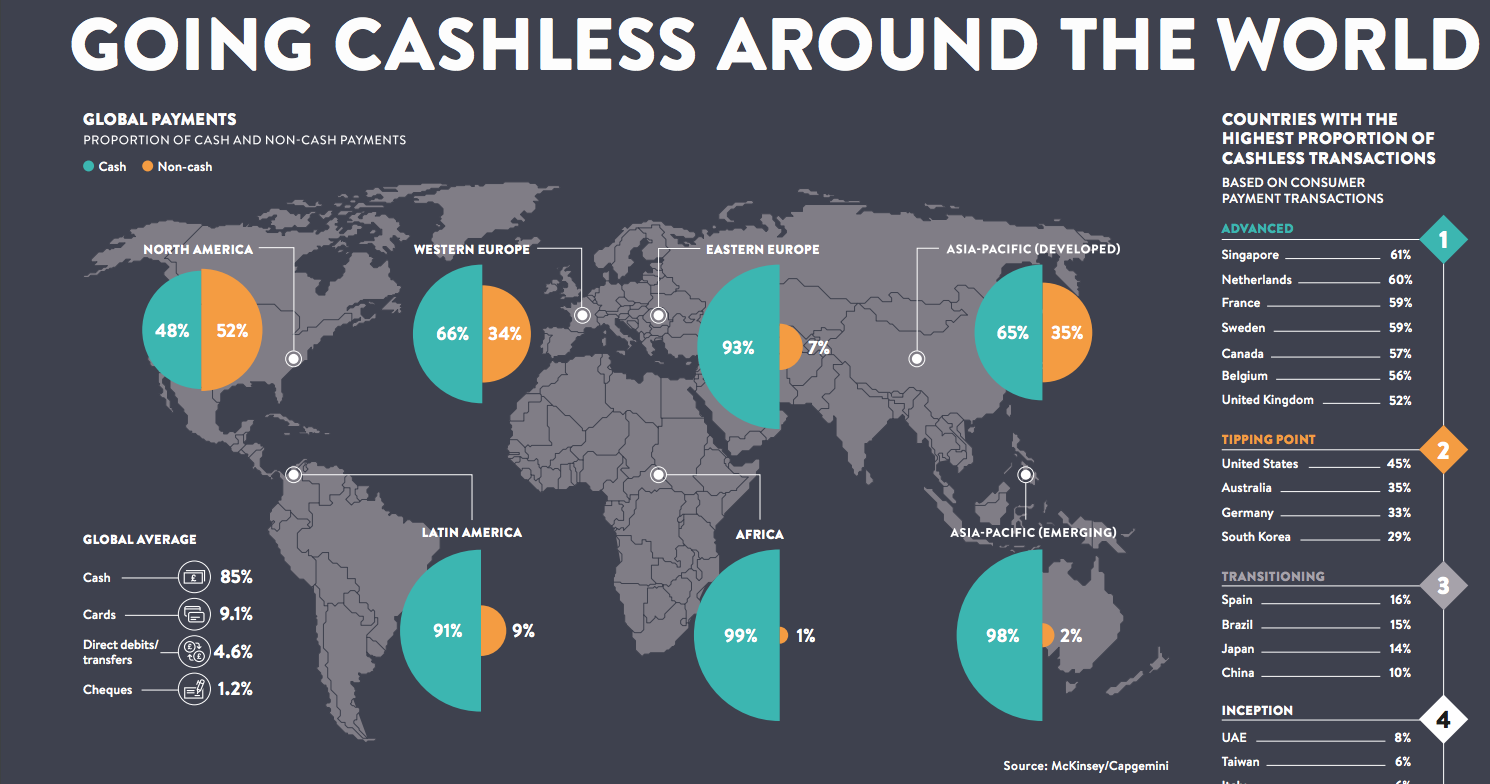
The shift to a cashless society continues to snowball
If the EU Commission wants to stop finance terrorism and money laundering – they need not look further than the Western banking system and its network of tax havens that launders trillions of dollars every single year, as evidenced by this article; Enemies of the State: How The Financial Services Industry Is Destroying Democracy.
Some EU countries are using terrorism as cover for the implementation of its cashless society initiative and already imposed maximum bank withdrawals. Some larger transactions in cash or moving cash from one EU country to another already require the state to be informed. Cash payments for goods and services in France and Italy have been limited to a maximum of €1,000. In Spain the maximum cash transaction is €2500 and no transactions in cash over €15,000 are allowed. The EU is now considering the banning of lower denomination notes than the €500.
“The ECB has already decided to progressively phase out the €500 banknote. But as long as cash exists, large payments will remain possible even with lower denomination banknotes. Therefore there is an option to extend the restrictions to cash payments to all (including crypto) payments.”
The EU Commission is also looking at its legal position that might be, or at least should be challenged. However, the work-around is explained thus:
“While being allowed to pay in cash does not constitute a fundamental right, the objective of the initiative, which is to prevent the anonymity that cash payments allow, might be viewed as an infringement of the right to privacy enshrined in Article 7 of the EU Charter of Fundamental Rights. However, as complemented by article 52 of the Charter, limitations may be made subject to the principle of proportionality if they are necessary and genuinely meet objectives of general interest recognised by the Union or the need to protect the rights and freedoms of others. The objectives of potential restrictions to cash payments could fit such description. It should also be observed that national restrictions to cash payments were never successfully challenged based on an infringement to fundamental rights.”
One point that the EU Commission do not focus on is cybercrime. Europol set up the European Cybercrime Centre (EC3) in 2013 to strengthen the law enforcement response to cybercrime in the EU and thus to help protect European citizens, businesses and governments from online crime. Cybercrime costs EU Member States EUR 265 billion a year. And that’s just the financial side. There is no contingent for a financial cyber-attack from say Russia, the latest arch enemy that seems able, according to the CIA and FBI, to decide who gets into office in Washington DC. If a foreign enemy state was indeed able to successfully launch such an attack it would bring any country to its knees within days if there was no cash moving around the economy as society would be entirely dependent on an electronic payments system.
The document ends with the observation that depending on the complexity of the final proposal and the legal instrument used, an implementation plan is not just feasible it might well be established quite quickly. The EU’s war on cash and desire to control citizens through a cashless-society model is snowballing without a real open debate with its people.
The original source of this article is True Publica
Copyright © Graham Vanbergen, True Publica, 2017
Credit to globalresearch.ca
http://www.globalresearch.ca/eu-steps-up-the-pace-for-cashless-society-in-201718/5573210
The Globalist Long Game - Redefine Liberty Activism As Evil "Populism"

One of the most favored propaganda tactics of establishment elites and the useful idiots they employ in Marxist and cultural-Marxist circles is to relabel or redefine an opponent before they can solidly define themselves. In other words, elites and Marxists will seek to “brand” you (just as corporations use branding) in the minds of the masses so that they can take away your ability to define yourself as anything else.
Think of it this way: Say you want to launch an organization called “Movement Blue,” and you and others have gone through great struggle to grow this organization from the ground up. However, just as your movement is about to achieve widespread recognition, someone else comes along, someone with extensive capital and media influence, and they saturate every outlet with the narrative that your movement is actually more like “Movement Red,” and that Movement Red is a terrible, no-good, bad idea. They do such a good job, in fact, that millions and millions of people start calling you “Movement Red” without even knowing why, and they begin to believe all the negative associations that this label entails.
Through the art of negative branding, your enemy has stolen your most precious asset — the ability to present yourself to the public as you really are.
Negative branding is a form of psychological inoculation. It is designed to close people’s minds to particular ideas before they actually hear those ideas presented by a true proponent of the ideas. But beyond that, negative branding can also be used to trick groups and movements into abandoning their original identity.
For example, the concept of economic freedom for individuals –the freedom from overt government interference or government favoritism for certain people over others, the freedom to compete with ideas and ingenuity to build a better business and a better product, the freedom to retain the fruits of one’s labor — used to be widely referred to as “free markets”, as defined by Adam Smith. The very basis of free market philosophy was to remove obstruction and economic oppression from the common man in order to inspire a renaissance in innovation and prosperity. The problem is, you rarely hear anyone but libertarians talk about traditional "free markets" anymore.
Though Karl Marx did not coin the term “capitalism,” he and his followers (and editors) are indeed guilty of the pejorative version now used. It has always been Marxist propagandists who have sought to redefine the idea of “free markets” in a negative way, and the use of the term capitalism is how they did it. They have been so effective in their efforts that today even some free market proponents instead refer to themselves as “capitalists.”
While “free markets” denote freedom of the common man to pursue a better life through productivity and intelligence and merit, “capitalism” denotes a monstrous and blind pursuit of wealth and power without moral regard. One gives the impression of fairness, the other gives the impression of tyranny.
Is there even such an animal as “capitalism?” I can’t really say. What I do know is that the system we have today, a hybrid mutation of corporatism and socialism, is certainly NOT a free market system if we are to follow the true definition and the original intent. Yet, whenever cultural and economic Marxists attack the notion of economic freedom, they use the system we have now as an example of the failures of “free market capitalism.”
This is the magic of negative branding, and it is used in every facet of social life and geopolitics.
Now, before I get into the term “populist,” I recognize that people opposed to my position will immediately spring into a tirade about how liberty and sovereignty champions brand those against our ideals “in the exact same way.” This is not quite true, though.
When we refer to “globalists” in a negative manner, we are taking a pre-existing label, something that they often call themselves, and pointing out that their philosophy is flawed and highly destructive based on historical evidence and verifiable facts. We are not seeking to redefine them as anything other than what they already are. We are merely exposing to the public what they OPENLY promote and believe and then offer our side and our evidence as to why their beliefs are wrong.
This is not what they do to us. Instead, globalists and their cronies prefer that the public does not get to hear our views directly from us. They rarely, if ever, actually use our publications as a source for their attacks on our principles. They would much rather tell the public what we are and what we believe before they are ever exposed to us. This is why you will often find that many participants in protest groups at events held by anti-globalists like Ben Shapiro or Milo Yiannopoulos have never actually seen or heard a single speech by the men in question. They have no idea what we really stand for. In fact, they protest our speakers, groups and movements based on what they were told we stand for by other biased sources.
This brings us to “populism.”
There has been a deep and concerted propaganda campaign taking place against liberty activists, sovereignty champions, anti-globalists, anti-SJW groups, and conservatives in general. I noticed this particular campaign accelerating at the beginning of 2016, and it was the primary reason why I chose to take a hard stance on my predictions for Brexit passage and a Trump election win. The propaganda narrative could be summarized as follows:
Since early 2016 (according to globalists and the mainstream publications featuring their opinions), there has been a rising tide of nationalists and “populists” in western nations. This sudden surge in “populism” is inexorably tied to the Brexit movement and the support for candidates like Donald Trump. Populism will overrun the existing “stability” of globalism and cause severe economic crisis in numerous countries. It finds its roots in the “less educated” portions of the population, as well as in older generations that think they have something to lose if globalism succeeds. It is also driven by an “irrational fear” of economic change, global interdependence and multiculturalism. Populists are predominantly naive and desperate for “strongmen” leaders to fight for them. Some of them are motivated by self interest, while others are motivated by racism.
You can see these sentiments expressed bluntly in numerous mainstream media outlets. The Guardian has no qualms about linking the Brexit to “racism” and populism, for example. The Washington Post also has had no problem linking the Tea Party and Trump supporters to racism and populism as well.
Beyond the paper-thin accusations of racism, the general thrust of the negative branding is clear; if you are against globalism (or elitism) and its major tenets, then you are a “populist.” This is reiterated in recent articles from Bloomberg and The Guardian.
But in such publications, the most egregious argument is the one that is not directly made. The insinuation is that “populism” is not just defined by a fear of corruption through organized elitism, but that this fear is UNFOUNDED. Meaning, anyone who argues against the mechanizations of globalists, for instance, is not only redefined as a “populist,” but he/she is also, essentially, ignorant or insane. See how that works?
The populist label is often used to describe a political movement built on the cult of personality, a sycophantic love affair with a celebrity dictator that tends to have ulterior motives. Thus, the philosophical underpinnings of that particular movement are further eroded because they don’t even know why they are doing what they are doing; they are only playing a foolish game of follow the leader.
So, to recap, according to the establishment and their “press,” conservatives and sovereignty activists are actually “populists.” Our concerns over uncontrolled immigration and open borders are not based on rationalism and historic evidence of social and economic instability as well as the highly evidenced threats of terrorism; they are based on “xenophobia.”
Our concerns over the increasing fiscal weakness generated by the economic interdependence of globalism and our lack of self reliance are not based on math and logic, but our “lack of understanding” on how interdependence makes everything better.
Our concerns over rampant organized elitism and the corruption this entails are not based on numerous concrete examples, not to mention exposed documentation and the words of elitists themselves; they are based on a “fantasy world” of “tinfoil hatters” who just make stuff up while consuming heaping helpings of "fake news".
If this is the case, then I suppose I should fasten my own tinfoil hat tightly and note that this narrative is part of an ongoing long-game by globalists. They are not attempting to achieve the demonization of conservatives and sovereignty advocates today or tomorrow. This is about preparing the public for a near future, perhaps five to 10 years from now, after they have sufficiently sabotaged the global economy and scapegoated us for the crisis this will cause.
Not possible, you say? By all means, read my article 'The False Economic Recovery Narrative Will Die In 2017' for further explanation. If we are not careful, we will be redefined not just by establishment propaganda, but by a global calamity that will be gift wrapped with our name on it and tied around our collective necks.
In the meantime, how do we fight back against this disinformation campaign?
One factor that a “populist movement” generally does not have is the ability to remain self-critical. Populism, at least according to the mainstream media, requires a mentality of mass blind faith in a cause that is misunderstood or a leader that is dishonest. The liberty movement and conservative groups still have some members who are not afraid to point out when we are going astray in our logic or our actions.
We have not been silenced by our own peers, yet. Given enough crisis, it is hard to say how people will react. A major terrorist attack, an economic panic, a war; these kinds of rip-tides can inspire a lot of intolerance for contrary views. We are not there at this point, and as long as members of our movement are able to retain a critical eye, we will never be “populists.”
Another method is to refrain from adopting the “branding” that the establishment tries to use against us. Beware of anyone within our groups and organizations who begins referring to himself or us as “populists” as if this is a label of which we should be proud.
In the long run, people with ill intent will call us whatever they want to call us. The real issue is, will those labels stick? Will we help them to stick by losing our composure and acting the way the propagandists always said we would?
Negative branding is about burning a hole in the historical record, because memes last far longer than people. In 100 years, how will we be remembered? This is what the globalists value most - future impressions of today by generations not yet born. Because wars are not just fought in one moment over one piece of ground or over one idea; they are fought in ALL moments, for days not yet passed, for the posterity of all ideas, even those not yet thought of. If we do not fight back with this in mind, winning will be impossible.
Credit to Zero Hedge
In Nigeria Muslim Terrorists Have Slaughtered 100,000 Christians And Displaced 2 Million

Nigeria is on the edge of a civil war right now as Muslim terrorists are ripping through that nation. Over 100,000 Christians have been murdered, 2 million displaced, and the violence is only getting worse as Christianity spreads deeper into the once stronghold of Islam in West Africa:
Credit to ShoebatShettima of Borno state on Monday released the grim statistics of deaths and material losses suffered by the state due to the Boko Haram insurgency.Mr. Shettima gave the data at the annual Murtala Mohammed memorial lecture held at the Shehu Yar’Adua Centre in Abuja.The governor, who delivered a paper “Managing the Boko Haram Crisis in Borno State, Experiences and Lessons for a Multiparty, Multiethnic and Multireligious Nigeria”, said theinsurgency has led to the deaths of almost 100,000 persons, based on estimates by community leaders in the state over the years.“The Boko Haram insurgency has led to deaths of almost 100,000 persons going by the estimates of our community leaders over the years,” he said.This casualty figure is the highest ever provided by any government official from a state where remote areas which witness attacks by the insurgents are difficult to reach.“Two million, one hundred and fourteen thousand (2,114,000) persons have become internally displaced as at December of 2016, with five hundred and thirty seven thousand, eight hundred and fifteen (537,815) in separate camps; 158,201 are at official camps that consists of six centres with two transit camps at Muna and Customs House, both in Maiduguri.“There are 379,614 IDP’S at 15 satellite camps comprising Ngala, Monguno, Bama, Banki, Pulka, Gwoza, Sabon Gari and other locations in the state. 73,404 persons were forced to become refugees in neighbouring countries with Niger having 11,402 and Cameroon having 62,002.“We have an official record of 52,311 orphans who are separated and unaccompanied. We have 54,911 widows who have lost their husbands to the insurgency and about 9,012 have returned back to various communities of Ngala, Monguno, Damboa, Gwoza and Dikwa,” the governor said. (source)
Subscribe to:
Posts (Atom)