Sunday, December 6, 2015


Saturday, December 5, 2015
Alarm Bells Go Off As 11 Critical Indicators Scream The Global Economic Crisis Is Getting Deeper
 Economic activity is slowing down all over the planet, and a whole host of signs are indicating that we are essentially exactly where we were just prior to the great stock market crash of 2008. Yesterday, I explained that the economies of Japan, Brazil, Canada and Russia are all in recession. Today, I am mainly going to focus on the United States. We are seeing so many things happen right now that we have not seen since 2008 and 2009. In so many ways, it is almost as if we are watching an eerie replay of what happened the last time around, and yet most of the “experts” still appear to be oblivious to what is going on. If you were to make up a checklist of all of the things that you would expect to see just before a major stock market crash, virtually all of them are happening right now. The following are 11 critical indicators that are absolutely screaming that the global economic crisis is getting deeper…
#1 On Tuesday, the price of oil closed below 40 dollars a barrel. Back in 2008, the price of oil crashed below 40 dollars a barrel just before the stock market collapsed, and now it has happened again.
#2 The price of copper has plunged all the way down to $2.04. The last time it was this low was just before the stock market crash of 2008.
#3 The Business Roundtable’s forecast for business investment in 2016 has dropped to the lowest level that we have seen since the last recession.
#4 Corporate debt defaults have risen to the highest level that we have seen since the last recession. This is a huge problem because corporate debt in the U.S. has approximately doubled since just before the last financial crisis.
#5 The Bloomberg U.S. economic surprise index is more negative right nowthan it was at any point during the last recession.
#6 Credit card data that was just released shows that holiday sales have gone negative for the first time since the last recession.
#7 As I mentioned yesterday, U.S. manufacturing is contracting at the fastest pace that we have seen since the last recession.
#8 The velocity of money in the United States has dropped to the lowest level ever recorded. Not even during the depths of the last recession was it ever this low.
#9 In 2008, commodity prices crashed just before the stock market did, and late last month the Bloomberg Commodity Index hit a 16 year low.
#10 In the past, stocks have tended to crash about 12-18 months after a peak in corporate profit margins. At this point, we are 15 months after the most recent peak.
#11 If you look back at 2008, you will see that junk bonds crashed horribly. Why this is important is because junk bonds started crashing before stocks did, and right now they have dropped to the lowest point that they have been since the last financial crisis.
If just one or two of these indicators were flashing red, that would be bad enough.
The fact that all of them seem to be saying the exact same thing tells us that big trouble is ahead.
And I am not the only one saying this. Just today, a Reuters article discussed the fact that Citigroup analysts are projecting that there is a 65 percent chancethat the U.S. economy will plunge into recession in 2016…
The outlook for the global economy next year is darkening, with a U.S. recession and China becoming the first major emerging market to slash interest rates to zero both potential scenarios, according to Citi.As the U.S. economy enters its seventh year of expansion following the 2008-09 crisis, the probability of recession will reach 65 percent, Citi’s rates strategists wrote in their 2016 outlook published late on Tuesday. A rapid flattening of the bond yield curve towards inversion would be an key warning sign.
Personally, I am convinced that we are already in a recession. There is a lag in the official numbers, so often we don’t know that we are officially in one until it is well underway. For example, we now know that a recession started in early 2008, but in the summer of 2008 Ben Bernanke and our top politicians were still insisting that there was not going to be a recession. They were denying what was actually happening right in front of their eyes, and the same thing is happening now.
And of course if the government was actually using honest numbers, we would all be talking about the recession that never seems to end. According to John Williams of shadowstats.com, honest numbers would show that the U.S. economy has continually been in recession since 2005.
But just like in 2008, the “experts” at the Federal Reserve are assuring all of us that everything is going to be just fine. In fact, Janet Yellen is convinced that things are so rosy that she seems quite confident that the Fed will raise interest rates in December…
Federal Reserve Chair Janet Yellen signaled Wednesday that the Fed is all but certain to raise interest rates this month for the first time in nearly a decade, saying that gains in the economy and labor market have met the central bank’s goals.Her comments at the Economic Club of Washington amount to the strongest indication the Fed has provided so far that it will take action at a December 15-16 meeting.
This is the exact same kind of mistake that the Federal Reserve made back in the late 1930s. They thought that the U.S. economy was finally recovering, and so interest rates were raised. That turned out to be a tragic mistake.
But this time around, any mistake that the Fed makes will have global consequences. The rising U.S. dollar is already crippling emerging markets all around the globe, and an interest rate hike will just push the U.S. dollar even higher. For much more on this, please see my previous article entitled “The U.S. Dollar Has Already Caused A Global Recession And Now The Fed Is Going To Make It Worse“.
Many people are waiting for “the big crash”, but the truth is that almost everything has crashed already.
Oil has crashed.
Commodities have crashed.
Gold and silver have crashed.
Junk bonds have crashed.
Chinese stocks have crashed.
Dozens of other stock markets around the world have already crashed.
But the “big event” that many are waiting for is the crash of U.S. stocks. And just like in 2008, it is inevitable that a U.S. stock crash will follow all of the other crashes that I just mentioned.
Sometimes I get criticized for issuing these kinds of alarms. But just think of how many people could have been helped if they would have known that the financial crisis of 2008 was going to happen ahead of time.
The exact same patterns that we experienced back then are playing out once again right in front of our eyes, and the more people that we can warn in advance the better.
Credit to Economic Collapse
Credit to Economic Collapse
Friday, December 4, 2015
General Wesley Clark: ISIS Serves Interests Of US Allies Turkey And Saudi Arabia

"Let’s be very clear: ISIS is not just a terrorist organization; it is a Sunni terrorist organization. That means it blocks and targets Shi’a. And that means it’s serving the interests of Turkey and Saudi Arabia - even as it poses a threat to them." - Retired Gen. Wesley Clark
Former NATO Supreme Allied Commander General and retired U.S. General Wesley Clark revealed in an interview with CNN that the Islamic State (Daesh, ISIS) remains geostrategically imperative to Sunni nations, Turkey and Saudi Arabia, as they clamor for strategic power over Shi’a nations, Syria, Iraq, and Iran. He explained that “neither Turkey nor Saudi Arabia want an Iran-Iraq-Syria-Lebanon ‘bridge’ that isolates Turkey, and cuts Saudi Arabia off.”
When asked by the CNN host if Russian President Vladimir Putin’s suggestion that Turkey was “aiding ISIS” had any validity, he responded:
“All along there’s always been the idea that Turkey was supporting ISIS in some way. We know they’ve funneled people going through Turkey to ISIS. Someone’s buying that oil that ISIS is selling; it’s going through somewhere - it looks to me like it’s probably going through Turkey - but the Turks haven’t acknowledged that.”
After explaining this virtual gateway for the Islamic State’s oil, Clark was quick to emphasize that Putin’s allegations about Turkey’s support for terrorist organization, ISIS, aren’t without their own hypocrisy. Russia, of course, has been upholding President Bashar al-Assad’s administration in Syria against rebel groups backed by the U.S. — despite continuing denials by U.S. officials that that particular theater is its primary interest in the region.
He said, “Putin would like to dirty Turkey by saying it’s supporting terrorists, but the truth is that he’s supporting terrorists. I mean, the tactics used by the Assad regime have been terror tactics. They’re dropping barrel bombs on innocent civilians.”
Clark concludes the interview with a statement that encapsulates growing sentiment of many Westerners who’ve grown war-weary with such geopolitical wrangling overseas:
“There’s no good guy in this - this is a power struggle for the future of the Middle East.”
Credit to Zero Hedge
Global Crisis: Goldman Sachs Says That Brazil Has Plunged Into ‘An Outright Depression’
 One of the most important banks in the western world says that the 7th largest economy on the entire planet has entered a full-blown economic depression. Brazil’s economy has now contracted for three quarters in a row, and many analysts believe that things are going to get far worse before they have a chance to get any better. Earlier this year, I warned about “the South American financial crisis of 2015“, and now it is in full swing. The surging U.S. dollaris absolutely crushing emerging markets such as Brazil, and if the Fed raises interest rates this month that is going to make the pain even worse. The global financial system is more interconnected than ever before, and the decisions made by the Federal Reserve truly do have global consequences. So much of the “hot money” that was created by the Fed poured into emerging markets such as Brazil during the good times, but now the process is starting to reverse itself. At this point, it is hard to see how much of South America is going to avoid a complete and total economic disaster.
It is one thing for Michael Snyder from the Economic Collapse Blog to say that the Brazilian economy has entered a “depression”, but it is another thing entirely when Goldman Sachs comes out and publicly says it. The following comes from a Bloomberg article that was just posted entitled “Goldman Warns of Brazil Depression After GDP Plunges Again“…
Latin America’s largest economy shrank more than analysts forecast, as rising unemployment and higher inflation sapped domestic demand, pulling the nation deeper into what Goldman Sachs now calls “an outright depression.”Gross domestic product in Brazil contracted 1.7 percent in the three months ended in September, after a revised 2.1 percentdrop the previous quarter, the national statistics institute said in Rio de Janeiro. That’s worse than all but three estimates from 44 economists surveyed by Bloomberg, whose median forecast was for a 1.2 percent decline. It also marks the first three-quarter contraction since the institute’s series began in 1996, and a seasonally adjusted annual drop of 6.7 percent.
And when you look deeper into the numbers they become even more disturbing.
Unemployment is rising, consumer spending is way down, and investment spending is absolutely collapsing. Here is some of the data that Goldman Sachs just released that comes via Zero Hedge…
Private consumption has now declined for three consecutive quarters (at an average quarterly rate of -8.5% qoq sa, annualized), and investment spending for nine consecutive quarters (at an average rate of -10.0% qoq sa, annualized). Overall, gross fixed investment declined by a cumulative 21% from 2Q2013. The declining capital stock of the economy (declining capital-labor ratio) hurts productivity growth and limits even further potential GDP. The sharp contraction of real activity during 3Q was broad-based: both on the supply and final demand side. Final domestic demand weakened sharply during 3Q2015 (-1.7% qoq sa and -6.0% yoy) with private consumption down 1.5% qoq sa (-4.5% yoy) and gross fixed investment down 4.0% qoq sa (-15.0% yoy). Finally, on the supply side, we highlight that the large labor intensive services sector retrenched again at the margin (-1.0% qoq sa; -2.9% yoy).
The term “economic depression” is not something that should be used lightly, because it conjures up images of the Great Depression of the 1930s. And the Brazilian economy is very important to the global economic system. As I mentioned above, there are only six countries in the entire world that have a larger economy, and Brazil accounts for more than 242 billion dollars worth of exports every year.
So if Brazil is feeling pain, it is going to affect all of us.
Up to this point, everyone had been calling what has been going on in Brazil a “recession”, but now Goldman Sachs is the first major bank to label it “an outright economic depression”…
“What started as a recession driven by the adjustment needs of an economy that accumulated large macro imbalances is now mutating into an outright economic depression given the deep contraction of domestic demand,” Alberto Ramos, chief Latin America economist at Goldman Sachs Group Inc., wrote in a report Tuesday.
Of course Brazil is far from alone. The third largest economy on the globe, Japan, has also now slipped into recession territory. So has Russia. And just today we learned that Canadian GDP is plunging…
Who could have seen that coming? It appears, for America’s northern brethren, low oil prices are unequivocally terrible. Against expectations of a flat 0.0% unchanged September, Canadian GDP plunged 0.5% – its largest MoM drop since March 2009 and the biggest miss since Dec 2008.
It is just a matter of time before this global economic downturn catches up with us here in the U.S. too.
In fact, there is evidence that this is already happening.
According to brand new numbers that just came out, manufacturing activity in the U.S. is contracting at the fastest pace that we have seen since the last recession…
Manufacturing in the U.S. unexpectedly contracted in November at the fastest pace since the last recession as elevated inventories led to cutbacks in orders and production.The Institute for Supply Management’s index dropped to 48.6, the lowest level since June 2009, from 50.1 in October, a report from the Tempe, Arizona-based group showed Tuesday. The November figure was weaker than the most pessimistic forecast in a Bloomberg survey. Readings less than 50 indicate contraction.
Another indicator that I am watching is the velocity of money.
When an economy is healthy, money tends to flow fairly freely. I buy something from you, and then you buy something from someone else, etc.
But when economic conditions start to get tough, people start to hold on to their money. That means that money doesn’t change hands as quickly and the velocity of money goes down. As you can see below, the velocity of money has declined during every single recession since 1960…
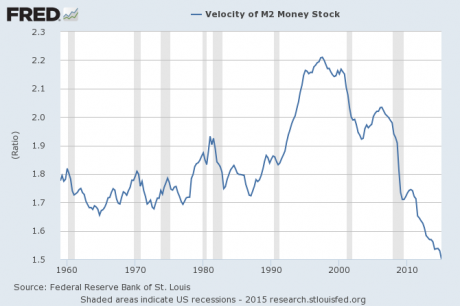
When a recession ends, the velocity of money normally starts going back up.
But a funny thing happened when the last recession ended. The velocity of money ticked up slightly, but then it started going down steadily. In fact, it has kept on declining ever since and it has now hit a brand new all-time record low.
This is not normal. Yes, Wall Street is temporarily flying high for the moment, but the underlying economic fundamentals are all screaming that something is horribly wrong.
A global crisis has begun, and the U.S. will not be immune from it. I truly believe that we are heading toward the worst economic downturn that any of us have ever experienced.
But there are many out there that insist that nothing is the matter and that happy times are ahead.
So who is right and who is wrong?
We will just have to wait and see…
Credit ti Economic Collapse
"Dis-Union" Grows - Danes Vote To Protect Sovereignty, Reject Further EU Integration
To be sure, just about the last thing the EU needed was another blow to European solidarity.
The monumental challenge of coping with the millions of refugees who have inundated the Balkans on their way to Germany has splintered the bloc and now, the debate on how best to deal with the flood of asylum seekers threatens to shatter the sacred Schengen ideal altogether.
On Wednesday we reported that the EU has now threatened Greece with indefinite suspension from the Schengen passport-free travel zone unless it overhauls its response to the migration crisis by mid-December, as frustration mounts over Athens’ reluctance to accept outside support. At the same time, Turkey (who is now fond of starting world wars) is set to receive a €3 billion check to support Ankara’s efforts to “keep migrants in the region.”
Well, in case the situation wasn’t fractious enough, Denmark voted against further integration on Thursday in a referendum that boasted a turnout of 72%. As WSJ reports, “voters were asked if parliament should have the power to opt-in on a total of 22 EU justice and home affairs laws, from which the small Nordic country has hitherto been exempt.”
53% of Danes said “no”.

“The outcome is a defeat both for the Danish government and the main opposition parties who had urged voters to back the proposal, arguing it was necessary for Denmark to combat cross-border crime and remain a member of Europol even after a planned overhaul of the intergovernmental police agency next year,” WSJ goes on to note.
“The result of the election is based on a general skepticism toward the EU,” PM Lars Loekke Rasmussen said. Rasmussen contends that deeper integration is paramount if the country wants to "fight cross-border crime." "At stake is the ability to coordinate everything from tracking cyber crime to ensuring family disputes get the same legal treatment across EU borders," Bloomberg adds.
"Danes are saying yes to cooperation but no to relinquishing more sovereignty to Brussels," Kristian Thulesen-Dahl, head of the EU-skeptic, anti-immigration Danish People's Party, said on Thursday. The DPP is the big winner here and the vote effectively means the majority of Danes do not support a move to subject the country to Brussels' migrant quota system."DPP leaders have said that adopting the government plan could compel Denmark to participate in joint EU efforts to tackle the region’s migrant crisis," WSJ says. Rasmussen says that isn't the case.
Now, the PM will have to struggle to keep his country in Europol. "Rasmussen said he now would have talks with European Council President Donald Tusk and European Commission President Jean-Claude Juncker aimed at reaching so-called parallel agreements that would allow Denmark to continue cooperation with Europol, among others," AP says.
As for the consequences of preserving the opt-out, Denmark will now be cut off from critical information given last week's changes to the role of the European police agency. Danes "won't have immediate access to Europol registers on foreign fighters in Syria, criminal motorbike gangs, etc.," Henning Soerensen, a lecturer in EU law at the University of Southern Denmark, warns.
So there you go. No access to centralized data on "motobike gangs," which means that if the Hell's Angels decide to stage an attack on Copenhagen, Denmark will be out of luck when it comes to shared intelligence.
The vote has wider ramifications. As WSJ goes on to suggest, "the result of the Danish vote could have implications for British Prime Minister David Cameron as he seeks to renegotiate Britain’s relationship with the EU."
As a reminder, Brexit is one of SocGen's five black swans for 2016 and "Denmark voting against further European integration could strengthen Cameron’s negotiating hand, since he could use the Danish referendum to show the U.K. isn’t the only country with major concerns about the EU and that other European populations are weary about further integration."
So there you have it, more "dis-union" and just one more reason to believe that the EU project has entered what might fairly be described as a terminal decline. If the Denmark vote tells us anything, it's that terrorists need not waste time attacking Europe - it's going to fall apart on its own.

Credit to Zero Hedge
Thursday, December 3, 2015
The Fall Of America Signals The Rise Of The New World Order
“The contemporary quest for world order will require a coherent strategy to establish a concept of order within the various regions and to relate these regional orders to one another.” — Henry Kissinger, “Henry Kissinger On The Assembly Of A New World Order”“[P]art of people’s concern is just the sense that around the world the old order isn’t holding and we’re not quite yet to where we need to be in terms of a new order that’s based on a different set of principles, that’s based on a sense of common humanity, that’s based on economies that work for all people.” — Barack Obama“We reiterate our strong commitment to the United Nations (UN) as the foremost multilateral forum entrusted with bringing about hope, peace, order and sustainable development to the world. The UN enjoys universal membership and is at the center of global governance and multilateralism.” — Fifth BRICS Summit Declaration“We support the reform and improvement of the international monetary system, with a broad-based international reserve currency system providing stability and certainty. We welcome the discussion about the role of the SDR in the existing international monetary system including the composition of SDR’s basket of currencies. We support the IMF to make its surveillance framework more integrated and even-handed.” — Fifth BRICS Summit Declaration
Here is where many political and economic analysts go terribly wrong in their examination of current global paradigms: They tend to blindly believe the mainstream narrative rather than taking into account conflicting actions and statements by political and financial leaders. Even in the liberty movement, composed of some of the most skeptical and media savvy people on planet Earth, the cancers of assumption and bias often take hold.
Some liberty proponents are more than happy to believe in particular mainstream dynamics. They are happy to believe, for example, that the growing “conflict” between the East and West is legitimate rather than engineered.
You can list off quotation after quotation and policy action after policy action proving that Eastern governments, including China and Russia, work hand in hand with globalist institutions like the International Monetary Fund, the Bank of International Settlements, the World Bank and the U.N. toward the goal of global governance and global economic centralization. But these people simply will not listen. They MUST believe that the U.S. is the crowning villain, and that the East is in heroic opposition. They are so desperate for a taste of hope they are ready to consume the poison of false dichotomies.
The liberty movement is infatuated with the presumption that the U.S. government and the banking elites surrounding it are at the “top” of the new world order pyramid and are “clamoring for survival” as the U.S. economy crumbles under the facade of false government and central banking statistics. How many times have we heard over the past year alone that the Federal Reserve has “backed itself into a corner” or policy directed itself “between a rock and a hard place?”
I have to laugh at the absurdity of such a viewpoint because central bankers and internationalists have always used economic instability as a means to gain political and social advantage. The consolidation of world banking power alone after the Great Depression is a testament to this fact. And even former Fed Chairman Ben Bernanke has admitted (at least in certain respects) that the Federal Reserve was responsible for that terrible implosion, an implosion that conveniently served the interests of international cartel banks like JPMorgan.
But the Federal Reserve is no more than an appendage of a greater system; it is NOT the brains of the operation.
In his book “Tragedy And Hope,” Carroll Quigley, Council on Foreign Relations member and mentor to Bill Clinton, stated:
"It must not be felt that these heads of the world’s chief central banks were themselves substantive powers in world finance. They were not. Rather, they were the technicians and agents of the dominant investment bankers of their own countries, who had raised them up and were perfectly capable of throwing them down. The substantive financial powers of the world were in the hands of these investment bankers (also called “international” or “merchant” bankers) who remained largely behind the scenes in their own unincorporated private banks. These formed a system of international cooperation and national dominance which was more private, more powerful, and more secret than that of their agents in the central banks."
In “Ruling The World Of Money,” Harper’s Magazine established what Quigley admitted in “Tragedy And Hope” — that the control of the global economic policy and, by extension, political policy is dominated by a select few elites, namely through the unaccountable institutional framework of the BIS.
The U.S. and the Federal Reserve are mere tentacles of the great vampire squid that is the new world order. And being a tentacle makes one, to a certain extent, expendable, if the trade will result in even greater centralization of power.
The delusion that some people within the liberty movement are under is that the fall of America will result in the fall of the new world order. In reality, the fall of America is a necessary step towards the RISE of the new world order. The Rothschild-owned financial magazine The Economist reaffirmed this trend of economic “harmonization” in its 1988 article “Get Ready For A World Currency By 2018,” which described the creation of a global currency called the “Phoenix” over three decades:
"The phoenix zone would impose tight constraints on national governments. There would be no such thing, for instance, as a national monetary policy. The world phoenix supply would be fixed by a new central bank, descended perhaps from the IMF. The world inflation rate — and hence, within narrow margins, each national inflation rate — would be in its charge. Each country could use taxes and public spending to offset temporary falls in demand, but it would have to borrow rather than print money to finance its budget deficit. With no recourse to the inflation tax, governments and their creditors would be forced to judge their borrowing and lending plans more carefully than they do today. This means a big loss of economic sovereignty, but the trends that make the phoenix so appealing are taking that sovereignty away in any case.""...The phoenix would probably start as a cocktail of national currencies, just as the Special Drawing Right is today. In time, though, its value against national currencies would cease to matter, because people would choose it for its convenience and the stability of its purchasing power."
We are now on the cusp of the “prediction” set forth by The Economist over 27 years ago. The BRICS nations, including Vladimir Putin’s Russia, have all consistently called for the formation of a global reserve currency system under the direct control of the IMF and predicated on the basket methodology of the SDR. This new global system, as The Economist suggested, requires the marginalization of existing power structures and the end of sovereign economic control. Governments around the world including the U.S. would be at the fiscal mercy of the new financial high priests through the use of insidious debt based incentives given or withheld at the whim of the IMF.
China is set to be inducted into the SDR basket in 2015, with specific economic changes to be made by September 2016, a development I have been warning about for years. The "vote" is in and the decision has been finalized. While some in the mainstream media are playing off the rise of the Yuan as meaningless, IMF head Christine Lagarde presents the shift as a major event, not for China, but for the IMF and the SDR which she proudly refers to as the "currency of currencies".
The addition of China to the SDR, I believe, is the next trigger event for the continuing removal of the dollar as the world reserve currency. The monetary shift may explode with speed if Saudi Arabia follows through with a possible plan to depeg from the dollar, effectively ending the petrodollar status the U.S. has enjoyed for decades.
This is, of course, the same IMF-controlled SDR system that Putin and the Kremlin have called for, despite the running fantasy that Putin is somehow an opponent of the globalists.
Putin continues to press the “U.S. as bumbling villain” narrative, while at the same time supporting globalist institutions and the internationalization of economic and political governance. While many people were overly focused on his “calling out” of the U.S. and its involvement in the creation of ISIS in his recent speech at the U.N., they seemed to have completely overlooked his adoration of the United Nations and the development of a global governing body. Putin often speaks at cross purposes just as Barack Obama does — one minute supporting sovereignty and freedom, the next minute calling for global centralization:
"Russia is ready to work together with its partners to develop the UN further on the basis of a broad consensus, but we consider any attempts to undermine the legitimacy of the United Nations as extremely dangerous. They may result in the collapse of the entire architecture of international relations, and then indeed there will be no rules left except for the rule of force.""Dear colleagues, ensuring peace and global and regional stability remains a key task for the international community guided by the United Nations. We believe this means creating an equal and indivisible security environment that would not serve a privileged few, but everyone."
Putin also proclaimed his support for the UN's fight against "climate change", the same climate change which Secretary of State John Kerry argued was a "contributing factor" in the crisis in Syria and the rise of ISIS. I have written in the past on the fraud of "man made climate change (global warming)" and will not enter that tangent here now, but the point remains that Putin is fully on board with said fraud like all other puppet politicians around the globe:
"...One more issue that shall affect the future of the entire humankind is climate change. It is in our interest to ensure that the coming UN Climate Change Conference that will take place in Paris in December this year should deliver some feasible results. As part of our national contribution, we plan to limit greenhouse gas emissions to 70–75 percent of the 1990 levels by the year 2030.""It is indeed a challenge of global proportions. And I am confident that humanity does have the necessary intellectual capacity to respond to it. We need to join our efforts, primarily engaging countries that possess strong research and development capabilities, and have made significant advances in fundamental research. We propose convening a special forum under the auspices of the UN to comprehensively address issues related to the depletion of natural resources, habitat destruction, and climate change. Russia is willing to co-sponsor such a forum."
one more issue that shall affect the future of the entire humankind is climate change. It is in our interest to ensure that the coming UN Climate Change Conference that will take place in Paris in December this year should deliver some feasible results. As part of our national contribution, we plan to limit greenhouse gas emissions to 70–75 percent of the 1990 levels by the year 2030. - See more at: http://www.russianmission.eu/en/news/president-vladimir-putin-addresses-...
It is indeed a challenge of global proportions. And I am confident that humanity does have the necessary intellectual capacity to respond to it. We need to join our efforts, primarily engaging countries that possess strong research and development capabilities, and have made significant advances in fundamental research. We propose convening a special forum under the auspices of the UN to comprehensively address issues related to the depletion of natural resources, habitat destruction, and climate change. Russia is willing to co-sponsor such a forum. - See more at: http://www.russianmission.eu/en/news/president-vladimir-putin-addresses-...
Indeed, it has been Putin’s intention all along to support and defend the internationalist framework while at the same time participating in the theatrical East versus West false paradigm:
"In the BRICS case we see a whole set of coinciding strategic interests.First of all, this is the common intention to reform the international monetary and financial system. In the present form it is unjust to the BRICS countries and to new economies in general. We should take a more active part in the IMF and the World Bank’s decision-making system. The international monetary system itself depends a lot on the US dollar, or, to be precise, on the monetary and financial policy of the US authorities. The BRICS countries want to change this."
The Chinese support the same agenda of an IMF managed economic world:
The world economic crisis shows the "inherent vulnerabilities and systemic risks in the existing international monetary system," Gov. Zhou Xiaochuan said in an essay released Monday by the bank. He recommended creating a currency made up of a basket of global currencies and controlled by the International Monetary Fund and said it would help "to achieve the objective of safeguarding global economic and financial stability."
It is rather interesting how the desires of the BRICS seem to directly coincide with the designs of international bankers. This Hegelian dialectic is perhaps the most elaborate public distraction of all time, with the ultimate solution to the artificially engineered problem being a single “multilateral” but centrally dictated world economic system and world government, i.e., the new world order.
Again, the globalists at the BIS and the IMF require a diminished U.S. dollar, greatly reduced U.S. living standards and a much smaller U.S. geopolitical footprint before they can establish and finalize a single publicly accepted global elitist oligarchy.
If you cannot understand why it seems that the Federal Reserve and U.S. government appear hell-bent on self-destruction, then perhaps you should consider the facts and motivations at hand. Then, you’ll realize it is THEIR JOBto destroy America, not save America. When you are finally willing to accept this reality, every disastrous development since the inception of the Fed a century ago, as well as all that is about to happen in the next few years, makes perfect sense.
This is not to say that the ultimate endgame of the new world order will result in victory. But the cold, hard, concrete evidence shows that internationalists do have a plan; they are implementing that plan systematically; and all major governments around the world are participating in that plan. This plan involves the inevitable collapse and reformation of America into a Third World enclave, a goal that is nearly complete, as I will outline in my next article.
As the U.S. destabilizes, we are not escaping the clutches of the Federal Reserve system, only trading out one totalitarian management model for another. It is absolutely vital that the liberty movement in particular finally and fully embrace this reality. If we do not, then there will truly be no obstacle to such a plan’s success and no end to the tyrannies of the old world or the new world.
Credit to Zero Hedge
Subscribe to:
Posts (Atom)