Thursday, October 27, 2011


Nationwide EAS Test coming on Nov. 9

ATLANTA -- On November 9 at 2 p.m., virtually every radio, television, cable and satellite station in the nation will take part in a nationwide test of theEmergency Alert System.
The test will be administered by the Federal Emergency Management Agency, the Federal Communications Commission and the National Oceanic and Atmospheric Administration. The test itself is expected to last up to three and a half minutes. The public will hear a message on all media that says, "This is a test."
Ordinarily, EAS tests are conducted locally on an ongoing basis, and this will be no exception, though the tests most viewers are familiar with generally last a minute in length.
The Department of Homeland Security, along with FEMA, the FCC and other federal, state and local government organizations have been working to make sure that the system will enable the president and other authorities are able to address the American public during a time of extreme emergency.
People are reminded to obtain or craft an emergency preparedness kit and make sure that they have an emergency plan for themselves and their families. More information can be found about emergency preparedness at http://www.ready.gov/.
Pope to promote peace in talks with world religious leaders
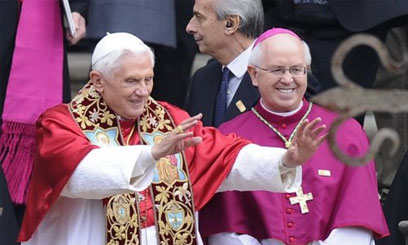
VATICAN CITY, Oct 25 – Pope Benedict XVI has invited 300 religious leaders to a meeting in Assisi in Italy to repudiate “violence in the name of God” amid growing tensions fuelled by fundamentalists across the world.
The day of interreligious council, which will be held on Thursday in St. Francis of Assisi’s birthplace, is intended to be a “journey of reflection, dialogue and prayer for peace and justice in the world,” the Vatican said.
Over 50 Islamic representatives are expected to attend the talks from several countries, including Saudi Arabia and Iran.
They will be joined by Rabbis, Hindus, Buddhists, Jains, Sikhs, a Zoroastrian, a Bahai and representatives of Taoism and Confucianism as well as of other traditional religions from Africa and America.
For the first time, four atheists will also attend the meeting, which is traditionally organised so as not to coincide with the Muslim day of prayer on Friday, the Jewish one on Saturday or the Christian one on Sunday.
However, the Imam from the Al-Azhar University in Cairo, a heavyweight authority on Sunnism, will not be coming, having fallen out with the pope after he urged Egypt to protect Christians from attacks by radical Islamists.
The meeting is being criticised by Catholic fundamentalists who are strongly against the idea of dialogue with other religions. French fundamentalist Regis de Cacqueray said 1,000 masses would be needed to be said in reparation.
The event marks the 25th anniversary of the first interreligious meeting in Assisi, organised by John Paul II in 1986 as a “day of prayer” inspired by the United Nation’s proclamation of an International Year of the Peace.
Cardinal Joseph Ratzinger, the then prefect of the Congregation for the Doctrine of the Faith, chose not to attend because of concerns shared by traditionalists that it risked mixing religions into a vague common belief.
While guests attending this year’s encounter — the third in Assisi — will in principle follow a “common course”, those who wish to pray will do so separately, according to their beliefs, the Holy See has said.
Cardinal Roger Etchegaray, who helped organise the first Assisi day in 1986, said John Paul II had been careful to avoid mixing beliefs, and Benedict XVI was no different.
“Interreligious dialogue has spread” over the last 25 years, and the pope sees it “as a common, irrevocable heritage of Christian sensibility,” he said.
The pope’s main aim is for participants to agree to “a common commitment to reject the instrumentalism of religion and the use of violence in the name of God,” said a Vatican insider.
Number two of the Pontifical Council for Interreligious Dialogue, Pier Luigi Celata, said the problems that particularly concern religions are immigration, cultural diversity, religious liberty and the defence of the family.
“These issues oblige faithful people from different religions to look for common solutions,” he said.
At the end of the day of talks, the main participants will renew their commitment to peace in the square in front of St. Francis’ Basilica.
A burning torch will be symbolically presented to the delegations in the hope that they will take the message back with them to their communities.
Capital News
Italy, Berlusconi pushed to the brink

Italy’s stability, as well as the leadership of its flamboyant prime minister, both hinge on a set of fiscal reforms, which were hastily concocted and delivered to the latest installment in Europe’s perpetual emergency summit on Wednesday.
A letter delivered by Silvio Berlusconi to European Union leaders in Brussels promises to balance the country’s budget by 2013, increase the age of retirement to 67, and raise €5-billion annually in asset sales.
“We are aware that our debt is too high and our growth is too limited,” Mr. Berlusconi said in the letter.
While the EU has insisted on austerity in exchange for support of Italy’s debt, Mr. Berlusconi has faced resistance within his fractured governing coalition.
And according to at least one Italian newspaper, parliamentary agreement on economic reform required Mr. Berlusconi pay the steepest of political prices — his resignation.
Already scandalized by sexual improprieties and allegations of corruption, the 75-year-old leader’s domestic mandate has been on the wane for some time.
Internal tensions flared up this week when government officials came to blows with opposition legislators over the reform plan.
Mario Draghi, Italy’s chief central banker who is set to take over as head of the European Central Bank on Nov. 1, called the situation in Italy “confusing and dramatic.”
With the eurozone’s largest sovereign bond market, Italy’s public debt has climbed to €1.9-trillion, amounting to 120% of its national production.
Yields on 10-year sovereign bonds sit at almost 6%, near the level that prompted intervention by the ECB in August.
The prospect of Italy falling to contagion would prove a vastly greater problem than that of the insolvency of Greece, whose debt load and economic strength is paltry by comparison.
As in Greece, the ECB intervention was made conditional on Italy passing a series of budget reforms.
But with deepening divisions in the centre-right coalition, and with Mr. Berlusconi’s chief political ally, the Northern League, intent on diluting fiscal reform, the proposals faltered.
As a result, confidence in Mr. Berlusconi’s authority suffered.
“Either this government is able to take structural reforms or we need another government,” said Mario Baldassarri, a former Berlusconi ally.
Italian President Giorgio Napolitano said the country cannot afford a leader that does not grasp the urgent need for budget reform.
“We can no longer dither over the categoric imperative of making a consistent and constant effort to lower our debt,” he said.
International reprimand followed. Mr. Berlusconi subsequently lashed back at the perceived interference in Italy’s affairs.
But the expectations for Wednesday’s summit were made clear.
“Our Italian friends know well that we have to assume that we will be informed this evening that there will be significant structural consolidation efforts from Italy. That is a must,” said Eurogroup president and Prime Minister of Luxembourg, Jean-Claude Juncker.
Mr. Berlusconi’s letter of intent appeared to at least propose such significant efforts.
But in order to secure the support of Northern League leader Umberto Bossi, the prime minister offered his resignation by the end of the year and agreed to early elections, according to newspaper la Repubblica. The prime minister’s office has denied the report.
For his part, Mr. Bossi has expressed doubt at the prospect of the coalition surviving.

Financial Post
Financiers Put A Red Light On Euro Project
 As if financiers weren't already the most unpopular people in Europe, they are, as I write this, holding the entire euro project to ransom.
By now, European leaders were supposed to have nailed down their three-part bailout deal and should have been back at their respective capitals toasting the salvation of the single currency.
They confirmed the deal to recapitalise struggling banks with just over 100bn euro of cash, sourced from the private sector or, if in need, the public sector.
They agreed, at least in theory, to increase the size of the currency's live-in bail-out fund, the European Financial Stability Facility (EFSF), from an effective 440bn euro to around 1trn euro.
There are question marks - big ones - over how this will work in practice, but the leaders have nonetheless made enough progress to draw up a draft announcement of the fund.
All of this, however, was before they reckoned with the difficulty they would have in the third and final part of the bailout - persuading private sector investors to accept a haircut - an effective semi-default - on the Greek debt.
Now, this element may seem incidental to the rest of the deal, and is often dismissed as less important than the "big bazooka" element of leveraging up the EFSF.
But unless the Europeans can find a deal to reduce what Greece owes, the country is likely to fall into an inescapable economic hole that could only end in a full-scale messy default.
Sky News
Subscribe to:
Posts (Atom)