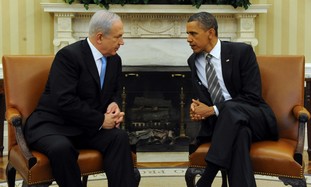
Prime Minister Binyamin Netanyahu departed early Wednesday morning to do battle against recognition of a Palestinian state at the UN, with his first stop being a meeting in New York with US President Barack Obama just a few hours after arrival.
Before leaving, Netanyahu told Likud MKs and mayors meeting in the Knesset that “We don’t want peace just on paper, but a lasting peace. For that we need to stand up for our interests. It’s much easier to give in to pressure, not stand up, and get applauded by the world that doesn’t understand what we have been through. We are determined to protect our interests and stand up for our truth.”
The Netanyahu-Obama meeting, the eighth between the two leaders since they both took office in early 2009, takes place four months after a meeting in May at the White House during which administration officials reportedly fumed at Netanyahu for what they perceived as his lecturing of the president over Obama’s call for Israeli-Palestinian negotiations to begin on the basis of the pre-1967 lines, with mutually-agreed land swaps.
Though Netanyahu came out strongly against that proposal at the time, in the intervening months he has rolled back his position and agreed in principle to accept – with reservations – the pre-1967 lines with mutual swaps as part of the formula for renewing talks. That agreement was based on the condition that the Palestinians agree that the parameters would also include recognition of Israel as the state of the Jewish people.
This idea is still serving as the basis for attempts by the Quartet to find a formula to restart the negotiations and thereby take much of the “sting” out of any resolution on statehood that the PA brings to either the Security Council or the UN.
Quartet envoys were scheduled to meet Tuesday afternoon in New York for the third consecutive day to discuss the matter. Among other ideas that are being bandied about to restart negotiations are for the Palestinians to delay a vote on the matter in the Security Council or General Assembly for six months, and for Israel to declare another settlement construction freeze.
Ironically, Netanyahu’s meeting with Obama comes as the US president is being pummeled by Republican presidential candidates over his treatment of Israel, a week after his Middle East positions had a part to play in the loss of a safe Democratic seat in a very Jewish district in New York, but as Netanyahu is saying that coordination with the administration is the best it has been since the beginning of the Obama term.
In a sign of the closeness of the cooperation, US Envoy to Israel Dan Shapiro flew on the prime minister’s plane to New York, something US ambassadors have not done since Martin Indyk used to fly on Ehud Barak’s plane when he was prime minister.
The Obama-Netanyahu meeting is expected to focus on the Palestinian statehood bid at the UN, with both the US and Israel having the shared interest of trying to keep the Palestinians from getting nine positive votes on the 15-member council, so the US would not have to use its veto to shoot down the measure.
That effort received a boost Tuesday when Nigeria’s President Goodluck Jonathan told Defense Minister Ehud Barak during a meeting that his country would abstain if the measure came to a vote in the Security Council.
At this point Israel believes the other countries who may be convinced to either vote against or abstain on the measure in the Security Council are, in addition to the US, Britain, France, Germany, Portugal, Bosnia- Herzegovina, Colombia, and Gabon. The other countries on the council are India, Brazil, South Africa, Lebanon, China and Russia.
Netanyahu will meet with the heads of state of a number of these countries before Friday when Abbas is expected to formally request to UN Secretary-General Ban Kimoon that the issue be taken up by the Security Council.
Netanyahu is expected to meet Portuguese Prime Minister Pedro Passos Coelho on Wednesday, as well as French President Nicolas Sarkozy.
Netanyahu is also expected to meet Ban on Wednesday.
The meeting between Barak and Jonathan was set up about a week ago, and – according to a statement put out by Barak’s office – was coordinated both with Netanyahu and the US.
In addition to discussing the Palestinian issue, the statement said the two also discussed the “challenges of international terrorism and ways the two countries can cooperate in this area.” Nigeria, one of Israel’s closest friends in Africa, has been plagued over the last number of years by radical Islamic terrorism.
Jerusalem Post
hostgator coupon 2011
US lawmakers said Tuesday a new budget stalemate over funding for disaster relief could lead to a government shutdown if an agreement is not reached by the end of the fiscal year September 30.
The latest bone of contention comes over aid for recovery for states hit by Hurricane Irene and subsequent flooding.
Republicans have said any new relief funds should be offset by cuts in other services, and also want some of the funds to be put into the 2012 fiscal year which begins October 1.
Senate Majority Leader Harry Reid, a Democrat, said he was not persuaded by comments from some Republicans that they would avert a shutdown, saying the Republican-led House of Representatives may take a hard line.
"I'm not that sure (that a shutdown will be averted), because the Tea Party-driven House of Representatives has been so unreasonable in the past, I don't know why they should suddenly be reasonable," Reid said.
The Senate has approved the release of $6.9 billion for disaster relief included in the budgets for fiscal 2011 and 2012.
But in the House, the Republican leadership is working toward approval of $1 billion for the current year and $2.6 billion for fiscal 2012.
House Majority Leader Eric Cantor said the Senate leadership is the cause of the stalemate.
"There is nothing but politics involved if Harry Reid wants to go and play these games," Cantor said. "We are delivering the monies that are needed. We are twice what is requested from the emergency standpoint." He noted that President Barack Obama has requested $500 million in emergency funds.
Cantor said that if the government is forced to curtail services, "it will be on Leader Reid's shoulders, because he's the one playing politics with it. No one wants to stand in the way of disaster relief monies that are needed."
Reid said lawmakers should keep working to avert a shutdown despite a planned recess next week.
"We are not going to back down. Remember, the government doesn't shut down on Thursday or Friday," he said.
"If they want to stay into next week, that's fine. We can do that. Next week, we can work all next week. Government doesn't shut down until -- I think it's a week from Saturday."
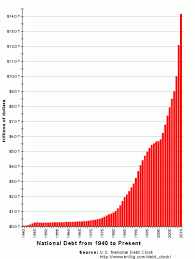
The latest stalemate comes just weeks after a bruising political debate overbudget cuts and the raising of the US debt ceiling, with a shutdown narrowly averted after the White House and lawmakers agreed to create a "supercommittee" to examine deep cuts.
Breitbart
hostgator coupon 2011
Tehran, Sept 21, IRNA – Energy Minister Madjid Namjou said Iran has reached an agreement with Russia and Turkey on making investments in construction of power plants in the country.

Namjou said the Russian and Turkish sides will also share technical experiences with the Islamic Republic of Iran to build those power plants.
hostgator coupon 2011

The slowly drifting location of Earth's magnetic north pole means the Hillsboro Airport's main runway underwent a name change early this week - from 12/30 to 13/31.
The new numbers were painted at one end of the runway early this week as part of general maintenance, said a spokeswoman for the Port of Portland, which owns and operates the airport.
Pilots and clients of the airport were mailed notices to be on the lookout for the runway work, but the airport was never shut down, as was rumored, said spokeswoman Kama Simonds.
Runways are designated according to the points on a compass, and the changing location of true magnetic north meant the runway sometimes is renamed.
Experts say magnetic north is slipping slowly from above the Arctic Ocean in a north-northwestern direction toward Siberia, at about 34.2 miles per year. When the magnetic points were recalibrated, Hillsboro, like some other airports, had to renumber its main runway.
"Over time, every 20 years or so, the magnetic headings change, and the runways have to be renamed," Simonds said
Every five years, federal agencies tabulate magnetic variation, which varies by location. It correlates true direction to the magnetic compass readings needed for navigation.
While modern navigation is moving toward more satellite-based systems, most U.S. aviation still relies on ground radar - calibrated to the local magnetic variation used in navigational aids such as instrument landing systems and beacons, she said.
The adjustment is the result of a natural, ongoing process. The Earth has an iron core, and movement within its outer part is believed to be responsible for sustaining the magnetic field used to measure the Earth's surface.
This makes the Earth like a giant magnet, but with the location of its north and south poles always shifting around. As a result, true magnetic north, on which the workings of a compass needle are focused, doesn't always match up with the permanently drawn lines on the map. Thus, the location of the airport in relation to true north has to be adjusted.
Scientists believe the activity of the Earth's core could cause massive shifts in polarity, including the north and south poles reversing themselves.
It's believed this last happened 780,000 years ago, and took about 10,000 years to happen.
Pilots and clients at the airport were warned to be cautious Sunday and Monday as the new numbers were painted, in addition to the paving and milling and at the end of the landing strip.
But the timing, on the 10th anniversary of the 9/11 World Trade Center attacks, was mere coincidence, Simonds said.
"It just so happened to be scheduled for the second week of September, and the weather was still nice," Simonds said.Sott Net
hostgator coupon 2011

The gold market is revving up to reach new record highs in excess of $2,000 (U.S.) an ounce in the next year, according to the average forecast of bankers, traders and investors at the gold industry’s largest annual gathering.
The bullish prediction, if correct, suggests that the gold bull market remains intact, despite having already gained almost 30 per cent this year and 600 per cent over the past decade.
The widespread optimism at the London Bullion Market Association conference in Montreal, the largest gathering of the gold industry, comes as the gold market has been transformed from a backwater dominated by jewellery demand to one of the hottest investment assets.
The conference, which enjoyed a record attendance in excess of 500, predicted that gold would be trading at $2,019 an ounce at the time of next year’s meeting in November 2012. That would mark a fresh nominal record for gold, although it is still below the inflation-adjusted peak touched in 1980, which translates to more than $2,400 in today’s money.
The delegates at the LBMA conference have a strong record of predicting the trajectory of the gold price, although their forecasts have traditionally been overcautious. Last year, with gold trading at $1,298 an ounce, the conference predicted a price of $1,450. On Tuesday, bullion (GC-FT1,809.600.500.03%) was trading at $1,805.70, down from a record peak of $1,920 in early September.
The forecasts, if accurate, bode well for hedge fund managers such as John Paulson of Paulson & Co and David Einhorn of Greenlight Capital, who bought gold in the financial crisis as a means of betting that governments and central banks would fail to safeguard their economies from the market turmoil.
Many hedge fund investors believe a sharp appreciation in the gold price is likely as they expect the eurozone debt crisis to deepen.
Despite the optimistic price predictions, traders were wary of growing volatility in the gold market, which has experienced some of the sharpest swings on record in recent weeks. Asked whether the market was in a bubble, 39 per cent of the traditionally bullish audience replied that it was. A growing number expect the market to accelerate in the next year or two and peak above $2,500.
“We expect to see $2,500 some time in the next 12 months,” said Som Seif, chief executive of Claymore Investments, a Canadian asset manager.
The most bullish forecast came from Pierre Lassonde, chairman ofFranco-Nevada (FNV-T44.070.972.25%), who predicted that gold would reach parity with the Dow Jones industrial average index, at present trading at 11,400, within the next four to six years. “This bull market is far from over,” said Mr. Lassonde, whose predictions are optimistic even by the standards of market bulls.
A drop below $1,600 an ounce could mark the end of the rally for the next few months, traders believe – although many expect demand from Asian investors and central banks to prop up prices above that level.
Mr. Lassonde said: “I think there’s going to be a strong correction at some point and it’s going to set up the last phase that will take the market to numbers that few people can imagine.”
The bullish sentiment has been underpinned by the strength of demand for coins and small bars from retail investors from Germany to China.
Steven Nathan, marketing director at the Rand Refinery in South Africa, said that sales of the popular gold krugerrand coin were at a record level: “Demand is insatiable. It’s the strongest period ever right now.”
A comparable surge in demand was reported by other mints, refiners and coin dealers. “I just can’t see the price coming down,” said one senior precious metals banker. “Physical demand is incredibly strong.”The Globe
hostgator coupon 2011

Mysterious booming sounds are occasionally heard on the North Carolina coast, often powerful enough to rattle windows and doors. They cannot be explained by thunderstorms or any manmade sources — their source is a mystery.
Such dins are not unique to North Carolina or the modern age. People living near Seneca Lake in upstate New York have long known of similar booming sounds, which they called "Seneca guns." In coastal Belgium, they are known as "mistpouffers," or fog belches; in the Ganges delta and the Bay of Bengal, "Bansal guns;" in the Italian Apennines, "brontidi," or thunder-like; and by the Harami people of Shikoku, Japan, "yan."
"What's going on is an interesting challenge, whatever it might be," said seismologist David Hill, scientist emeritus at the U.S. Geological Survey office in Menlo Park, Calif.
Long list of explanations
A host of plausible explanations may now exist for these enigmas, including earthquakes, rock bursts, mud volcanoes, explosive venting of gas, storm-driven waves, tsunamis, meteors, distant thunder and so-called booming sands.
"It seems there is quite a range of processes in nature that might be responsible," Hill told OurAmazingPlanet.
"Earwitnesses" described sounds like booming cannons or falling stones accompanying small to moderate earthquakes in England from 1880 to 1916. In 1975, U.S. Geological Survey researchers managed to record both acoustic and seismic signals of an earthquake swarm in California, finding that three earthquakes with magnitudes ranging from 2.0 to 2.8 produced sounds that began within 0.02 seconds of the arrival of seismic waves at the scientists' station. Similar results were seen with quakes in the French Pyrenees in 2004.
All in all, audible sounds from earthquakes might be perceived even when shaking is not, Hill suggested. For instance, while earthquakes are rare in coastal North Carolina, they are relatively common in the Charleston area of South Carolina, the site of the 1886 magnitude 7.6 Charleston quake, and the Catskill Mountains that Seneca Lake is located within do host low-level earthquake activity. Locals could be hearing an earthquake that is too small for them to feel.
Also, rock bursts, where long-buried rock can suddenly release stress, often because of mining removing confining material above it, can essentially be seen as a type of small, near-surface earthquake. Scientists have reported feeling perceptible jolts and hearing sharp booming sounds from such bursts, Hill said.
Giant waves might also be responsible for the mystery sounds, Hill suggested. Scientists have found that booming sounds are apparently familiar to big-wave surfers during extreme waves. In addition, after the catastrophic 2004 magnitude 9.1 Sumatra earthquake and tsunami, multiple witnesses said they heard loud, offshore booming sounds closely accompanying two or three of the largest waves that struck the coast at any given site.
"I was surprised to learn about the possibility that tsunamis produce these kinds of sounds," Hill said. "I don't think anyone understands that process."
Hill suggests the sounds heard off the coasts of North Carolina, Belgium and the Bay of Bengal might be large waves caused by distant storms that break well offshore, beyond outer banks or barrier beaches. Such waves might also disrupt offshore methane hydrate deposits, leading to explosive venting of high-pressure gas trapped deep within the Earth.
Booming sands and seismometers
Another possibility is meteors. Meteors can generate sonic booms and explode dramatically as they plummet from space. Given how long it can take a shockwave to reach the Earth's surface from the upper atmosphere, visible signs of the meteor can vanish before its sonic boom is heard, especially during the daytime, Hill noted.
Under the right circumstances, even sand dunes can generate a variety of sounds, including whispering, humming, whistling and squeaking. Booming sands, comparable to rumbling thunder, can be heard to distances of 6 miles and for as long as 15 minutes, are possible as well. They generally appear limited to large sand dunes in arid climates with steep faces pointing away from the wind, and seem to require loosely packed, very smooth, almost spherical sand grains.
"In the eastern desert in Egypt, the Bedouins have a long history of hearing booms and avoiding that area — after installing seismometers there, researchers were able to go back and see these sounds seem correlated with small earthquakes that caused booming sands," Hill said.
In the future, after potential artificial sources of mysterious booming sounds are ruled out, such as military exercises and quarry blasts, seismic networks could quickly reveal if earthquakes or volcanoes were responsible. For instance, the USArray, a mobile network of seismometers, is currently moving east across the United States and "it might help resolve the issue of what the sounds on the North Carolina coast are," Hill said.
MSNBC
hostgator coupon 2011


