Wednesday, October 25, 2017


The universe shouldn't exist, scientists say after finding bizarre behaviour of anti-matter
Colossians 1:17
He is before all things, and in Him all things hold together.

Our universe shouldn't exist, scientists say.
The most elite scientists in the world are still struggling to find why exactly our universe didn't destroy itself as soon as it came into existence. That's what science says should have happened – but it clearly hasn't, since you're here reading this, as far as we know.
At the beginning of the universe, according to the standard model, there equal amounts of matter and anti-matter. The trouble with that is that they would each have annihilated each other, leaving none of the matter that surrounds us today.
Researchers have been frantically looking for some difference between matter and anti-matter that could explain why the universe is still around. But they have tried a range of different possibilities – that they have different mass, electric charge, or something else – but have found no difference.
That has led researchers to question why the universe is still around at all.
"All of our observations find a complete symmetry between matter and antimatter, which is why the universe should not actually exist," explained Christian Smorra, the author of a new study conducted at CERN.
"An asymmetry must exist here somewhere but we simply do not understand where the difference is. What is the source of the symmetry break?"
The latest possibility was matter and anti-matter's different magnetism. But new research shows that they are identical in that way too – lending further mystery to the question of why the universe is still around at all.
The new study, led by Dr Smorra, looked to measure anti-protons to find out how they were different from the protons that surround us. They measured the anti-matter's magnetism in more precise detail than ever before, and were surprised to find that both matter and anti-matter looked exactly symmetrical.
The CERN research saw scientists capture the anti-protons in special "Penning traps", since it's not possible to hold anti-matter inside a physical container. "This tremenduous increase in such a short period of time was only possible thanks to completely new methods," said Stefan Ulmer, spokesperson of the group of researchers who conducted the work.
Credit to independent.co.uk
http://www.independent.co.uk/news/science/universe-exist-cern-universe-matter-bizarre-behaviour-scientists-a8015216.html
Russia to test new generation of intercontinental missile that can 'beat US defence systems'
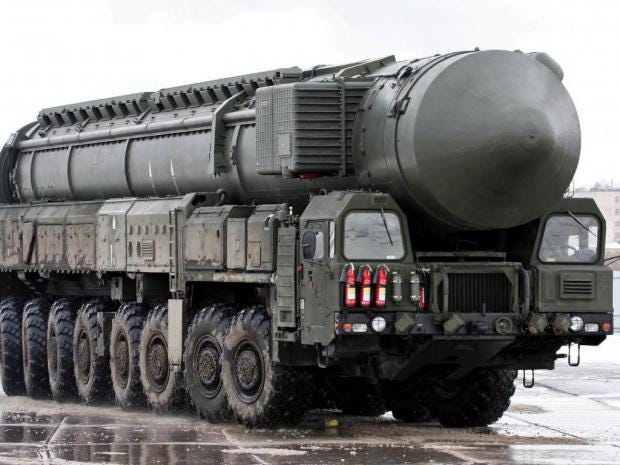
Russia is preparing to test-launch its new generation of nuclear-armed intercontinental ballistic missile (ICBM), which it has claimed will be able to penetrate the US’ defensive shield.
Delayed several times, the tests of the RS-28’s launch and first few seconds of flight are to be carried out at the Plesetsk Cosmodrome, in Russia’s north-west, before the end of the year.
The trials had been postponed because launch silos and the projectiles themselves were not ready, according to the state-controlled Sputnik website, which cited the Kommersant newspaper.
The RS-28 Sarmat, a 100-plus-ton ICBM that government-controlled media has claimed could destroy an area the size of Texas, is designed to evade missile defences with multiple hypersonic warheads, known as MIRVs.
Talking up its capabilities, state-linked Russian sites have claimed an 11,000km range, a payload of up to 15 warheads and the ability to “speed past every missile defence system in existence”.
RIA Novosti said individual warheads could have yields up to 750kt and that RS-28 launch silos would be built to withstand seven nuclear strikes.
Outside sources cast doubt on some of these specifications. RIA said the new missile will have a “throw weight” – the mass of all components minus fuel and the launch rocket – of five tons.
But Michael Kofman, a research scientist from the Centre for Naval Analyses, told The National Interest earlier this year: “If RIA is right, and it probably is not right, how do you fit a payload of 10 warheads and tons of decoys into five tons?
“There are large questions outstanding about conflicting claims about throw-weight, warheads and penetration aids.”
Russia expects the RS-28 to enter service by the beginning of the next decade as part of its ongoing nuclear modernisation.
Credit to independent.co.uk
http://www.independent.co.uk/news/world/asia/russia-icbm-test-nuclear-weapons-rs-28-sarmat-defence-systems-plesetsk-cosmodrome-a8016696.html
Subscribe to:
Posts (Atom)