Friday, April 28, 2017


Have the U.S. Just Reached Peak Stock Market Absurdity?
Have you ever wondered how tech companies that have been losing hundreds of millions of dollars year after year can somehow be worth billions of dollars according to the stock market? Because I run a website called “The Economic Collapse“, there are naysayers out there that take glee in mocking me by pointing out how well the stock market has been doing. This week, the Dow is flirting with 21,000 and the Nasdaq crossed the 6,000 threshold for the first time ever. But a lot of the “soaring stocks” that have been fueling this rally have been losing giant mountains of money every single year, and just like the first tech bubble this madness will eventually come to an end in a spectacular fiery crash in which investors will lose trillions of dollars.
Anyone that cannot see that we are in the midst of an absolutely insane stock market bubble simply does not understand economics. Every valuation indicator that you can possibly point to says that we are in a bubble of epic proportions, and history teaches us that all bubbles inevitably come to an end at some point.
Earlier today, I came across an article by Graham Summers in which he persuasively argued that the price to sales ratio indicates that stock prices are far more inflated than they were just prior to the great stock market crash of 2008…
Sales cannot be gimmicked. Either money comes in the door, or it doesn’t. And if a company is caught messing around with its sales numbers, someone is going to jail.For this reason, Price to Sales is perhaps the single most objective and clear means of measuring stock valuations.This metric, above all others, you can point to and say, “this is definitively accurate and has not been messed with.”On that note, as Bill King recently noted, today the S&P 500 is sporting a P/S ratio that is massively higher than it was in 2007 and is only marginally lower than it was during the Tech Bubble (the single largest stock bubble of all time for most measures).
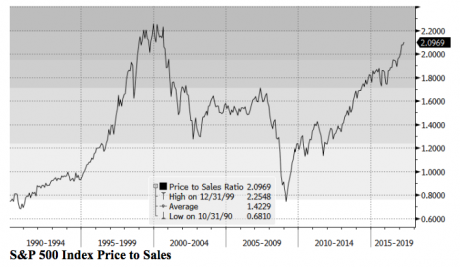
To me, looking at profitability is even more important than looking at sales.
Large tech companies such as Twitter certainly have lots of revenue coming in, but many of them are deeply unprofitable.
In fact, Twitter has never made a yearly profit, and over the past decade it has actually lost more than 2 billion dollars.
But despite all of that, investors absolutely love Twitter stock. As I write this article, Twitter has a market cap of 11.5 billion dollars.
How in the world is that possible?
How can a company that has never made a single penny be worth more than 11 billion dollars?
Twitter is never going to be more popular than it is now. If it can’t make a profit at the peak of its popularity, when will it ever happen?
And guess what? ABC News says that Twitter actually just reported a decline in revenue for the most recent quarter…
Twitter has never turned a profit, and for the first time since going public in 2013, it reported a decline in revenue from the previous year. Its revenue was $548.3 million, down 8 percent.Net loss was $61.6 million, or 9 cents per share, compared with a loss of $79.7 million, or 12 cents per share, a year earlier.
The only reason why financial black holes such as Twitter can continue to exist is because investors have been willing to pour endless amounts of money into them, but now that bubble is starting to burst.
In his most recent article, Simon Black discussed how Silicon Valley investors are starting to become more cautious because so many of these “unicorns” are now going bust. One of the examples that he cited in his article was a company called Clinkle…
(Given that investing in an early stage company is high-risk, investors might provide a few hundred thousand dollars in funding, at most. Clinkle raised $25 million.)The company went on to burn through just about every penny of its investors’ capital.There were even photos that surfaced of the 21-year old CEO literally setting bricks of cash on fire.At the end of the farce, Clinkle never actually managed to build its supposedly ‘world-changing’ product, and the website is now all but defunct.
Most of you may have never even heard of Clinkle, but I bet that you have definitely heard of Netflix.
Netflix has revolutionized how movies are delivered to our homes, and that revolution helped drive movie rental stores to the brink of extinction.
There is just one huge problem. It turns out that Netflix is losing hundreds of millions of dollars…
Netflix might be my favorite example.The company’s most recent earnings report for the period ending March 31, 2017 shows, yet again, negative Free Cash Flow of MINUS $422 million.Not only is that a record loss, it’s 62% worse than in Q1/2016, and over twice as bad as Q1/2015.Netflix just keeps losing more and more money.
But even though Netflix is losing money at a pace that is exceedingly difficult to imagine, investors absolutely love the company.
I just checked, and at this moment Netflix has a market cap of 68.4 billion dollars.
Sometimes I just want to scream because of the absurdity of it all.
Companies that are losing hundreds of millions of dollars a year at the peak of their popularity should not be worth billions of dollars.
Nobody can possibly argue that these enormously inflated stock prices are sustainable. Just like with every other stock market bubble in our history, this one is going to burst too, and I have been warning about this for quite a long time.
But for the moment, the naysayers are having their time to shine. Despite the fact that U.S. consumers are 12 trillion dollars in debt, and despite the fact that corporate debt has doubled since the last financial crisis, and despite the fact that the federal government is 20 trillion dollars in debt, they seem to be convinced that this irrational stock market bubble can keep inflating indefinitely.
Perhaps they can all put their money where their mouth is by pouring all of their savings into Twitter, Netflix and other tech company stocks.
In the end, we will see who was right and who was wrong.
Credit to Economic Collapse
Thursday, April 27, 2017
Japan Warns Citizens To Prepare For North Korean Missile Attack

As the United States begins to move elements of its Terminal High Altitude Area Defense (THAAD) system to a deployment site in South Korea earlier than expected - in the name of defending against the “evil North Korea” of the mainstream narrative - Japan is warning its citizens they’ll have little time to find safety if Kim Jong-un launches an attack.

From the Washington Post:
“North Korea might be talking about building missiles that can reach the United States, but Kim Jong-un’s regime already has lots of missiles that can reach Japan. So the Japanese government is preparing its citizens in case a missile comes their way — possibly with less than 10 minutes’ warning.“The prime minister’s office issued new ‘actions to protect yourself’ guidelines this week, including for the first time instructions on how to respond if a North Korean ballistic missile is heading toward Japan.”
The government’s advice, essentially, is to find cover, meaning a sturdy building or structure — in itself a largely ineffectual tip, given their own guidelines admit “It is extremely difficult to be able to pinpoint missile landing areas before their launch.”

So, randomly choose the right building and you might make it.
As to after the missiles launch and the warning bells sound, one Japanese mayor wants people to understand they’ll have precious little time to act.
“A missile may not be detected as soon as it leaves the launch pad…and that could take several minutes,” said Osaka Mayor Hirofumi Yoshimura, according to The Japan Times. “Depending on the case, the warnings and alarms might only sound four or five minutes before a missile arrives.”
Just like its counterpart in the United States, the Japanese government wants its citizens to understand that the North Korean threat is real — though, apparently, there isn’t much they can do about it should Kim Jong-un choose to attack, despite what the mainstream narrative would have you believe.
* * *
Full Japanese Guide below...
Credit to Zero Hedge
Compelling Evidence of the Incursions of Giants, Their Extraordinary Technology, and IMMINENT RETURN Part #2

By Dr. Thomas R. Horn
As the research included within the upcoming book and documentary film attests, the fact that oversized humans walked the earth in ancient times—some of whom were so large they hardly identify as “human” by comparison—is not at all far-fetched, and we have likewise found proof at times that they were violent cannibals and the ritual of consuming humans was to alter DNA in order to become ‘fit extensions’ for Rephaim incarnation. Though theories of origin range all the way from the corrupt-DNA Nephilim of Genesis 6:4 to systematic human evolution that somehow produced a strand of people who grew to towering dimensions (the latter of these theories conflicts with both science and common sense), history and archaeology simply produce too much witness that giants were existent for us to write them off. The proof is not simply in bodily remains, but also in material possessions that defy use by ancient peoples of regular size, as well as cultural phenomena surrounding them (hieroglyphs, ancient documents, legends, etc.). Add to this the increased intelligence executed in the architectural and agricultural sites of wonder associated with these cultures that completely flouts all we know of the early, nomadic human groups, and we have a recipe for the treasure hunt of the century.
The questions are then presented: Where are these remains, and why are they not displayed for the public? Why aren’t they in a museum somewhere? Wouldn’t the Smithsonian be the perfect place to house these items of interest?
Is it possible that the Smithsonian has cooperated with a cover-up?
First of all, let us not assume that everything the Smithsonian says or features is accurate. It, too, has a disregard for complete, transparent truth.
I did not originally intend to involve much of the following in this entry, as it appears at the onset to be unrelated to the subject of large human bones. I like to be thorough, however, so I did a little fact-checking in order to bare a quick example of the proverbial shrug that the Smithsonian offered when we first pressed for adherence to precision. Quickly, though, this little side-assignment became much more than that.
One visiting the administrative headquarters building known as the “Castle” (the Smithsonian Institution Building, formally) will see the tomb of James Smithson, whose monetary donation to the United States government founded the site despite the fact that Smithson never set foot on North American soil. His epitaph, so beautifully engraved upon the front panel of the tomb, says, “Sacred to the Memory of James Smithson Esq. Fellow of the Royal Society, London, who died at Genoa [Italy] the 26th June 1829, aged 75 years.” However, it is common knowledge that James Smithson was not seventy-five years old when he died. The exact calendar date of his birth is unknown because his mother hid her pregnancy and labored in secret, but we do know for certain that he was born in the year 1765 in Paris, France. This would place him at the age of sixty-three or sixty-four at the oldest, and this updated age-of-death information not only appears on the official Smithsonian Institution Archives website,[i]but also in the book An Account of the Smithsonian Institution: Its Origin, History, Objects, and Achievements[ii]—written by Cyrus Adler, commissioned by the institution itself, and published via its own printing channels. (And this is not to mention the numerous historical sources that confirm this age outside the Smithsonian.) Yet, no correction to the date has been displayed on the tomb.
 If the Smithsonian is aware of the date discrepancy of its own founding donor, as its own published materials expose, then is it not an affront to the integrity of the institute as proclaimed reporters of historic fact that the venerated tomb displays that he was seventy-five when he died instead of just displaying his true age to visitors? If we cannot trust the very exhibition of this most celebrated forefather—what some would consider the most important thing on view in the entire museum, as it bespeaks of its very own origin—how many other of the museum’s displays or claims are untrustworthy?
And yes, one might argue that this error is a small concern when compared to concealed giant bones, and that would be correct. Comparatively, this is a very petty thing to be worried about. But bear with me as I canvas what I learned from looking into this. It represents a symptom of a much larger issue. I had senior staff researcher Donna Howell call an information specialist at the Castle building to get a response on this, and her findings were interesting—not because she uncovered a major conspiracy, but because she was given an excellent example of the precise global naïveté that I was hoping to address early on in Cloudeaters.
After being on hold for several minutes over the automated system, a woman named Maryann came on the line. The conversation was a well-anticipated dead end. I knew Donna wouldn’t get much info over the phone, but I had her call nonetheless, because it was the line to the generic title “information specialist,” so I just assumed the one who answered the call might know something about it at least. If nothing else, I was sure we would be redirected to the appropriate department or person equipped to answer. However, a couple of this nice and helpful woman’s responses forced a raised eyebrow:
MARYANN: Information center, this is Maryann, how may I help you?
DONNA HOWELL: Hello, I was curious about the tomb of your founding donor, James Smithson. It’s on display there at the Castle, correct?
MARYANN: Yes, his tomb is here.
DONNA HOWELL: Oh, good. I thought so. We’re working on a project and noticed that the age of death on his tomb was incorrect. Do you know someone I can ask about this?
MARYANN: Um, uh, um. [She stammered for probably ten seconds straight.] What now? The date is incorrect?
DONNA HOWELL: His age is, yes. It says that he died at seventy-five, but he couldn’t have been older than sixty-four at most.
MARYANN: No, if it says he died at seventy-five, then that would be the age he died. [Her tone was kind, but firm.] It wouldn’t say that on his tomb if [she interrupted herself]— Is there a reason you believe we’re incorrect?
DONNA HOWELL: Oh, actually, it’s in your own literature. I have it pulled up in front of me on your website, as well as a book I have here, published by the Institution in 1904.
MARYANN: [Momentary silence.] You mean we are the ones saying the dating on the tomb is incorrect?
DONNA HOWELL: Yes, that’s right. The story goes that Smithson’s nephew wrote the epitaph and it was engraved that way, but it’s still showing the wrong age. Is it still this way for sentimental purposes, or because it’s considered to be an artifact in itself, or…?
MARYANN: Uh, you know, I don’t know. I don’t think I can answer your question. I don’t have that information. If the display says he was seventy-five years old when he died, then that’s the age [she interrupted herself again]— I mean, it’s what the tomb says, right? We would certainly only give the correct information there. Um. Uh… We don’t just have people on the phone ready to talk about James Smithson.
DONNA HOWELL: I’m sorry. I shouldn’t have assumed that you guys would know the answer to such an obscure question off the cuff. The title “information specialist” threw me off. That was probably a term that referred to scheduled tours or something. Do you know who I might be able to call or email?
MARYANN: Well, I mean we are the specialists here to— We do have information on— I tell you what, why don’t you just send your question in over email?
DONNA HOWELL: Sounds good. [Donna took the info from her and then bravely plugged one last thought.] While I have you on the line, do you happen to know if there is a plaque on display in that room anywhere that corrects the information for visitors? I mean, it’s the Smithsonian. I know the Smithsonian has very high standards of reporting only what’s true. Doesn’t it create an issue that the very founder’s information is in error and that people might be misled? Wouldn’t some think that other information on display there is inaccurate if they learn that this one is?
MARYANN: I don’t believe there is another plaque, no. Just what the tomb says. I understand why you would be concerned, but it is just the date of his age. Everything else here is true. [!!!]
DONNA HOWELL: Oh, of course. I didn’t mean to insinuate there was a conspiracy or anything. Well, this email is helpful, thank you!
Donna ended the call on a cheerful note and let Maryann get on with her day, and then immediately followed up with an email to the address she provided. She received an email back a few days later saying that her question was forwarded to the curator, but the curator never responded.
But readers should not assume that we are patting ourselves on the back just because we were able to prove that a person named Maryann at the information center didn’t know about the tomb of James Smithson. I am well aware that you cannot rely on even the most trained employees of an institution to be able to answer every question about every display on command, and Donna said as much to her during the call. The only thing this short talk confirmed to me was that our national—no, global—attitude toward historical accuracy is yielding, lenient, and far too quick to trust anything a plaque says at a museum somewhere. Maryann was absolutely so sure and so trusting that information on the tomb was accurate, just because it was posted by the Smithsonian authority she works for. Maryann’s response to the display essentially translates, “No, if the Smithsonian said it, it must be true, because they only speak the truth. And if there isan error, then it’s an irrelevant one. No big deal. Just a date. A typo. But everything else is true.” Such a quick conclusion bespeaks of substantial naïveté.
Never mind the fact that the tomb has been in its current location since the celebratory escort by the United States Cavalry in January of 1904, and that the Institute has known about the discrepancy since. We’re not talking about a commemoration panel for some unremarkable personality put up yesterday that the staff hasn’t had a chance to correct yet. We are talking about the exhibition of an errant fact regarding the most important individual behind the Smithsonian that the institution has deliberately ignored for 112 years, and the only way the members of the public would know they have been misinformed is if they dig into the small print and do their own independent research. (And again, if they are keeping the original “75 years” age on the tomb because the stone with the inscription is itself an artifact, then a nearby panel should explain the discrepancy.)
There are times, as proved by this experience, that we treat truth like plastic that can bend when it’s not really considered an important affair. We respond with, “Well, it is just this insignificant detail, but everything else is true. Let’s not be petty.” Why is “everything else” true? Because the illustrious and benevolent “they”—that authority who has the reputation for the last word on the respective subject—have said so. And there have been times the “they” have “said so” to the fatal detriment of the trusting public.
Remember what people first said about cigarettes? “No, cigarettes aren’t harmful. Theywouldn’t be allowed to sell them if they were dangerous.” In this case, the “they” might be referring to the tobacco companies or the trust in FDA protection, but the people inhaling carcinogens prior to their doctor’s cancer diagnosis were convinced the powers-that-be were ensuring the product’s integrity. Recall what was said of asbestos originally? “No, that’s ridiculous. Asbestos isn’t causing cancer. They said that was all just a ridiculous rumor. They wouldn’t be allowed to insulate buildings with asbestos if exposure to it was making people sick.” In this case, the “they” would have been the manufacturing companies who wanted to continue cutting cost corners regardless of the death count, but hordes of people were made ill or died when the powers-that-be took as long as they did to unveil the dangers. And consider Wall Street prior to the Great Depression. “Trust me, investing in these stocks is completely safe. Everyone is investing today, and they said the economy is brighter than it’s ever been and only shows signs of continual growth and prosperity.” The “they” here might have been anyone from the nation’s richest stock brokers to the Wall Street Journal to President Hoover to the society around everyone in general who had begun living lavish lifestyles, but soon the entire country fell into one of the largest economic travesties we’ve ever witnessed in world history because the powers-that-be weren’t as Johnny-on-the-spot or transparent as they presented themselves to be.
They said the Titanic would never sink. They said the Jews were living happy lives in Nazi concentration camps.
They posted that Smithson died at the age of “75 years,” and Maryann initially pronounced that if they said “75 years,” then it was true, and even if it wasn’t, everything else was…because the Smithsonian is the “they” of the last word.
“They” are not always the final authority, even though “they” are often trusted as the final authority.
And as small a detail as the information on the tomb of Smithson may be, where does one draw the line? Who discerns what is irrelevant and inconsequential from what is important? Is there a strict rule about what false information is allowed versus what is not? Has the same individual who deemed the great late James Smithson’s tomb a trivial matter also marginalized the feelings of those who say their Native American national exhibit “inadequately represents the persecution of Native Americans” (which has also been a major ongoing concern)?[iii] What about all the voices that have cried out against the inaccuracies of their African History exhibit?[iv] Were those insignificant details as well?
It’s not just Maryann. It’s not limited to the offense that a representative of the “company of truth” has no idea the lie that greets every tourist that enters their main facility, or that she doesn’t consider it a big deal. Like I said only pages ago, this is a symptom of a much bigger problem.
I can’t possibly be the only one who finds that thread of thought unsettling, especially when unquestioning and assumptive sentiments such as “everything else is true” come from those who are representatives of “an Establishment for the increase and diffusion of knowledge among men”[v] (the Smithsonian mission statement in James Smithson’s will).
Ultimately, we have to accept the fact that when the injury of misinformation is added to the intentional neglect of the all-knowing “they,” then piled atop a public that will consider the last word of the authority gospel, we arrive at an equation that spreads distortion like a brush fire. Add to this years and years of the public’s cultural familiarity with, and acceptance of, the skewed concept, and we arrive at a day when anything that challenges the national “truth” is immediately marginalized or written off as the ramblings of a conspiracy-theory madman despite supporting evidence. It’s an age-old social science: When people have largely adopted a way of thinking into their society and slowly built a universal worldview around it, they will not easily receive modifications to that worldview—even when the worldview is based on inaccuracy in the first place. They don’t want to hear the truth, because it means letting go of all they’ve known or believed in up to that point, so they hold on to what’s familiar, what’s comfortable, always referring back to some “they” authority to support them when questioned.
In the upcoming Cloudeaters book and documentary film, readers and viewers will no longer assume the evidence of enormous human bones—and the challenges those bones produce toward our mainstream evolutionary worldviews—is all nonsense just because some “they” says so.
They say we came from monkeys. They say there are no giant bones that oppose mainstream evolutionary science. They say these giants will never be reanimated or return.
But they are lying, and the proof of that is penetrating, as the world will soon know.
Credit to Tom Horn
Subscribe to:
Posts (Atom)