Friday, January 16, 2015


Duke University has announced it will begin allowing a Friday afternoon Muslim call to prayer to be played via loudspeaker from the Duke Bell Tower
The logo explains a lot......
Great. In the week after multiple terror attacks by Islamic extremists on Jews and harmless cartoonists in Paris, Duke University has announced it will begin allowing a Friday afternoon Muslim call to prayer to be played via loudspeaker from the Duke Chapel Bell Tower, thereby bringing the suburban Parisian ambience to the upscale campus.
The Muslim call to prayer will now be heard weekly across the Duke University campus in North Carolina.
The chant, known as “adhan,” will resound from the Duke Chapel bell tower every Friday beginning Jan. 16, echoed by members of the Muslim Students Association, the university announced via Duke Today. The chant will sound for three minutes at a “moderately amplified” level to announce the Jummah prayer service, held Friday afternoons in the chapel basement.
While Duke University is proclaiming its slide into dhimmitude as a major success for interfaith understanding, what they are doing is objectively wrong.
The Adhan will be sung in Arabic, then followed by an English translation, according to a Facebook event announcing the call.
The objection should not be to the call to prayer, per se, so long as Duke rings an Angelus bell, but to the blatant, school sponsored proselytizing that it is permitting by making the call also in English. Something that is not done in mosques in the United States. The text of the call is:
Allahu Akhbar, Allahu Akhbar
Allah is the Greatest, Allah is the Greatest
Ashhadu anla ilaha illal laa (2 times)
I testify, there is no God but Allah
Ashadu anna Muhammadur rasulullah (2 times)
Muhammad is the messenger of Allah
Haia alas salaah (2 times)
Come to prayer
Haia alal falah (2 times)
Come for success
As salatus khairum minan naum*
Prayer is better than sleep*
Allahu Akhbar, Allahu Akhbar
Allah is the Greatest, Allah is the Greatest
La ilaha illal laa
There is no God but Allah
This is not a mere call to prayer for Muslims, it is active call to become a Muslim. It is no different than a Christian exhortation to attend church.
If Duke permitted the Lord’s Prayer or 23d Psalm to be announced from the Chapel Bell Tower you can bet the nutcases at the Freedom From Religion Foundation and commies at the ACLU would be squirting blood from their ears. But they won’t. Because they know that Christians will accept they abuse and Muslims will chop their pointy little heads off.
Credit to Red State
Great. In the week after multiple terror attacks by Islamic extremists on Jews and harmless cartoonists in Paris, Duke University has announced it will begin allowing a Friday afternoon Muslim call to prayer to be played via loudspeaker from the Duke Chapel Bell Tower, thereby bringing the suburban Parisian ambience to the upscale campus.
The Muslim call to prayer will now be heard weekly across the Duke University campus in North Carolina.
The chant, known as “adhan,” will resound from the Duke Chapel bell tower every Friday beginning Jan. 16, echoed by members of the Muslim Students Association, the university announced via Duke Today. The chant will sound for three minutes at a “moderately amplified” level to announce the Jummah prayer service, held Friday afternoons in the chapel basement.
While Duke University is proclaiming its slide into dhimmitude as a major success for interfaith understanding, what they are doing is objectively wrong.
The Adhan will be sung in Arabic, then followed by an English translation, according to a Facebook event announcing the call.
The objection should not be to the call to prayer, per se, so long as Duke rings an Angelus bell, but to the blatant, school sponsored proselytizing that it is permitting by making the call also in English. Something that is not done in mosques in the United States. The text of the call is:
Allahu Akhbar, Allahu Akhbar
Allah is the Greatest, Allah is the Greatest
Ashhadu anla ilaha illal laa (2 times)
I testify, there is no God but Allah
Ashadu anna Muhammadur rasulullah (2 times)
Muhammad is the messenger of Allah
Haia alas salaah (2 times)
Come to prayer
Haia alal falah (2 times)
Come for success
As salatus khairum minan naum*
Prayer is better than sleep*
Allahu Akhbar, Allahu Akhbar
Allah is the Greatest, Allah is the Greatest
La ilaha illal laa
There is no God but Allah
This is not a mere call to prayer for Muslims, it is active call to become a Muslim. It is no different than a Christian exhortation to attend church.
If Duke permitted the Lord’s Prayer or 23d Psalm to be announced from the Chapel Bell Tower you can bet the nutcases at the Freedom From Religion Foundation and commies at the ACLU would be squirting blood from their ears. But they won’t. Because they know that Christians will accept they abuse and Muslims will chop their pointy little heads off.
Credit to Red State
Iran Building Missile Sites in Syria

Iranian military leaders admitted this week to building and operating missile-manufacturing plants in Syria, where it was also revealed that Tehran is helping to build a secret nuclear facility.
An Iranian Revolutionary Guard Corps (IRGC) commander stated in a recent interview that the country’s Supreme Leader ordered forces to build and operate missile plants in Syria, where Iran continues to fight on behalf of embattled leader Bashar al-Assad, according to regional media reports.
IRGC Aerospace Commander Haji Zadeh touted Iran’s capabilities and bragged that Iran has gone from importing most of its military hardware to producing it domestically, as well as for regional partners such as Assad.
“A country such as Syria which used to sell us arms, was later on to buy our missiles,” Zadeh was quoted as saying earlier this week by the Young Journalists Club. “Right now the missile manufacturing firms in Syria are built by Iran.”
It has long been suspected that Iranian forces operating in Syria are providing weaponry to Assad’s forces. Zadeh’s remarks confirm that Tehran is committed to a long fight in Syria and hopes to turn the country into an Iranian proxy state.
Iran’s military actions in Syria could constitute a gross violation of sanctions on the regime enacted by the United Nations and Western powers.
Zadeh also bragged about Tehran’s ability to build missiles capable of travelling at least 2,000 kilometers, far enough to reach into Israel and other Middle Eastern countries, according to the report.
Iranian Supreme Leader Ayatollah Khamenei has made it a priority for Tehran to produce advanced missiles, Zadeh said.
“The Supreme Leader wanted us to make the missiles prices, something which he had noted earlier than that,” he was quoted as saying.
Meanwhile, Germany’s Der Spiegel reported over the weekend, based on leaked intelligence and other sources, that Iran has been helping to build a secret nuclear facility in Syria.
Western sources fear that Tehran is attempting to continue its controversial and clandestine nuclear work in Syria, where it does not have to battle against international nuclear inspectors and Western powers seeking to curb Iran’s nuclear ambitions.
Obama administration officials have sought to downplay the developments and said that they will not raise the issue with Iran during an upcoming round of talks over its program.
“Will you discuss this issue with the Iranians in the upcoming talks?” a reporter asked State Department spokeswoman Marie Harf on Monday.
“No,” Harf replied. “The upcoming talks are about the Iranian nuclear program.”
When pressed on the issue, Harf said that nuclear talks only focus on Iran’s domestic program and nothing else.
“We don’t discuss other issues with them at those talks, as you all know,” she said.
Credit to Washington Free Beacon
Thursday, January 15, 2015
The Greek Bank Runs Have Begun: Two Greek Banks Request Emergency Liquidity Assistance

The first time the phrase Emergency Liquidity Assistance, or ELA, was used in the context of Greece was in August 2011, when Greece was imploding, when its banking sector was on (and past) the verge of collapse, and just before the ECB had to unleash a global coordinated bailout with other central banks including global central bank liquidity swap and unleash the LTRO to preserve the Eurozone.
As a reminder, this is what happened back then: "In a move described as the "last stand for Greek banks", the embattled country's central bank activated Emergency Liquidity Assistance (ELA) for the first time on Wednesday night."
"Although it was done discreetly, news that Athens had opened the fund filtered out and was one of the factors that rattled markets across Europe. At one point Germany's Dax was down 4pc before it recovered. The ELA was designed under European rules to allow national central banks to provide liquidity for their own lenders when they run out of collateral of a quality that can be used to trade with the ECB. It is an obscure tool that is supposed to be temporary and one of the last resorts for indebted banks."Raoul Ruparel of Open Europe told The Telegraph: "The activation of the so-called ELA looks to be the last stand for Greek banks and suggests they are running alarmingly short of quality collateral usually used to obtain funding."He added: "This kicks off another huge round of nearly worthless assets being shifted from the books of private banks onto books backed by taxpayers. Combined with the purchases of Spanish and Italian bonds, the already questionable balance sheet of the euro system is looking increasingly risky."
As a further reminder, this is how cryptically little the ECB has to say about its "last-ditch" liquidity bailout program:
Euro area credit institutions can receive central bank credit not only through monetary policy operations but exceptionally also through emergency liquidity assistance (ELA). ELA means the provision by a Eurosystem national central bank (NCB) of
- central bank money and/or
- any other assistance that may lead to an increase in central bank money
to a solvent financial institution, or group of solvent financial institutions, that is facing temporary liquidity problems, without such operation being part of the single monetary policy.
We bring this up because things in Greece just went bump in the night. Again.
Recall that as we reported three days ago, while Greece refused to admit that it was suffering a bank run ahead of a potentially game-changing election, it did report that "most taxpayers have chosen to delay their [tax] payments, given that the positions of the two main parties leading the election polls are diametrically opposite: Poll leader SYRIZA promises to cancel the ENFIA and even write off bad loans, while ruling New Democracy acknowledges the difficulties but is avoiding raising issues that would generate problems and fiscal consequences."
Well, yesterday we got some more details on the collapse in tax payments when Kathimerini reported that indeed as feared, Greek tax remittances have plunged by up to 80% compared to last year, in the process making a mockery of any Greek reforms.
Finance Ministry officials believe there will be no problem meeting the targets of the bailout program as far as the general government primary surplus, which amounts to 1.5 percent of gross domestic product for 2014, is concerned. There are, however, worries regarding the 2015 budget, as the year has got off to a terrible start in terms of revenue collections.The target for January is 4.5 billion euros, but tax officials report that they saw no activity that would support that goal in the first 10 days of the month.Sources say that the decline compared to the first 10 days of 2014 ranges between 70 and 80 percent.
That's not the bad news. The bad news is that as we also speculated, and as Greek officials tried to cover up as usual, the Greeks have resumed doing what they do best any time their country is facing a grand crisis: walking to the bank and withdrawing what little deposits they have left. Or rather running to the bank.
Which brings us back to the topic of the Emergency Liquidity Assistnace, which as Kathimerini reported moments ago, at least two Greek systemic banks have reportedly resorted to, indicating that the liquidity situation in Greece is once again as dire as it was in the depth of the European collapse.
To wit:
Two Greek systemic banks reportedly submitted the first requests to the Bank of Greece for cash via the emergency liquidity assistance (ELA) system on Thursday, in response to the pressing liquidity conditions resulting from the growing outflow of deposits as well as the acquisition of treasury bills forced onto them by the state.Banks usually resort to ELA when they face a cash crunch and do not have adequate collateral to draw liquidity from the European Central Bank, their main funding tool. ELA is particularly costly as it carries an interest rate of 1.55 percent, against just 0.05 percent for ECB funding.The requests by the two lenders will be discussed by the ECB next Wednesday.Bank officials commented that lenders are resorting to ELA earlier than expected, which reflects the deteriorating liquidity conditions in the credit sector.Besides the decline in deposits, banks were dealt another blow on Thursday with the scrapping of the euro cap on the Swiss franc. Bank estimates put the impact of the euro’s drop on the local system’s cash flow at between 1.5 and 2 billion euros.Deposits recorded a decline of 3 billion euros in December – a month when they traditionally expand – while in the first couple of weeks of January the outflow continued, although banks say it is under control.A major blow to the system’s liquidity has come from the repeated issue of T-bills: In November the state drew 2.75 billion euros in this way, in December it secured 3.25 billion euros, and it has already tapped another 2.7 billion in January. Of the above amounts, a significant share – amounting to 3 billion euros according to bank estimates – was in the hands of foreign investors who will not renew them, so they have to be bought by the Greek banks.Local lenders had also resorted to ELA in 2011 to cope with the outflow of deposits and consecutive credit rating downgrades of the state (and the banks) that made Greek paper insufficient for the supply of liquidity by the Eurosystem. In May 2012, due to the uncertainty of the twin elections at the time, local banks drew 124 billion euros in ELA to handle the unprecedented outflow of deposits.
And just like that, it's deja vu all over again, and the worst days of the summer of 2011 are ahead of us once more, only this time Draghi's "Whatever it takes" unconditional OMT bazooka has conditions, and anyway after today's SNB fiasco, what a central bank threatens, warns, begs or even does, may no longer even matter.
Credit to Zero Hedge
ISIS’s Crucifixions and Beheadings Continue
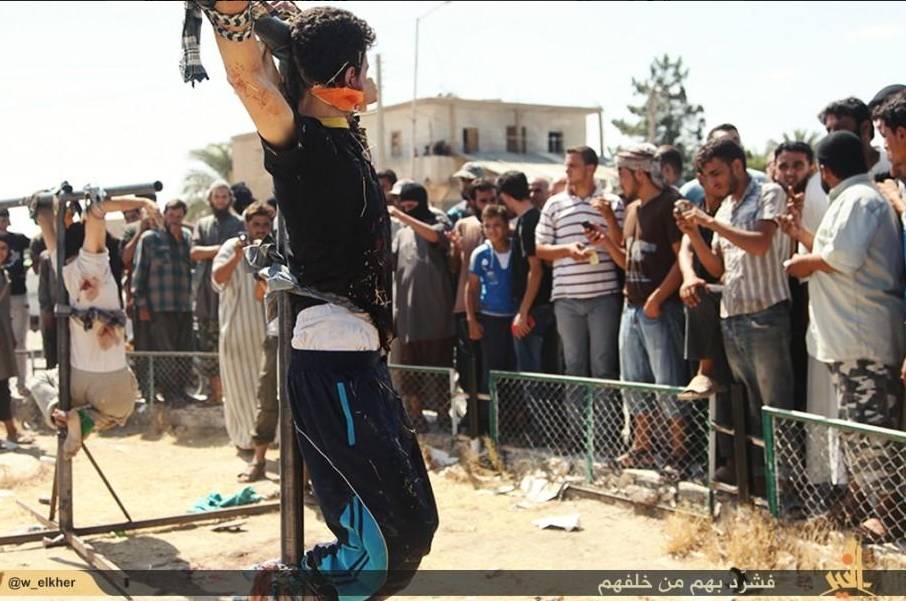
ISIS has continued its barbarism, executing five men in Deir Ezzor, an eastern province of Syria, on Wednesday, Jan, 14.
Two men were shot for “dealing with the Nusayri [Alawite] regime,” and a third was beheaded. Then all three were crucified, and they will remain so for three days for “establishing a cell to fight IS,” according to the Syrian Observatory for Human Rights.
ISIS forces then murdered a university student who was accused of being an “informant for the Nusayri regime.” This student had already been detained on the charge of “smoking.”
A fifth man was shot to death after being accused of being an agent for the regime and for allegedly being in communication with the regime’s intelligence apparatus.
Credit to Jewishpress
"It's Carnage" - Swiss Franc Soars 30% After SNB Abandons EURCHF Floor
"As if millions of macro hedge funds suddenly cried out in terror and were suddenly silenced"
Over two decades ago, George Soros took on the Bank of England, and won. Just before lunch local time, the Swiss National Bank took on virtually every single macro hedge fund, the vast majority of which were short the Swiss Franc and crushed them, when it announced, first, that it would go further into NIRP, pushing its interest rate on deposit balances even more negative from -0.25% to -0.75%, a move which in itself would have been unprecedented and, second, announcing that the 1.20 EURCHF floor it had instituted in September 2011, the day gold hit its all time nominal high, was no more.
What happened next was truly shock and awe as algo after algo saw their EURCHF 1.1999 stops hit, and moments thereafter the EURCHF pair crashed to less then 0.75, margining out virtually every single long EURCHF position, before finally rebounding to a level just above 1.00, which is where it was trading just before the SNB instituted the currency floor over three years ago.
Visually:

The SNB press release:
Swiss National Bank discontinues minimum exchange rate and lowers interest rate to –0.75%Target range moved further into negative territoryThe Swiss National Bank (SNB) is discontinuing the minimum exchange rate of CHF 1.20 per euro. At the same time, it is lowering the interest rate on sight deposit account balances that exceed a given exemption threshold by 0.5 percentage points, to ?0.75%. It is moving the target range for the three-month Libor further into negative territory, to between –1.25% and -0.25%, from the current range of between -0.75% and 0.25%.The minimum exchange rate was introduced during a period of exceptional overvaluation of the Swiss franc and an extremely high level of uncertainty on the financial markets. This exceptional and temporary measure protected the Swiss economy from serious harm. While the Swiss franc is still high, the overvaluation has decreased as a whole since the introduction of the minimum exchange rate. The economy was able to take advantage of this phase to adjust to the new situation.Recently, divergences between the monetary policies of the major currency areas have increased significantly – a trend that is likely to become even more pronounced. The euro has depreciated considerably against the US dollar and this, in turn, has caused the Swiss franc to weaken against the US dollar. In these circumstances, the SNB concluded that enforcing and maintaining the minimum exchange rate for the Swiss franc against the euro is no longer justified.The SNB is lowering interest rates significantly to ensure that the discontinuation of the minimum exchange rate does not lead to an inappropriate tightening of monetary conditions. The SNB will continue to take account of the exchange rate situation in formulating its monetary policy in future. If necessary, it will therefore remain active in the foreign exchange market to influence monetary conditions.
The resultant move across all currency pairs has seen the EUR and USD sliding, the USDJPY crashing, and US futures tumbling even as European stocks plunged only to kneejerk higher as markets are in clear turmoil and nobody knows just what is going on right now.
In other asset classes, Treasury yields, understandably plunged across the entire world, and the entire Swiss bond curve lest of the 10 Year is now negative, with the On The Run itself threatening to go negative soon as can be seen on the table below:
Crude and other commodities, except gold, are also tumbling, as are most risk assets over concerns what today's epic margin call will mean when the closing bell arrives.
Credit to Zero Hedge
Subscribe to:
Posts (Atom)