We will have a mirror site at http://nunezreport.wordpress.com in case we are censored, Please save the link

Tuesday, January 6, 2015

gay couples were wed in Miami on Monday


Lesbian and gay couples were wed in Miami on Monday by the same judge who approved their marriage licenses, hours before Florida’s coming-out party as the nation’s 36th state where same-sex marriages are now legal statewide.

The addition of Florida’s 19.9 million people means 70 percent of Americans now live in states where gay marriage is legal.

Credit to Washington Post

The Pakistan accused India of "unprovoked firing and targeting of civilians."


Pakistan announced last week that the U.S. ambassador had said a request had been made to Congress for a $532 million aid payment under an act co-authored by Kerry in 2009. Washington denied that on Monday, but not before drawing India's ire.

"How the Government of the United States of America decides to spend U.S. tax payers' money is entirely its prerogative," foreign ministry spokesman Syed Akbaruddin said in a statement.

"However, India does not believe that Pakistan is showing 'sustained commitment'," against Islamist militants, he added.

State Department spokeswoman Jen Psaki said no request had been made to U.S. Congress for a payment under the act, which requires Pakistan to cease support for extremist groups such as the Taliban and al Qaeda.

However, she said other funds were available to Pakistan.

In 2009, under the Kerry-authored act, the United States agreed to give an annual $1.5 billion to Pakistan, and in 2013 handed over the cash under a waiver despite what critics said was a lack of progress in countering Islamist militancy.

Funding for 2014, the last year of the four-year plan, has not yet been released, Psaki said.

Washington has for years been trying to encourage a rapprochement between India and Pakistan.

Relations were badly damaged in 2008 when a group of Pakistani militants killed 166 people in a three-day rampage through the Indian city of Mumbai after landing by sea.

India's coast guard last week said four suspected militants blew themselves up in a boat in waters between the two countries, an account that has been questioned by Indian media and opposition parties, and denied by Pakistan.

"WAR-LIKE"

In the disputed region of Kashmir, thousands of Indians have fled their homes as fighting between India and Pakistan spread along a 200-km (124-mile) border stretch. At least 10 people have been killed since Dec. 31.

Tensions have been high since Modi called off peace talks in August, and border clashes have erupted intermittently since.

Indian and Pakistani security officials have not spoken since Jan. 1 to reduce the violence, according to D.K. Pathak, director general of India's Border Security Force. Pakistan has lost more lives and suffered more damage to property, he said.

"It is not a happy situation and we would like the restoration of normalcy as fast and soon as possible," said Pathak. "But what can be done? If firing comes from their side we definitely have to respond."

Pakistan in turn accuses India of killing two of its men in an ambush on New Year's Eve.

About 6,000 civilians in Indian-controlled Kashmir fled late on Monday as fighting spread to civilian areas, said Shantmanu, divisional commissioner of Jammu region. About 4,000 left after fighting began last week.

"We had a narrow escape and there is a war-like situation," Sham Kumar, 54, from Sherpur village told Reuters. "Pakistani troops are using long-range weapons. It is the first time we have seen such intense shelling."

The Pakistan foreign ministry accused India of "unprovoked firing and targeting of civilians."

Credit to Reuters

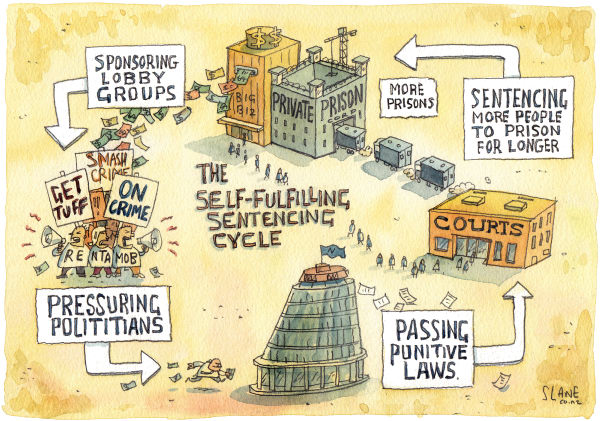
Children Increasingly Comprise the Rapidly Growing Prison Slave Labor Force

My wife used to run the corporate McDonald’s restaurants as the executive director in Arizona for almost a decade. The goal of every one of her stores was to create return business.  McDonalds would invest in playland equipment and dine in furniture, all designed to make the restaurants a desirable place to return to. The business principle is called “Return on Investment”. An now, our prisons are being organized along the same business principle.
The present privatized prison system operates on the same principle and it is quite effective. The average person is sentenced from 5-7 years in prison. There is no rehabilitation, only the prison life which produces a more hardened criminal. When the convict is released, they find it virtually impossible to get a job because of their ex-con label. Within three years of release from prison, 70% of all prisoners return. Can you imagine if every restaurant had a 70% return rate from its customers? If my wife could have enjoyed these kinds of numbers, she would have been the executive of the year, each and every year.
According to the Pew Center in their study The Long Reach of American Corrections (March 2009), it costs nearly $79 per day to house an inmate which is 20 times the cost of putting someone on probation. Wouldn’t it make sense to sentence nonviolent offenders to probation and save the taxpayers’ money? Of course it would, unless you are Vanguard Investments,  the largest owner of privatized citizens in the form of the Correctional Corporation of America (CCA), GEO (2nd largest private prison company), Wackenhut, Viacom, AOL Time Warner and they are all controlled by the Vanguard Family of Funds. You remember Vanguard don’t you?
The problem of prison slave labor, goes right to the top and these corporations have a powerful political ally.
This is the same Vanguard that moved money prior to the Gulf Oil Explosion in a manner which made massive sums of money for key investors in the same manner as did Transocean, Goldman Sachs and Halliburton. And one of those insiders that benefitted from the Gulf Oil Explosion was President Obama as he was vested in Vanguard I and Vanguard II. The late Bob Chapman reported on this Obama conflict of interest as did I in an earlier article.  Obama’s corruption is not limited to his investors having and acting on foreknowledge of the Gulf Oil Explosion, he is an active investor in the slave labor motivated Prison Industrial Complex.
Obama benefits and profits from prison slave labor.

Overt Slave Labor
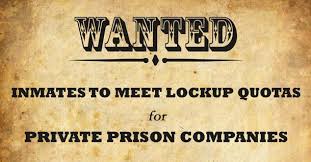
wanted inmatesMany of Wall Street’s giants have been invited to the party and are reaping huge profits. The following is a list of the corporations that contract with CCA and GEO to produce American slave labor goods. They include Intel, Northern Telecom, TWA, Nordstrom’s Boeing, Motorola, Microsoft, AT&T, prison for profitWireless, 3Com, Revlon, Macy’s, Pierre Cardin. Texas Instrument, Dell, Compaq, Honeywell, Hewlett-Packard, Nortel, Lucent Technologies, Target, and countless more. All of these businesses are excited about the economic boom generation by prison slave labor and most actively lobby for mandatory sentencing.
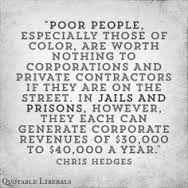
Generally, prison inmates in state run penitentiaries generally receive minimum wage for their work. In Agenda 21 controlled Colorado, they only receive about $2 per hour, well under the minimum for state run prisons. However, Colorado inmates are rich compared to inmates in privately-run prisons where they can receive as little as 17 cents per hour. This is worse than Walmart slave labor in China! The highest-paying private prison run by the CCA pays 50 cents per hour for “highly skilled positions.” I am not sure how this is even legal as I remember reading something about the 13th Amendment being repealed.

Prison Slave Labor Has Become One of the Mainstays of the American Economy
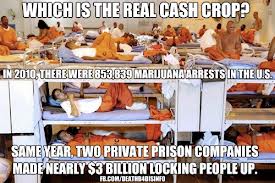
Since 2010, this trend is accelerating.
If there is a silver lining as America has found and antidote to the loss of manufacturing through the various free trade agreements (i.e. NAFTA, CAFTA). Unfortunately, prison slave labor is the solution. The Left Business Observer identifies private corporate interests benefiting from prison slave labor which includes the manufacturing of “93% of all paints and paintbrushes; 92% of stove assembly; 46% of body armor; 36% of home appliances; 30% of headphones/microphones/speakers; and 21% of office furniture.  This is a kind of Walmart for prisons and your State Legislatures are promoting this as a kind of cost savings, but they guarantee 90-100% prison bed occupancy rates. And we wonder why mandatory sentencing  has replaced judicial discretion when deciding the disposition of a criminal case.

Time Off for Good Behavior
The CCA, the largest owner of privatized prisons.
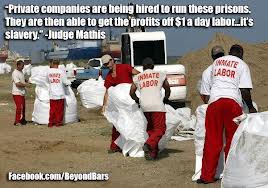
prison slave laborIn these normally overcrowded prisons, inmates may get their sentences reduced for “good behavior,” but for any violation of prison rules, they get 30 days tacked on to their sentences. I thought only a judge, under the Fifth Amendment due process provisions of the Constitution, can impose a prison sentence. This translates into more profits for CCA. According to a study of New Mexico prisons, it was found that CCA inmates lost  their “time off for good behavior”  at an 800% higher rate than inmates in state run prisons. CCA’s prisons are notoriously understaffed and this under-staffing leads to more acting out by the inmates which in turn leads to longer sentences resulting in more profit.
Therefore, one of the profit motivators for CCA is administration by neglect. In other words, they make more money if the prisons are poorly run and decidedly more dangerous.
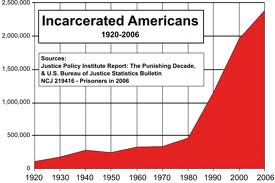
If only the stock market was so reliable as a revenue generator.

Rockefeller Scams the System in Search of Profits

In New York,  Nelson Rockefeller’s heralded anti-drug law, initiated in 1973, provided for a mandatory prison sentences of 15 years to life for possession of four ounces of any illegal drug. Fifteen years to life for possessing four ounces of marijuana? Mr. Rockefeller, what could possibly be the motive for such strict drug laws? Answer, the same motive on why Obama has his money in Vanguard.
Besides Nelson Rockefeller, the privatized prison system has enjoyed having low friends in high places for a very long time beginning with Nancy Reagan’s “Just say no” and her husband’s War on Drugs program. Ironically under Reagan, his CIA traded guns for drugs in the Air America Iran-Contra Affair. Enter former president, George H. W. Bush, and an ex CIA director, and things only got worse. Bush helped fuel the growth of the industry during his presidency. And upon leaving office, he became a player in privatized prisons.
Under Reagan and Bush, Federal drug laws became more draconian.  Presently, Federal law mandates five years’ imprisonment with no hope of parole for possession of five grams of crack or 3.5 ounces of heroin. Further, Federal law provides for 10 years imprisonment  for possession of less than two ounces of crack. A sentence of five years for cocaine powder requires possession of 500 grams. This puts the United States on a par with nations like Turkey with regard to excessive sentences handed out for simply drug possession. There can only be one outcome from this trend curve, more slave labor and a lot more smiling faces on Wall Street.

Go to School and End Up In Prison

prison 666

The above graphic now applies to our children as our kids are increasingly becoming victim to what is called the School to Prison Pipeline.
Every good major leagues baseball team has a successful farm system of minor league teams in smaller towns and cities. This is where the majority of baseball talent develops their skills prior to coming to the parent club. The Prison Industrial Complex is run like a major league baseball team’s farm system in which young talent is developed to replace the aging veterans.

Your child this fall?
Is this going to be your child this school year?
It used to be a given that unless one committed murder, juveniles under the age of 18 did not go to jail or prison. That is no longer the case. The incarceration of our youth is big business. There are almost 75,000 juveniles in prison and the rates are skyrocketing because of a phenomenon that is now being referred to as the school to prison pipeline in which schools are increasingly refusing to deal with even minor discipline issues and are placing juveniles in police custody.
In 2010, there were 5,574 school-based arrests of juveniles in the Chicago Public School. The juvenile arrests accounted for about one of every five juvenile arrests in the entire city of Chicago for all of 2010. The incarceration rates for Chicago’s juveniles are in line with most other metropolitan areas in the country. There is also a general trend of disproportionate rates of minority contact within the juvenile justice system, Black youth accounted for 74% of school-based arrests, and 22.5% of youth arrested were Latino. The enrollment of Chicago schools in was 45% Black and 41% Latino. These high arrest rates for so many of our minority youth, create potential slave laborers for the Prison Industrial Complex. Once a child is adjudicated in the justice system, society usually witnesses a straight line right to prison. These precious children are having their futures robbed from them before they can even get started. What are they being arrested for? The number one reason is for fighting on school grounds.
As a child, I had fights on school grounds, but nobody tried to send me to prison. The number two reason why children end up in the justice system is for possessing small amounts of marijuana.
As a former mental health counselor, I am all too familiar with the devastation brought on by use of drugs. However, marijuana is not one of these drugs. If legalizing marijuana runs against everything you believe in, how about decriminalizing. In other words, we still make the drug illegal but nobody goes to prison for simple possession.
The federal authorities, controlled by the corporations will never allow such a common sense, liberalized approach to drug enforcement. The feds even arrest medical marijuana dispensers and users. Why? Because Wall Street wants prisoners to fill its increasingly privatized and for-profit prison system. This is the major reason why America has 25% of the world’s prison population.
Our minority youth, in the inner cities, are being conditioned by the system that going to prison is part of the life experience. And with extremely high recidivism rates, prison slave labor will never have any shortage of participants.
The Prison Industrial Complex and their lobbyists are responsible for zero tolerance policies, mandatory sentencing and the three strikes life sentencing that is so prominent in many of our states and unless we identify these abuses and stop them, it is only going to get worse.
These events are culminating to establish was has been dubbed as the School to Prison Pipeline. Remember the term, because they are actively recruiting our children for the prison slave labor force.

Conclusion

Since the advent of privatized prisons in 1984, America has witnessed the passage of laws that require minimum sentencing, without regard for any extenuating circumstances. Our prison system is experiencing a much larger percentage of work by prisoners, thus creating profits for Wall Street which in turn motivate the incarceration of more people for longer periods of time. And privatized prison corporate investors make happy campaign contributors. Therefore, you can bet that the proverbial poop rolls down hill to the cops and the push is on to incarcerate more and more. Some argue that is fine, but when one of the fastest growing segments of our prison population are children, we all need to sit up take notice and take action.
Again, this system is very effective and efficient. With only four percent of the world’s population, the United States has over 25% of the world’s prison population. As a people, we are very ingenious as our corporations have learned to make money from virtually any life circumstance. Do your kids have a “get out of jail card”?
Credit to Common Sense

The Illuminati is Fulfilling Bible Prophecy by Doc Marquis

"The Good Times Are Over, The Time For Risk Taking Has Passed"


A January Investment Outlook should normally be filled with recommended “do’s and don’ts,” “picks and pans” and December 31, 2015, forecasts for interest rates and risk assets. I shall do all of that as usual when I travel to New York City for the annual Barron’s Roundtable in a few weeks’ time. That is always an opportunity for me to engage in verbal jousting with Marc Faber, Mario Gabelli and the usual bearish forecast from the Gnome of Zurich, Felix Zulauf. So I’ll leave the specific forecasting for a few weeks’ time and sum it up in a few quick sentences for now: Beware the Ides of March, or the Ides of any month in 2015 for that matter. When the year is done, there will be minus signs in front of returns for many asset classes. The good times are over.
Timing the end of an asset bull market is nearly always an impossible task, and that is one reason why most market observers don’t do it. The other reason is that most investors are optimists by historical experience or simply human nature, and it never serves their business interests to forecast a decline in the price of the product that they sell. Nevertheless, there comes a time when common sense must recognize that the king has no clothes, or at least that he is down to his Fruit of the Loom briefs, when it comes to future expectations for asset returns. 
Now is that time and hopefully the next 12 monthly “Ides” will provide some air cover for me in terms of an inflection point. Manias can outlast any forecaster because they are driven not only by rational inputs, but by irrational human expressions of fear and greed. Knowing when the “crowd” has had enough is an often frustrating task, and it behooves an individual with a reputation at stake to stand clear. As you know, however, moving out of the way has never been my style so I will stake my claim with as much logic as possible and hope to persuade you to lower expectations for future returns over the next 12 months.
My investment template shares a lot in common with, and owes credit to, the similar templates of Martin Barnes of the Bank Credit Analyst and Ray Dalio of Bridgewater Associates. All three of us share a belief in a finance-driven economic cycle which over time moves to excess both on the upside and the downside. For the past few decades, the secular excess has been on the upside with rapid credit growth, lower interest rates and tighter risk spreads dominating the long-term trend. There have been dramatic reversals as with the Lehman Brothers collapse, the Asia/dot-com crisis around the turn of the century, and of course 1987’s one-day crash, but each reversal was met with a new and increasingly innovative monetary policy initiative on the part of the central banks that kept the bull market in asset prices alive.

Consistently looser regulatory policies contributed immensely as well. The Bank Credit Analyst labels this history as the “debt supercycle,” which is as descriptive as it gets. Each downward spike in the economy and its related financial markets was met with additional credit expansion generated by lower interest rates, financial innovation and regulatory easing, or more recently, direct central bank purchasing of assets labeled “Quantitative Easing.” The power of additional and cheaper credit to add to economic growth and financial asset bull markets has been underappreciated by investors since 1981. Even with the recognition of the Minsky Moment in 2008 and his commonsensical reflection that “stability ultimately leads to instability,” investors have continued to assume that monetary (and at times fiscal) policy could contain the long-term business cycle and produce continuing prosperity for investors in a multitude of asset classes both domestically and externally in emerging markets.
There comes a time, however, when zero-based, and in some cases negative yields, fail to generate sufficient economic growth. While such yields almost automatically result in higher bond prices and escalating P/E ratios, their effect on real growth diminishes or in some cases, reverses. Corporate leaders, sensing structural changes in consumer demand, become willing borrowers, but primarily to reduce their own outstanding shares as opposed to investing in the real economy. Demographics, technology, and globalization reversals in turn have promoted a sense of “secular stagnation” as economist and former Treasury Secretary Larry Summers calls it and the “New Normal” as I labeled it as early as 2009. 
The Alice in Wonderland fact of the matter is that at the zero bound for interest rates, expected Returns on Investment (ROI) and Returns on Equity (ROE) are capped at increasingly low levels. The private sector becomes less willing to take a chance with their owners’ money in a real economy that has a lack of aggregate demand as its dominant theme. Making money by borrowing at no cost for investment in the real economy sounds like a no-brainer. But, it comes with increasing risk in an environment of secular stagnation, demand uncertainty, and with the ROI closer to zero itself than an entrepreneur is willing to bear.
And so the miracle of the debt supercycle meets a logical end when yields, asset prices and the increasing amount of credit place an unreasonable burden on the balancing scale of risk and return. Too little return for too much risk. As the real economy of developed and developing nations sputter, so too eventually do financial markets. The timing – as mentioned previously – is never certain but the inevitable outcome is commonsensically sound. 
If real growth in most developed and highly levered economies cannot be normalized with monetary policy at the zero bound, then investors will ultimately seek alternative havens. Not immediately, but at the margin, credit and assets are exchanged for figurative and sometimes literal money in a mattress. As it does, the system delevers, as cash at the core or real assets at the exterior become the more desirable holding. The secular fertilization of credit creation and the wonders of the debt supercycle may cease to work as intended at the zero bound.
Comprehending (or proving) this can be as frustrating as understanding the differences between Newtonian and quantum physics and the possibility that the same object can be in two places at the same time. Central banks with their historical models do not yet comprehend the impotence of credit creation on the real economy at the zero bound. Increasingly, however, it is becoming obvious that as yields move closer and closer to zero, credit increasingly behaves like cash and loses its multiplicative power of monetary expansion for which the fractional reserve system was designed.
Finance – instead of functioning as a building block of the real economy – breaks it down. Investment is discouraged rather than encouraged due to declining ROIs and ROEs. In turn, financial economy asset class structures such as money market funds, banking, insurance, pensions, and even household balance sheets malfunction as the historical returns necessary to justify future liabilities become impossible to attain. Yields for savers become too low to meet liabilities. Both the real and the finance-based economies become threatened with the zero-based, nearly free money available for the taking. It’s as if the rules of finance, like the quantum rules of particles, have reversed or at least negated what we historically believed to be true.
And so that is why – at some future date – at some future Ides of March or May or November 2015, asset returns in many categories may turn negative. What to consider in such a strange new world? High-quality assets with stable cash flows. Those would include Treasury and high-quality corporate bonds, as well as equities of lightly levered corporations with attractive dividends and diversified revenues both operationally and geographically. With moments of liquidity having already been experienced in recent months, 2015 may see a continuing round of musical chairs as riskier asset categories become less and less desirable.
Debt supercycles in the process of reversal are not favorable events for future investment returns. Father Time in 2015 is not the babe with a top hat in our opening cartoon. He is the grumpy old codger looking forward to his almost inevitable “Ides” sometime during the next 12 months. Be cautious and content with low positive returns in 2015. The time for risk taking has passed.
Credit to Zero Hedge

"If Oil Drops To $40 The Geopolitical Consequences Could Be Terrifying"


In a recent interview with FuW, DoubleLine's Jeff Gundlach explained his concerns about the oil market not being "unequivocally good" for everyone...
Question: The crash in the oil market is already causing jitters in the financial markets around the globe. What is your take on that?

Gundlach: Oil is incredibly important right now. If oil falls to around $40 a barrel then I think the yield on ten year treasury note is going to 1%. I hope it does not go to $40 because then something is very, very wrong with the world, not just the economy. The geopolitical consequences could be – to put it bluntly – terrifying.
What would that mean for stocks?
Gundlach is right historically...
Large and rapid rises and falls in the price of crude oil have correlated oddly strongly with major geopolitical and economic crisis across the globe. Whether driven by problems for oil exporters or oil importers, the 'difference this time' is that, thanks to central bank largesse, money flows faster than ever and everything is more tightly coupled with that flow.


So is the 45% YoY drop in oil prices about to 'cause' contagion risk concerns for the world?
*  * *
Of course Gundlach is not alone in this rational concern...
"In its November 14, 2014 Daily Observations ("The Implications of $75 Oil for the US Economy"), the highly respected hedge fund Bridgewater Associates, LP confirmed that lower oil prices will have a negative impact on the economy.

After an initial transitory positive impact on GDP, Bridgewater explains that lower oil investment and production will lead to a drag on real growth of 0.5% of GDP.

The firm noted that over the past few years, oil production and investment have been adding about 0.5% to nominal GDP growth but that if oil
levels out at $75 per barrel, this would shift to something like -0.7% over the next year, creating a material hit to income growth of 1-1.5%."

-- Mike Lewitt, The Credit Strategist

Credit to  Zero Hedge

We're Entering The Matrix in 2015