After three consecutive days of rioting and looting in Ferguson, MO, despite a second night of curfews which was honored by few if any, Missouri's governor said on Monday he would send the National Guard into the violent suburb to "restore calm" after authorities forcibly dispersed yet another crowd overnight. Gov. Jay Nixon signed an executive order deploying the U.S. state militia, saying demonstrators had thrown Molotov cocktails and shot at police as well as a civilian, a description of the night's events diverging widely from some eyewitness accounts.

“Tonight, a day of hope, prayers, and peaceful protests was marred by the violent criminal acts of an organized and growing number of individuals, many from outside the community and state, whose actions are putting the residents and businesses of Ferguson at risk," Nixon said in a statement on his website.

As we reported overnight, around dusk on Sunday, hundreds of protesters in Ferguson including families with young children fled to safety after police wearing gas masks and body armor fired tear gas and smoke canisters to scatter them hours ahead of the curfew.

Reuters cites a protester who said that "The smoke bombs were completely unprovoked," said Anthony Ellis, 45. "It (the protest) was led by kids on bikes. Next you know they're saying, 'Go home, Go home!'" Of course, one could say the gunshots that led to injured people were also unprovoked but that is merely in the realm of the rational, something the Ferguson situation has long gone beyond.

The Missouri Highway Patrol said "aggressors" were trying to infiltrate a law enforcement command post and that armored vehicles were deployed to ensure public safety. "We ordered them back. We ordered them back again. After several attempts, we utilized the smoke to disperse these individuals," said Highway Patrol Corporal Justin Wheetley. State Highway Patrol Captain Ron Johnson told a late night news briefing: "Molotov cocktails were thrown, there were shootings, looting, vandalism and other acts of violence that clearly appear not to have been spontaneous."
He was explaining the police tactics against what he said had to that point been a peaceful demonstration.

"Coordinated acts" by a few in the crowd were "premeditated criminal acts designed ... to provoke a response," Johnson said. "I had no alternative but to elevate the level of our response." He noted most of the protesters were peaceful and blamed the trouble on "a few people bent on violence and destruction."

Johnson said the trouble began after police responded to the shooting of a civilian at 8.25 p.m., which was followed by gunfire directed towards police and Molotov cocktails being thrown. At least one other person was shot, and several were arrested. No police were injured.

One wonders, considering that virtually every provocation in the international arena in 2014 has been premediated and choreographed, usually by the intelligence forces of this superpower or that, whether the same applies to Ferguson, and whether this push to impose an even more active, blanket weaponized police presence in backwater "violent" US towns is all part of a bigger scheme to make already massive government even bigger?
The biggest winner, however, from last night's events: children. Officials said Ferguson schools would be closed on Monday.
Credit to Zero Hedge

DONETSK, August 17 (RIA Novosti) – Fighting between pro-Kiev forces and independence supporters resumed late on Sunday in the city of Yasynuvata, a northern suburb of Donetsk.
Kiev forces are shelling Yasynuvata, still controlled by militia. It's a strategically important city with a rail junction that borders Donetsk to the north.
There is communications failure in the city of Yasynuvata and partial power outage, according to local residents. A lot of buildings are damaged or fired. For example, the shelling destroyed a roof of a kindergarten.
There is no Ukrainian military in the city.
The intense fighting started in Yasynuvata on Saturday. Earlier on Sunday, Ukrainian President Petro Poroshenko said in a tweet that government troops reclaimed the city.
Credit to RIA Novosti
Armoured personnel carriers and support vehicles cross the border, while the 280-truck convoy comes to a halt separately
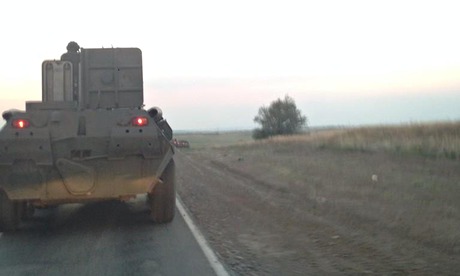
Armoured personnel carriers in Russia move towards the Ukraine border. Photograph: Shaun Walker
The white trucks of humanitarian aid rumbled through Russia in a convoy stretching for miles, moving slowly southwards on the M4 highway, amid a landscape of fertile fields and Ladas stopped at the roadside – their boots overflowing with watermelons for sale.
But, while the trucks came to a halt well short of Ukraine's border, a different Russian convoy did make the crossing into Ukrainian territory late on Thursday evening.
The Guardian saw a column of 23 armoured personnel carriers, supported by fuel trucks and other logistics vehicles with official Russian military plates, travelling towards the border near the Russian town of Donetsk – about 200km away from Donetsk, Ukraine.
After pausing by the side of the road until nightfall, the convoy crossed into Ukrainian territory, using a rough dirt track and clearly crossing through a gap in a barbed wire fence that demarcates the border. Armed men were visible in the gloom by the border fence as the column moved into Ukraine. Kiev has lost control of its side of the border in this area.
The trucks are unlikely to represent a full-scale official Russian invasion, and it was unclear how far they planned to travel inside Ukrainian territory and how long they would stay. But it was incontrovertible evidence of what Ukraine has long claimed – that Russian troops are active inside its borders.
It was also ironic given the attention to the huge convoy of humanitarian aid that moved slowly southwards on the M4 highway on Thursday. As the convoy moved closer to the stretch of border controlled by pro-Russian rebels it was hard to escape the feeling that Moscow's aid convoy had the potential to turn into a slow-motion disaster, perhaps even prompting a moment that could push Ukraine and Russia out of the messy conflict fought by proxies into full-blown, open engagement.
According to Moscow, the convoy is a goodwill gesture, packed with much-needed aid for the residents of eastern Ukraine. In Kiev's view, the convoy is at best a cynical ploy; at worst, a kind of Trojan centipede, winding its way into the country at a border point no longer controlled by Ukrainian forces, the nature of its cargo taken only on trust.
The humanitarian convoy stalled for 24 hours in the city of Voronezh during Wednesday, but set out at dawn on Thursday.
At one point, with President Vladimir Putin more than two hours late to address a gathering of top Russian officials in newly annexed Crimea, and the first lorries in the convoy taking the turnoff from the main M4 highway towards rebel-controlled Luhansk in Ukraine, there were whispers that perhaps Putin's announcement was being delayed to announce that the trucks would enter Ukraine whether or not the country's authorities gave the green light, a move Kiev has said would be seen as an invasion. The aid convoy on the road in Russia. Photograph: Itar-Tass/Corbis
In the end, the convoy ground to a halt shortly after the turnoff, still about 20 miles from the border and, over a period of two hours, the vehicles parked in neat lines, throwing up clouds of dust.
Russia's foreign ministry has said there are 262 vehicles in the convoy, including 200 carrying aid. Some of the drivers put the number at 270. Already, the start of a field camp had been erected on the site, with a dozen large tents and a shower area where the men could wash off the grime and sweat of the long journey.
The trucks could be stacked with weapons, some said. Others claimed they could be carrying advance supplies for a later Russian invasion using the ground troops that have hovered in border areas. There was also a suggestion that the circus around the mysterious convoy could distract attention from other Russian moves, a fear apparently justified given the military column that crossed the borderon Thursday night.
The hundreds of men driving the trucks in the convoy were all dressed in identical khaki T-shirts, shorts and caps, and there was certainly something military about their bearing.
For some observers, the large convoy moving with obvious top-level coordination and accompanied by numerous vehicles with official Russian military plates brought back memories of the "little green men" involved in the annexation of Crimea back in March. Wearing green uniforms without insignia, those men claimed to be local volunteers, although they were clearly highly trained Russian special operatives. Despite denying their presence all through the annexation, Putin later admitted that Russian military units had been involved.
But, with their easy manner, lack of discipline and in some cases physiques that hinted more at beer halls than special forces training grounds, the "little brown men" of the aid convoy are clearly not the highly trained elite troops used in the annexation of Crimea.
In general, the men did not want to speak about who they were or how they had come to be involved in the convoy. One said he was a volunteer from a non-governmental organisation, but clammed up when asked for the name of the organisation.
"I'm being paid to do a job here, not to stand around talking to journalists," he said when pressed, and then looked sheepish when reminded he had just claimed to be an unpaid volunteer.
Others said they were military veterans but claimed not to be serving currently. It is possible the convoy was assembled using the semi-official method Russia has used to find volunteers to fight for rebel separatists in eastern Ukraine – phone calls from military veterans' organisations offering work.
Those at the site were dismissive of fears in Ukraine that the convoy may be carrying secret military cargo. Two of the men in brown, who would not give their names but said they were "in charge of the cargo", offered to open any of the trucks picked at random and show what was inside. Men scrambled to untie the cords securing the tarpaulin on two of the trucks chosen by the Guardian and other journalists at the site.
Inside one were white sacks filled with buckwheat, while the other contained stacked cardboard boxes. Three men pulled the tape from one of the boxes to reveal newly packed sleeping bags. As the tarpaulin was pulled away, the original military green of the trucks was revealed; their exteriors apparently only recently painted white.
Nobody would say how long they planned to be there: a few hours or several days. Neither was it clear whether a decision had been taken in Moscow to move only with approval from the International Committee of the Red Cross, or whether a decision would be made to move ahead regardless, if diplomatic wrangling takes too long.
A lone car with diplomatic plates and Red Cross insignia arrived at the location of the convoy on Thursday afternoon. Two men inside confirmed they were Red Cross officials based in Moscow but refused to give any further information about whether they had travelled with the convoy, what plans there were for inspection, or whether more representatives were on the way. On Thursday evening, the organisation tweeted that "initial contact" with the convoy had been made, and there were "many practical details to be clarified".
Credit to The Guardian

