We will have a mirror site at http://nunezreport.wordpress.com in case we are censored, Please save the link

Monday, April 7, 2014

US Threatens Russia Over Petrodollar-Busting Deal


On the heels of Russia's potential "holy grail" gas deal with China, the news of a Russia-Iran oil "barter" deal, it appears the US is starting to get very concerned about its almighty Petrodollar
  • *U.S. HAS WARNED RUSSIA, IRAN AGAINST POSSIBLE OIL BARTER DEAL
  • *U.S. SAYS ANY SUCH DEAL WOULD TRIGGER SANCTIONS
  • *U.S. HAS CONVEYED CONCERNS TO IRANIAN GOVT THROUGH ALL CHANNELS
We suspect these sanctions would have more teeth than some travel bans, but, as we noted previously, it is just as likely to be another epic geopolitical debacle resulting from what was originally intended to be a demonstration of strength and instead is rapidly turning out into a terminal confirmation of weakness.
As we explained earlier in the week,
Russia seems perfectly happy to telegraph that it is just as willing to use barter (and "heaven forbid" gold) and shortly other "regional" currencies, as it is to use the US Dollar, hardly the intended outcome of the western blocakde, which appears to have just backfired and further impacted the untouchable status of the Petrodollar.

...

"If Washington can't stop this deal, it could serve as a signal to other countries that the United States won't risk major diplomatic disputes at the expense of the sanctions regime,"
The US dollar's position as the base currency for global energy trading gives the US a number of unfair advantages. It seems that Moscow is ready to take those advantages away.

The existence of “petrodollars” is one of the pillars of America's economic might because it creates a significant external demand for American currency, allowing the US to accumulate enormous debts without defaulting. If a Japanese buyer want to buy a barrel of Saudi oil, he has to pay in dollars even if no American oil company ever touches the said barrel. Dollar has held a dominant position in global trading for such a long time that even Gazprom's natural gas contracts for Europe are priced and paid for in US dollars. Until recently, a significant part of EU-China trade had been priced in dollars.

Lately, China has led the BRICS efforts to dislodge the dollar from its position as the main global currency, but the “sanctions war” between Washington and Moscow gave an impetus to the long-awaited scheme to launch the petroruble and switch all Russian energy exports away from the US currency .

The main supporters of this plan are Sergey Glaziev, the economic aide of the Russian President and Igor Sechin, the CEO of Rosneft, the biggest Russian oil company and a close ally of Vladimir Putin. Both have been very vocal in their quest to replace the dollar with the Russian ruble. Now, several top Russian officials are pushing the plan forward.

First, it was the Minister of Economy, Alexei Ulyukaev who told Russia 24 news channel that the Russian energy companies must should ditch the dollar. “ They must be braver in signing contracts in rubles and the currencies of partner-countries, ” he said.

Then, on March 2, Andrei Kostin, the CEO of state-owned VTB bank, told the press that Gazprom, Rosneft and Rosoboronexport, state company specialized in weapon exports, can start trading in rubles. “ I've spoken to Gazprom, to Rosneft and Rosoboronexport management and they don't mind switching their exports to rubles. They only need a mechanism to do that ”, Kostin told the attendees of the annual Russian Bank Association meeting.

Judging by the statement made at the same meeting by Valentina Matviyenko, the speaker of Russia's upper house of parliament, it is safe to assume that no resources will be spared to create such a mechanism. “ Some ‘hot headed' decision-makers have already forgotten that the global economic crisis of 2008 - which is still taking its toll on the world - started with a collapse of certain credit institutions in the US, Great Britain and other countries. This is why we believe that any hostile financial actions are a double-edged sword and even the slightest error will send the boomerang back to the aborigines,” she said.

It seems that Moscow has decided who will be in charge of the “boomerang”. Igor Sechin, the CEO of Rosneft, has been nominated to chair the board of directors of Saint-Petersburg Commodity Exchange, a specialized commodity exchange. In October 2013, speaking at the World Energy Congress in Korea, Sechin called for a "global mechanism to trade natural gas" and went on suggesting that " it was advisable to create an international exchange for the participating countries, where transactions could be registered with the use of regional currencies ". Now, one of the most influential leaders of the global energy trading community has the perfect instrument to make this plan a reality. A Russian commodity exchange where reference prices for Russian oil and natural gas will be set in rubles instead of dollars will be a strong blow to the petrodollar.

Rosneft has recently signed a series of big contracts for oil exports to China and is close to signing a “jumbo deal” with Indian companies. In both deals, there are no US dollars involved. Reuters reports, that Russia is close to entering a goods-for-oil swap transaction with Iran that will give Rosneft around 500,000 barrels of Iranian oil per day to sell in the global market. The White House and the russophobes in the Senate are livid and are trying to block the transaction because it opens up some very serious and nasty scenarios for the petrodollar. If Sechin decides to sell this Iranian oil for rubles, through a Russian exchange, such move will boost the chances of the “petroruble” and will hurt the petrodollar.

It can be said that the US sanctions have opened a Pandora's box of troubles for the American currency. The Russian retaliation will surely be unpleasant for Washington, but what happens if other oil producers and consumers decide to follow the example set by Russia? During the last month, China opened two centers to process yuan-denominated trade flows, one in London and one in Frankfurt. Are the Chinese preparing a similar move against the greenback? We'll soon find out.
Finally, those curious what may happen next, only not to Iran but to Russia, are encouraged to read "From Petrodollar To Petrogold: The US Is Now Trying To Cut Off Iran's Access To Gold."

Credit to Zero Hedge

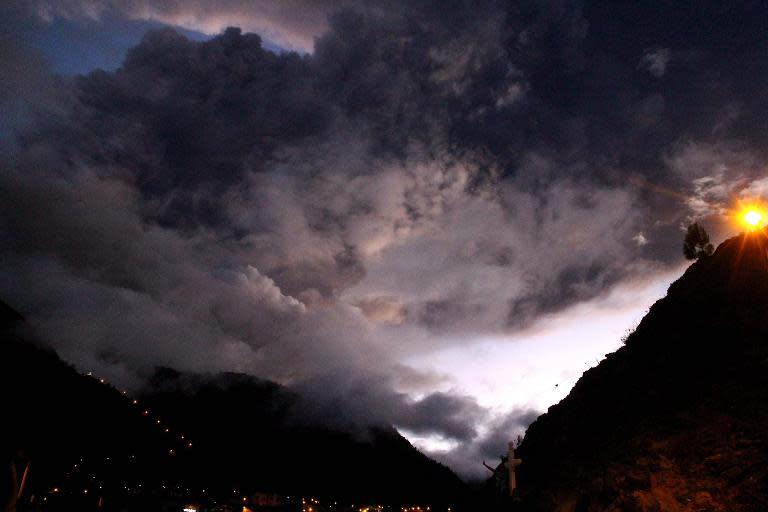
ECUADOR'S TUNGURAHUA VOLCANO EXPLODES SPEWING COLUMNS OF ASH 6 MILES HIGH

Sunday, April 6, 2014

German police beat protesters in Wittenberge

The Complete Interactive Guide To How The NSA Spies On Everything You Do


With all the hoopla about missing airplanes, renewed wars of the cold variety, and rigged markets, it is easy to forget that America is now officially a totalitarian state of the Orwellian kind, where the population has - 
involuntarily - ceded all of its privacy in exchange for... something. Because it certainly isn't security. So we are happy to provide a reminder of just this, especially since as BusinessWeek notes, it gets harder to keep track of all the bizarre ways the National Security Agency has cooked up to spy on people and governments. This may help.
Data in Motion
NSA’s spies divide targets into two broad categories: data in motion and data at rest. Information moving to and from mobile phones, computers, data centers, and satellites is often easier to grab, and the agency sucks up vast amounts worldwide. Yet common data such as e-mail is often protected with encryption once it leaves a device, making it harder—but not impossible—to crack.
Data at Rest
Retrieving information from hard drives, overseas data centers, or cell phones is more difficult, but it’s often more valuable because stored data is less likely to be encrypted, and spies can zero in on exactly what they want. NSA lawyers can compel U.S. companies to hand over some of it; agency hackers target the most coveted and fortified secrets inside computers of foreign governments.
Where the Data Goes
Much of the data the NSA compiles from all these efforts will be stored in its million-square-foot data center near Bluffdale, Utah. It can hold an estimated 12 exabytes of data. An exabyte is the equivalent of 1 billion gigabytes.
And some of the specific methods the NSA uses to spy on US citizens and the occasional offshore "terrorist":
  • Call Recorder - The agency can intercept and store for up to a month 100 percent of a foreign country’s telephone calls, which can be sorted and played back.
  • Clone Phones - Foreign targets’ cell phones can be surreptitiously swapped for an identical model with built-in listening and data collection devices.
  • Fake Shops - Diplomats at the 2009 G-20 summit in London were tricked, with the NSA’s help, into using an Internet cafe that had been rigged to send data to British intelligence.
  • Travel Trackers - The NSA has several ways to follow the movements of intelligence targets as they get off planes, drive across borders, or move around a city, including an implant that directs a cell phone SIM card to send geolocation data via text message.
  • Special Delivery - Spies intercept computers that foreign targets buy online, fit them with devices that send data to the NSA, and box them back up for normal delivery.
  • X-Ray Vision - Radar waves beamed into a room can detect what is being typed on a keyboard or displayed on a computer screen.
  • Credit Cards - The agency tapped into the network of Visa and major banking systems to collect troves of transaction data.
  • Satellites - The NSA infiltrated German satellite communications used in remote locations such as drilling platforms—and by the country’s diplomats.
  • Gamer Spies - Agency employees join World of Warcraft and Second Life communities, hunting for criminal networks and recruiting informants. They’ve also infiltrated Microsoft’s Xbox Live network.
  • Cell Towers - Base stations mimicking cell towers siphon location data from targets’ phones. Agents can also intercept mobile calls with a shoe-box-size receiver.
  • Submarines - The agency can collect worldwide Internet traffic with a modified nuclear submarine that taps undersea fiber-optic cables—allowing spies to vacuum data from millions of users.
  • Secret Selfies - Malware planted in an iPhone can secretly activate its camera and microphone, turning it into a listening device. Malware for Windows mobile phones enables complete remote control of the handset.
  • Fake Rocks - Transmitters hidden inside rocks and other objects can receive information from NSA taps implanted in nearby computers even if they’re “air gapped” machines or networks that aren’t hooked up to the Internet—among the hardest of all digital targets.
The Stasi is spinning in its grave... with jealousy. The full interactive presentation can be found after the jump:
Credit to Zero Hedge

ABN Amro Ex-CEO Found Dead


A mere two weeks since former JPMorgan banker, Kenneth Bellando jumped to his death, Bloomberg reports that the former CEO of Dutch Bank ABN Amro (and his wife and daughter) were found dead at their home after a possible "family tragedy." This expands the dismal list of senior financial services executive deaths to 12 in the last few months. The 57-year-old Jan Peter Schmittmann, was reportedly discovered by his other daughter when she arrived home that morning. Police declined to comment on the cirumstances of his (and his wife and daughter's) death.This is not the first C-level ABN Amro banker to be found dead. In 2009, former CFO Huibert Boumeester was discovered with (assumed self-inflicted) shotgun wounds.

Former ABN Amro Group NV Netherlands Chief Executive Officer Jan Peter Schmittmann, his wife and a daughter were found dead at their home today after a possible “family tragedy,” Dutch police said.

“The bodies of a father and mother and their daughter were found at the property” in the town of Laren, 32 kilometers (20 miles) southeast of Amsterdam, Dutch police said in a statement on their website today. Leonie Bosselaar, a police spokeswoman, said in a telephone call with Bloomberg News that the deceased were Schmittmann and two family members.

The police received a call around 10:30 a.m. local time from a family acquaintance who said something may be wrong at the property, according to the statement. Bosselaar declined to comment further on what may have happened.

The Dutch newspaper AD reported, without citing anyone, that the family was discovered by Schmittmann’s second daughter when she arrived home this morning. She was scheduled to travel to India with her parents, where she had an internship lined up, the newspaper said.

Schmittmann, 57, joined ABN Amro in 1983 as assistant relationship manager and was named head of the lender’s Dutch unit in 2003. He stepped down from the Amsterdam-based bank in December 2008, after the company was nationalized earlier that year.
Sadly, given recent trends, the default assumption is that it is suicide until proven otherwise which is just as disturbing from a sociological perspective. (on the bright side, at least as far as we know, we was not involved in HFT) but further to that, this is not the first ABN Amro seniot executve to be found dead. In 2009, Schmittmann's former CFO was found dead from shitgum wounds:
The former chief financial officer of Dutch bank ABN Amro has been found dead with shotgun wounds near his home in Surrey, the BBC has reported.

Huibert Gerard Boumeester was found dead yesterday, Sunday, with shotgun wounds, one week after being reported missing and “vulnerable”. Reports claim he was found with two shotguns which he had brought from his home, though Thames Valley Police say his death is currently being treated as "unexplained".

Boumeester, 49, left his role as CFO encompassing responsibility for group-wide finance, risk management, investor relations, communications and strategic decision support in March 2008 citing "personal reasons" six months after ABN Amro was bought by Fortis, Royal Bank of Scotland and Santander. The Dutch government now owns Fortis Bank and has taken direct ownership of its stake in ABN Amro. The British government owns most of RBS.

There are suggestions that Boumeester took his own life...
Credit to Zero Hedge

Japan to intercept any North Korea missile deemed a threat


(Reuters) - Japan will strike any North Korean ballistic missile that threatens to hit Japan in the coming weeks after Pyongyang recently fired medium-range missiles, a government source said on Saturday.

Defense Minister Itsunori Onodera issued the order, which took effect on Thursday and runs through April 25, the day that marks the founding of North Korea's army, the source told Reuters on condition of anonymity.

Following the order, meant "to prepare for any additional missile launches," a destroyer was dispatched to the Sea of Japan and will fire if North Korea launches a missile that Tokyo deems in danger of striking or falling on Japanese territory, the source said.

Tensions have been building between North Korea and its neighbors since Pyongyang - in an apparent show of defiance - fired two Rodong missiles on March 26, just as the leaders of Japan, South Korea and the United States were sitting down to discuss containing the North Korean nuclear threat.

That first firing in four years of mid-range missiles that can hit Japan followed a series of short-range rocket launches over the past two months. The Rodong ballistic missiles fell into the sea after flying 650 km (400 miles), short of a maximum range thought to be some 1,300 km, Japan said.

Since then, North Korea has rattled sabres by firing artillery rounds into South Korean waters, prompting the South to fire back; South Korea has test-fired a new ballistic missile with a range of 500 km; and Pyongyang has threatened an unspecified "new form" of nuclear test.

At the same time, Japan and North Korea resumed talks - suspended since Pyongyang test-launched a long-range missile more than a year ago - over the North's nuclear and missile programs, as well as the fate of Japanese abducted in the 1970s and 1980s to help train North Korean spies.

Onodera has avoided publicly announcing the new missile-intercept order so as not to put a chill on those talks, Japanese media said.

He also did not deploy Patriot missile batteries that would be the last line of Defense against incoming warheads, the source told Reuters.

Japanese Aegis destroyers in the Sea of Japan are equipped with advanced radar equipment able to track multiple targets and carry missiles designed to take out targets at the edge of space.

Credit to Reuters

Ecuador's 'throat of fire' belches giant ash column