We will have a mirror site at http://nunezreport.wordpress.com in case we are censored, Please save the link

Friday, February 28, 2014

Gold Study Shows Signs of Decade of Bank Manipulation


The London gold fix, the benchmark used by miners, jewelers and central banks to value the metal, may have been manipulated for a decade by the banks setting it, researchers say.

Unusual trading patterns around 3 p.m. in London, when the so-called afternoon fix is set on a private conference call between five of the biggest gold dealers, are a sign of collusive behavior and should be investigated, New York University’s Stern School of Business Professor Rosa Abrantes-Metzand Albert Metz, a managing director at Moody’s Investors Service, wrote in a draft research paper.

“The structure of the benchmark is certainly conducive to collusion and manipulation, and the empirical data are consistent with price artificiality,” they say in the report, which hasn’t yet been submitted for publication. “It is likely that co-operation between participants may be occurring.”

The Libor Scandal Sets Off a Wave of Probes

The paper is the first to raise the possibility that the five banks overseeing the century-old rate -- Barclays Plc, Deutsche Bank AG, Bank of Nova Scotia, HSBC Holdings Plc and Societe Generale SA -- may have been actively working together to manipulate the benchmark. It also adds to pressure on the firms to overhaul the way the rate is calculated. Authorities around the world, already investigating the manipulation of benchmarks from interest rates to foreign exchange, are examining the $20 trillion gold market for signs of wrongdoing.


Union Jacks

Officials at London Gold Market Fixing Ltd., the company owned by the banks that administer the rate, referred requests for comment to Societe Generale, which holds the rotating chairmanship of the group. Officials at Barclays, Deutsche Bank, HSBC and Societe Generale declined to comment on the report and the future of the benchmark. Joe Konecny, a spokesman for Bank of Nova Scotia, didn’t respond to requests for comment.

Abrantes-Metz advises the European Union and theInternational Organization of Securities Commissions on financial benchmarks. Her 2008 paper “Libor Manipulation?” helped uncover the rigging of the London interbank offered rate, which has led financial firms including Barclays Plc and UBS AG to be fined about $6 billion in total. She is a paid expert witness to lawyers, providing economic analysis for litigation. Metz heads credit policy research at ratings company Moody’s.

The rate-setting ritual dates back to 1919. Dealers in the early years met in a wood-paneled room in Rothschild’s office in the City of London and raised little Union Jacks to indicate interest. Now the fix is calculated twice a day on telephone conferences at 10:30 a.m. and 3 p.m. London time. The calls usually last 10 minutes, though they can run more than an hour.
Unregulated Process

Firms declare how many bars of gold they want to buy or sell at the current spot price, based on orders from clients and themselves. The price is increased or reduced until the buy and sell amounts are within 50 bars, or about 620 kilograms, of each other, at which point the fix is set.

Traders relay shifts in supply and demand to clients during the call and take fresh orders to buy or sell as the price changes, according to the website of London Gold Market Fixing, where the results are published. At 3 p.m. yesterday, the price was $1,332.25 an ounce. The process is unregulated and the five banks can trade gold and its derivatives throughout the call.

Bloomberg News reported in November concerns among traders and economists that the fixing banks and their clients had an unfair advantage because information gleaned from the calls provided an insight into the future direction of prices and banks can bet on spot and derivatives markets during the call.
All Down

Abrantes-Metz and Metz screened intraday trading in the spot gold market from 2001 to 2013 for sudden, unexplained moves that may indicate illegal behavior. From 2004, they observed frequent spikes in spot gold prices during the afternoon call. The moves weren’t replicated during the morning call and hadn’t happened before 2004, they found.

Large price moves during the afternoon call were also overwhelmingly in the same direction: down. On days when the authors identified large price moves during the fix, they were downwards at least two-thirds of the time in six different years between 2004 and 2013. In 2010, large moves during the fix were negative 92 percent of the time, the authors found.

There’s no obvious explanation as to why the patterns began in 2004, why they were more prevalent in the afternoon fixing, and why price moves tended to be downwards, Abrantes-Metz said in a telephone interview this week.

“This is a first attempt to uncover potentially manipulative behavior and the results are concerning,” she said. “It’s down to regulators to establish why there are such striking patterns but banks have the means, motive and opportunity to manipulate the fixing. The results are consistent with the possibility of collusion.”


Credit to Bloomberg

Ukraine accuses Russia of 'armed invasion' after Crimea airports blockaded

Ukraine accused Russia of staging an "armed invasion" of Crimea on Friday as the ex-Soviet state's ousted leader prepared to emerge defiant from five days of hiding after winning protection from Moscow.

Unidentified armed men were patrolling outside of Crimea's main airport early Friday while gunmen were also reported to have seized another airfield on the southwest of the peninsula where ethnic Russians are a majority and where pro-Moscow sentiment runs high.

 
Armed men guard Simferopol airport (DAVID ROSE)

Western governments have been watching with increasing worry as Kiev's new pro-EU rulers grapple with dual threats of economic collapse and cession from Russified southern and eastern regions of the divided nation, which had backed fugitive ex-president Viktor Yanukovych.

Russian President Vladimir Putin this week stoked concerns that Moscow might use its military might to sway the outcome of Ukraine's three-month standoff by ordering snap combat drills near its border involving 150,000 troops and nearly 900 tanks.

Russian military vessels are anchored at a navy base in the Ukrainian Black Sea port of Sevastopol (REUTERS)

Ukraine's interim president Oleksandr Turchynov responded on Thursday by declaring that any movement of Russian troops out of their Black Sea bases in Crimea "will be considered as military aggression".

US Secretary of State John Kerry attempted to relieve diplomatic pressure that has increasingly assumed Cold War overtones by announcing that Russian Foreign Minister Sergei Lavrov had assured him that Moscow "will respect the territorial integrity of Ukraine."

Putin also appeared to take a more conciliatory approach late on Thursday by vowing to work on improving trade ties with Ukraine and promising to support international efforts to provide Kiev with funds that could keep it from declaring a debt default as early as next week.

Yet tensions continued to soar by the hour in the Russian-speaking Crimea - a scenic Black Sea peninsula that has housed Kremlin navies for nearly 250 years and was handed to Ukraine as a symbolic gift by a Soviet leader in 1954.

A hand-painted sign that reads: 'Crimea Russia' lies beside a flag on a barricade outside the Crimea parliament building in Simferopol (GETTY)
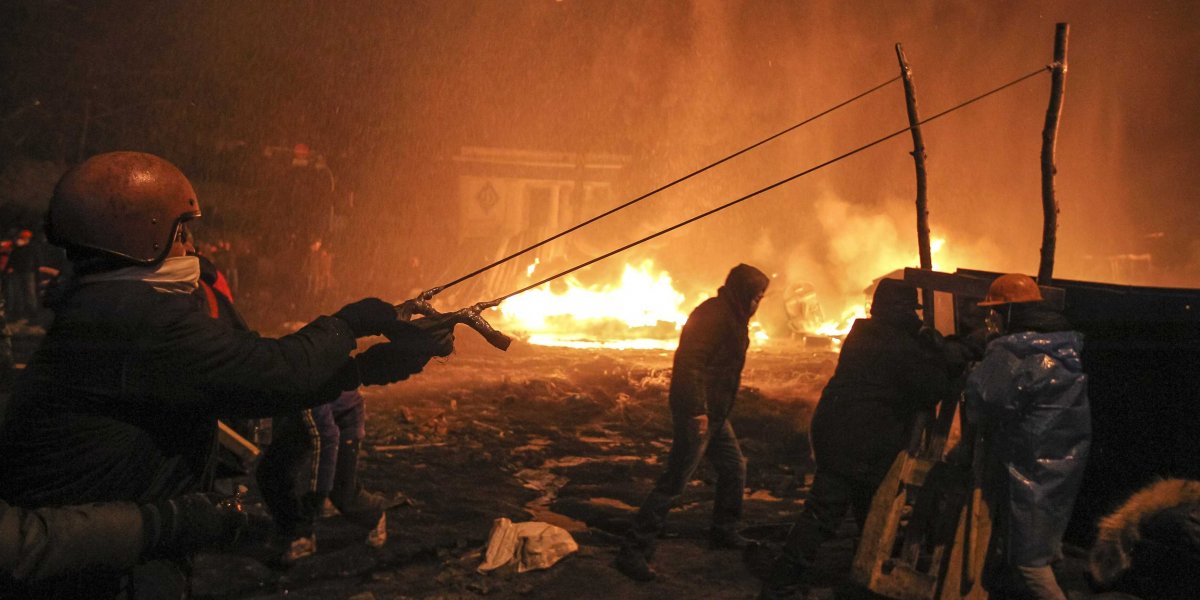
Ukraine's Interior Minister Arsen Avakov accused the Russian armed forces of being directly involved in armed dawn raids on an airport in Crimea's main city of Simferopol as well as an airfield on the southwestern coast.

AFP reporters saw dozens of men armed with Kalashnikovs encircle the Simferopol airport on Friday morning after reports suggested that they had briefly seized control of its runway.

An administrator told AFP the "airport was operating normally" on Friday morning despite the presence of the armed men in battle fatigues.

Several supporters of the apparently pro-Russian gunmen said the armed men arrived after reports that members of the country's new pro-EU government were planning to fly to Simferopol.

Unconfirmed reports by Ukrainian media said armed men had also seized the Belbek airfield near the city of Sevastopol, which is home to Russia's Black Sea fleet.

Avakov accused the Russian armed forces of being behind both incidents.


A soldier at Simferopol (GETTY)

Credit to The Telegraph

China Financial Collapse, Bitcoin Black Eye, Ukraine-Russia War and Bernanke Memoirs

The Road to World War III Runs through Ukraine


ukraine violence
For the immediate moment, forget about all the talk about Russian troops training inside of the United States under  a series of the Federal Emergency Management Agency Bilateral Agreements with the Russian military as now reported in European publications. For the moment, let’s suspend our comparisons of the extreme human rights violations committed by Russian backed sympathizers in Kiev and how the same is going to happen in the United States. When I read some of the accounts of the conflict and turmoil in the Ukraine, I feel like I have walked into the middle of the movie and the necessary background has gone unexplained. What first needs to be considered is the importance of the Ukraine and what it means to the grand chess board as it potentially relates to World War III. There is but one, yet undeniable fact, whoever exercises control over the Ukraine will tip the balance of power in the world, both economically and more importantly, militarily.
Most of the accounts that we are reading are very misleading. These accounts would have us believe that there is an Ukrainian Spring  event which surfaced on, or about, November 30th of last year. This is inaccurate as the struggle for who will bring the Ukraine under their sphere of influence has been brewing for some time.
Up until 2010, the Ukraine was turning pro-Western under the Orangist government of Viktor Yushchenko from 2005-2010. At the beginning of 2010, it almost appeared to be a certainty that the Ukraine would become an associate member of the European Union. However, Putin led Russia to a unprecedented post cold war economic and military revival. Under heavy Russian influence, this trend was reversed when pro-Russian leader, Victor Yanukovych, assumed the reigns of Ukrainian power in 2010. And now, as the world is witnessing, the modern trend of favoring Russia, is not universally embraced in the Ukraine. As a consequence, the Ukraine remains politically and socially divided between pro-Russian and subsequent pro-Western elements. Therefore, the Ukraine also remains an important tool of influence for both sides. The implications of who controls the Ukraine are staggering.
With the Yankuovych government fleeing to the safe haven of Russian in the midst of Ukrainian civil unrest, has brought the importance of the Ukraine to the center stage of the world’s political scene.

Putin Responds to the Ukrainian Western Leanings

Putin has started rattling his Russian saber as Russia is preparing to conduct military maneuvers along the Ukrainian border. The United States views this move as provocative and has warned Russia that these military exercises could “lead to miscalculation”.  This warning occurred  only mere hours after a counter-revolutionary move was conducted by pro-Moscow gunmen seized government offices in the region of Crimea and raised a Russian flag. A destabilized Ukraine is facing a financial disaster and the likelihood of a violent rebellion in the largely pro-Russian east and south.
The Ukraine is teetering on the brink of civil war.

The Importance of the Ukraine to Russia

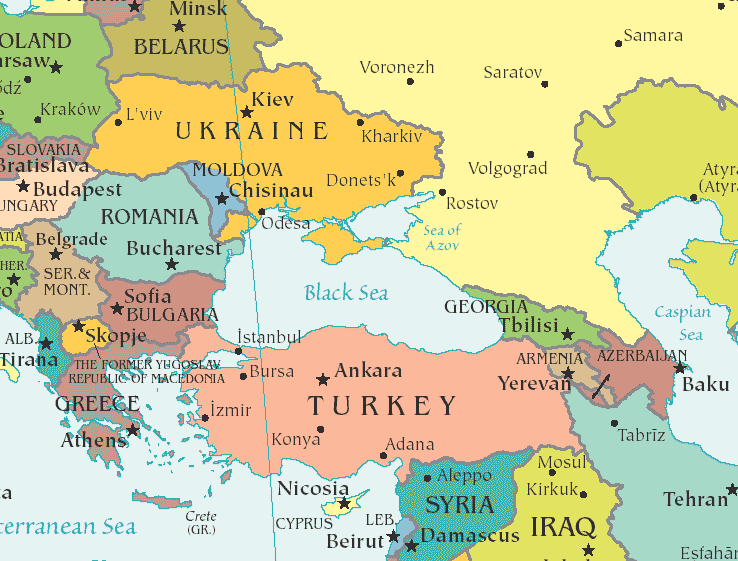
ukraine mapThe population of the Ukraine is 45 million and it has the second most robust economy in the former states of the Soviet Republic.This, alone, make the Ukraine important. However, the Ukraine’s importance extends far beyond these considerations.
In 1979, the Soviets invaded Afghanistan because they were hopeful of establishing a natural gas pipeline through the country and thus, make Russia a player in the energy business. Russia failed in this attempt. Despite losing the war in Afghanistan, the Russians pursued their policy of energy dominance under Putin. Subsequently, Russia has become a major player in the energy business in which Russia supplies much of Europe a healthy portion of its energy needs. Without the Ukraine, Russia becomes a significant purchaser of energy, not a seller. For both Europe and the Russians, the Ukraine is most important for its location, particularly as a transit state for energy. Nearly 25% of the European Union’s natural gas comes from Russia, and 80% of that gas passes through the Ukraine. Wars have been fought for far less important economic reasons.
The Ukrainians also possess a formidable military industrial complex. If the Ukraine were to join the European Union and perhaps even NATO, someday, this would constitute a major national security threat to the Russians as it would make the Cuban Missile Crisis, in reverse, look tame by comparison.
Most importantly, Putin is attempting to establish a Eurasian empire through the resurrection of many of the former Soviet Union States. This move is seen as being of paramount importance because the rise of this imperialistic Eurasian empire will propel the military prowess of the Russians on an equivalent level with the United States. Further, if the Russian/Chinese continue in their efforts to attempt to unseat the dollar as the world’s reserve currency, through the purchase of Iranian oil with gold, Russia must have the military muscle to back up this provocative move. The establishment of an Eurasian empire is of paramount to this strategy. Putin is keenly aware that without the Ukraine, Putin’s dreams of creating an Eurasian empire are dead. However, if Russia were to regain control over the Ukraine with its 45 million people, major resources and access to the Black Sea, Russia would automatically regain the necessary leverage to become a powerful imperial state. In short, the control of the Ukraine is a game changer and the outcome could result in World War III.
There are also other considerations when we contemplate how far Russia will go in terms of retaining control over the Ukraine. For example, the Ukraine is vital to Russia because of  economic industries, like steel and agriculture. The Ukraine is vitally important to Russia for military reasons.  The Ukrainian city of Sevastopol is the headquarters for Russia’s Black Sea Fleet. Any conflict with the West over Syria and Iran will not occur if the Russians do not control the port of Sevastopol. If the Ukraine joins the European Union, and Sevastopol falls into the hands of the West, Syria and Iran will be invaded without hesitation by the Obama administration.
Further, the Ukraine’s strategic location as a borderland between Russia and Europe cannot be overstated. Also, the proximity of the Ukraine to the major food growing region of Russia is critical the survival of the Russian people. Additionally, the economic heartland in the Volga region make the country key to Russia’s geopolitical strength and economic prowess.
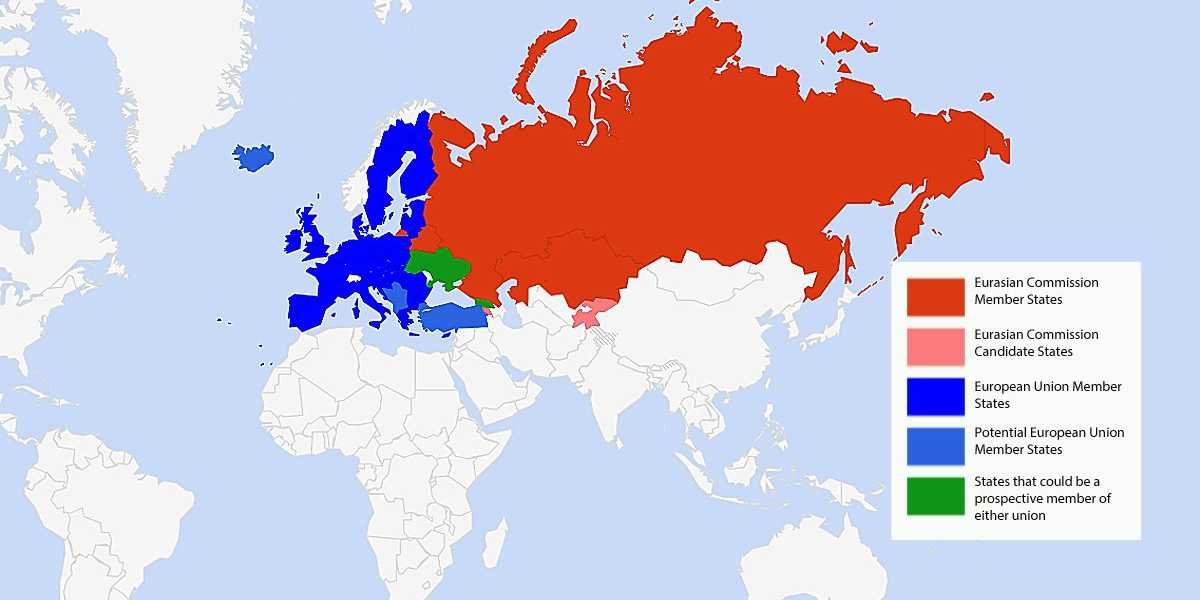
ukraine eu member mapUltimately, for reasons of national survival, Putin cannot, and will not allow the Ukraine to join the European Union. Yet, in five weeks, the European Union commences talk with the Ukraine in which the possibility of  establishing a free trade agreement between the two parties with the intent of moving the Ukraine into the EU.
In professional sports parlance, the Ukraine is a free agent and like a Lebron James, the Ukraine will eventually sign with the highest bidder. Putin will not be outbid as he is visiting the Ukraine, on April 12th, to offer concessions for the transit role that the Ukrainians play with regard to the transport of natural gas.
Meanwhile, the Russian military will bluster by moving its forces to high alert status. However, nothing will occur until the Ukrainian issue is resolved. If the Russians win, their Eurasian empire will challenge the US in Syria and Iran. If the Russians lose complete control of the Ukraine, a third world war could begin as NATO would surely oppose a Russian military incursion. Remember, NATO ally Turkey is right across a small pond and it is amazing what one can learn when one can properly read a map.
Credit to Common Sense

Another “Conspiracy Theory” Proven True


Yes, The Government is Spying on You Through Your Webcam – Another “Conspiracy Theory” Proven True
I still remember how many years ago in response to becoming aware of the possibility that my computer webcam could be accessed remotely I decided to put a piece of duct tape over the camera. I also remember the look on some of my friends’ faces upon seeing this and asking me why. 
They thought I was nuts. It wasn’t even a conversation I was comfortable having since the idea that the government or NSA could or would peep on innocent Americans through their webcams was beyond preposterous for the vast majority of people
This topic is exactly new, and I addressed it last April in my piece:A Look into the Malware the FBI Uses to Spy Through Webcams.
Now, thanks for Edward Snowden, we know more. Much, much more.
From the Guardian:
Britain’s surveillance agency GCHQ, with aid from the US National Security Agency, intercepted and stored the webcam images of millions of internet users not suspected of wrongdoing, secret documents reveal.
GCHQ files dating between 2008 and 2010 explicitly state that a surveillance program codenamed Optic Nerve collected still images of Yahoo webcam chats in bulk and saved them to agency databases, regardless of whether individual users were an intelligence target or not.
In one six-month period in 2008 alone, the agency collected webcam imagery – including substantial quantities of sexually explicit communications – from more than 1.8 million Yahoo user accounts globally.
GCHQ does not have the technical means to make sure no images of UK or US citizens are collected and stored by the system, andthere are no restrictions under UK law to prevent Americans’ images being accessed by British analysts without an individual warrant.
The system, eerily reminiscent of the telescreens evoked in George Orwell’s 1984, was used for experiments in automated facial recognition, to monitor GCHQ’s existing targets, and to discover new targets of interest. Such searches could be used to try to find terror suspects or criminals making use of multiple, anonymous user IDs.
Rather than collecting webcam chats in their entirety, the program saved one image every five minutes from the users’ feeds, partly to comply with human rights legislation, and also to avoid overloading GCHQ’s servers. The documents describe these users as “unselected” – intelligence agency parlance for bulk rather than targeted collection.
While the documents do not detail efforts as widescale as those against Yahoo users, one presentation discusses with interest the potential and capabilities of the Xbox 360?s Kinect camera, saying it generated “fairly normal webcam traffic” and was being evaluated as part of a wider program. 
Interesting that they were considering abusing the Kinect camera, something I wrote about last spring in my post: What’s in Your Xbox? A Lot of Surveillance Capabilities.
Documents previously revealed in the Guardian showed the NSA were exploring the video capabilities of game consoles for surveillance purposes.
Beyond webcams and consoles, GCHQ and the NSA looked at building more detailed and accurate facial recognition tools, such as iris recognition cameras – “think Tom Cruise in Minority Report”, one presentation noted.
Don’t forget: Your Government Loves You. Particularly your nude webcam pics.
Credit to Zero Hedge

"Russia Would Use Nukes to Stave Off Threats" General Nikolai Makarov


Chief of the Russian General Staff Gen. Nikolai Makarov

Russia would use nuclear weapons in response to any imminent threat to its national security, Chief of the Russian General Staff Gen. Nikolai Makarov said on Wednesday.

“We are certainly not planning to fight against the whole of NATO,” Makarov said in an interview with the Ekho Moskvy radio, “but if there is a threat to the integrity of the Russian Federation, we have the right to use nuclear weapons, and we will.”

The general said Russia’s nuclear deterrent is the cornerstone of strategic stability and serious efforts are being taken by the Russian government to modernize the country’s nuclear triad.

The Russian Defense ministry is planning to acquire at least 10 Borey class strategic nuclear submarines, thoroughly modernize its fleet of Tu-160 Blackjack and Tu-95 Bear strategic bombers, and equip its Strategic Missile Forces with formidable Yars mobile ballistic missile systems.

Makarov also stressed the importance of maintaining highly-efficient, mobile conventional forces.

“Unfortunately, we are facing threats from a number of unstable states, where no nuclear weapons but well-trained, strong and mobile Armed Forces are required to resolve any conflict situation," Makarov said.


The Russian government has allocated 22 trillion rubles ($730 billion) on the state arms procurement program until 2020.

Credit to RIA Novosti

NATO Strikes Back At Russia: To make Georgia FULL NATO MEMBER!! Russia warns of war with NATO!!


The U.S. State Department has endorsed granting Georgia its long-coveted status as an aspiring NATO member, the Membership Action Plan, on the heels of Prime Minister Irakli Gharibashvili’shigh-profile trip to Washington. It’s not clear whether this represents a substantive policy shift, but it is the first time in recent memory that the U.S. has explicitly come out in favor of MAP.

In response to a recent letter by 40 members of Congress urging the State Department to “advocate granting MAP to Georgia, the U.S. Assistant Secretary of State of Legislative Affairs Julia Frifield wrote:


We believe Georgia deserves credit at the upcoming NATO Summit for the progress it has made and its demonstrated commitment to NATO operations and standards. We stand ready to support Georgia’s own efforts to build a consensus within the Alliance for granting it a Membership Action Plan.

Now, that isn’t the strongest statement ever, and Secretary of State John Kerry’s remarks with Gharibashvili repeated what has been the standard Washington line that “We stand by the Bucharest decision and all subsequent decisions that Georgia will become a member of NATO,” adding that: “The United States will work to make sure that Georgia’s progress is acknowledged by all members of this year’s NATO Summit.”


(It was the 2008 Bucharest summit, recall, where NATO declined to give Georgia MAP but instead said that Georgia and Ukraine “will become members of NATO.” And we see how that worked out in Ukraine…)

Kerry also announced ”additional assistance” to Georgia: “Today I am announcing additional assistance by the United States to help support Georgia’s European and Euro-Atlantic vision, specifically to help Georgia achieve visa-free travel with the EU and to mitigate the hardships caused by borderization along the occupied territories.” As Civil.ge noted, “details of the ‘additional assistance’ were not immediately available.”

But State Department officials have recently shied away from talking about MAP, and have only discussed it when asked directly by Georgian reporters. Assistant Secretary of State for European and Eurasian Affairs Philip Gordon said in 2012, ahead of the parliamentary elections, that “the members of NATO have been watching very carefully how this plays out and their judgment as to whether the process with NATO should move forward, whether specifically on a MAP or just more generally will very much be affected on the state of democracy, and it’s one of the features of this alliance that democracy is a key criterion.” And Deputy Secretary of State William Burns in 2011: “The issue of MAP, as you well know, is a decision that all the Allies in NATO have to make. We will continue to support Georgia’s aspirations to become a member of NATO, just as we support Georgia’s aspirations to integrate more fully into Euro-Atlantic institutions more generally.”

As Frifield’s letter suggested, the U.S. is only one member of NATO. And it was in favor of MAP in 2008, NATO works on consensus and other Georgia-skeptical NATO members, primarily in Western Europe, scuttled that plan. There’s no indication that those skeptics have changed their mind on MAP for Georgia, so MAP still seems a remote prospect when NATO gets together later this year in Wales. But this nevertheless seems a significant statement from Washington. (The U.S. State Department and the U.S. embassy in Tbliisi did not respond to queries from The Bug Pit.) And it’s all the more reason to believe that something substantial will happen with Georgia and NATO in Wales.

Credit to Breakingdeception