
“Iranian military officials believe that the reason for deploying NATO’s Patriot missiles in Turkey is to prevent Iran from responding to the Zionist regime [of Israel] if it attacked Iran,” Mehmanparast said in Turkish capital city, Ankara, on Saturday.
Despite strong opposition from Russia, Syria and Iran, NATO approved Turkey’s formal request for the missile system on December 4.
On December 22, NATO issued a statement, saying, “Germany will deploy its batteries to Kahramanmaras, the Netherlands will deploy its batteries to Adana, and the United States will deploy its batteries to Gaziantep.”
All the six Patriot batteries, which will be under NATO command and control, are scheduled to be operational near the Turkish-Syria border by the end of January 2013.
“If something happens in the region, Western countries and the NATO will support the Zionist regime and these missiles will be used in favor of this regime,” the Iranian official added.
When asked whether Tehran would use its gas exports to Turkey as a means to exert pressure on Ankara, Mehmanparast said, “Relations between Iran and Turkey are strategic and the two countries have the best political and economic ties.”
The Iranian official stated that Iran and Turkey would never take advantage of the needs of the other country to exert pressure.
Following the imposition of European Union’s recent sanctions against Tehran, Turkish Energy Minister Taner Yildiz said on December 27 that Turkey would continue buying natural gas from Iran.
EU member states announced on October 15 a package of sanctions against Iran, which focuses on Iranian banks, trade and gas exports over allegations that Tehran is pursuing non-civilian objectives in its nuclear energy program.
Iran refutes allegations over its nuclear activities and argues that as a signatory to the Non-Proliferation Treaty and a member of the International Atomic Energy Agency, it is entitled to develop and acquire nuclear technology for peaceful purposes.
Press TV

MOSCOW, December 28 (RIA Novosti) - The Russian authorities will start issuing universal identity and payment cards in 2013 to streamline the payment of pensions and taxes and be used like bank cards in stores.
The universal card, implanted with an electronic chip, will serve as an identification card complete with the holder's picture and digital signature and be used to pay for household utilities, public transportation, prescriptions, or any other social or municipal needs. The cards resemble regular bank cards.
The cards will be issued on request beginning January 2013 and will be issued to all Russian citizens in 2014, except for those who submit a written refusal.
The card will be free of charge for all Russian citizens.
As of December 24, only 57 of 83 Russian regions were more than 50 percent ready to issue the cards. None of the regions were 100 percent ready.
In three-five years the card will be transformed into new-generation ID cards, replacing internal passports for Russians.
The Russian economics ministry earlier estimated the costs of the five-year program to be between 135 and 165 billion rubles ($4.4-$5.4 billion).
RIA Novosti
RR de Acuña & Asociados expects home prices in Madrid, Barcelona and other major cities to fall a further 30pc in a relentless slide until 2018, but it may be even worse in sunbelt regions where 400,000 Britons either live or own homes.
Fresh losses could reach 50pc and drag on for 10 to 15 years in those places where construction ran wild during the bubble, bringing the total decline from peak to trough towards 75pc.
"The market is broken," said Fernando Rodríguez de Acuña, the group's vice-president. "We calculate that there are almost 2m properties waiting to be sold. We have made no progress at all over the past five years in clearing the stock," he said.
"There are 800,000 used homes on the market. Developers are sitting on a further 700,00 completed units. Another 300,000 have been foreclosed and 150,000 are in foreclosure proceedings, and there are another 250,000 still under construction. It's crazy."
The overhang is vast for a country with 48m inhabitants and annual demand near 200,000. It is coupled with an outflow of workers and the start of an aging population crisis.

The government says the housing market has already "touched bottom" after falling 30pc since 2008, even though premier Mariano Rajoy admits that there will no economic recovery until 2014.
The International Monetary Fund forecasts contraction of 1.3pc next year, while Citigroup and Nomura both expect the depression to continue into 2014. The unemployment rate is 26.2pc and rising.
As a member of the eurozone, Spain no longer has the monetary levers to engineer a soft landing for "nominal" house prices. This makes it much harder to break the vicious cycle of debt-deflation. The property sector and the banks are each dragging the other down. The share price of nationalised Bankia fell 14pc on Thursday after the authorities said the lender is worthless, with "negative value " of -€4.2bn (-£3.5bn).
Bankia will need a further €13.5bn of taxpayer funds, taking the total to €18bn. Some 350,000 small investors - many talked into buying Bankia's preferred shares as a form of saving - have lost their money.
Banco de Valencia fell to €0.09 after state rescue fund (FROB) said it would seize 99.9pc of the company before selling it on to CaixaBank, a total wipe-out for shareholders.
El Confidencial reported that bank rescue costs will push the budget deficit to 9pc of GDP for 2012, far above the orginal EU target of 4.5pc, later modified to 6.3pc.
There has been scant improvement since 2009, when the deficit peaked at 11.2pc. The IMF says the deficit is still stuck at 7pc even if bank costs are stripped out.
It warns against austerity overkill, arguing that too much fiscal tightening can be self-defeating in a regional slump without offsetting monetary stimulus. New research by the Fund suggests that Spain's "fiscal multiplier" may be three times higher than originally assumed.
Mr Rodríguez de Acuña said Spain's property crisis varies enormously by region, with the worst damage on the Club Med belt. Even so, recent firesales in the inland city of Toledo have shocked analysts.

Santander recently slashed prices by 60pc to clear a backlog of properties. When Banco Sabadel followed shortly after, it had to offer haircuts of 70pc. Another large bank suspended its Toledo sales two weeks ago after prices went into meltdown.
"We think prices will recover in the traditional coastal areas like the Canaries or Malaga within five to eight years, but for now banks are offering huge discounts and nobody is calling. Marbella has already fallen by 50pc and prices are going down and down," Mr Rodríguez de Acuña said.
"In places like Castellon [near Valencia] where over-development was mad, banks are not financing anything and there is a high probability that these properties will never be sold. They will have to be knocked down," he said.
Spain's bank rescue from the EU bail-out fund (ESM) is bringing the crisis to a head quickly, and brutally. Brussels insists that Madrid crystallise the losses in the portfolios of the rescued banks, ending the "extend and pretend" policy that has concealed the full gravity of the crisis until now.
The big trio of healthy banks - Santander, BBVA, and Caixa - have all rushed to sell their backlog before the state's "bad bank" unloads its holdings. They have already written down 95pc of the value of their land portfolio. "There is little more to lose," said Mr Rodrigues de Acuña.
The Telegraph
Russia warned Thursday Syria would descend into “bloody chaos” if a proposal from Lakhdar Brahimi, the international peace envoy, to set up a transitional government fails.
Mr. Brahimi challenged those in the conflict to work together to pave the way for democratic elections and sideline President Bashar al-Assad.
His proposal received strong backing from Russian Foreign Minister Sergei Lavrov, who said negotiations were the only way to end the fighting.
“The alternative to a peaceful solution is bloody chaos. The longer it continues, the greater its scale — and the worse things get for all,” he said.

SANA / The Associated Press In this photo released by the Syrian official news agency SANA, UN Arab League deputy to Syria, Lakhdar Brahimi, speaks during a press conference in Damascus on Thursday. The international envoy charged with pushing to end Syria's civil war has called for the formation of a transitional government to run the country until new elections can be held.
After five days of negotiations with the regime in Damascus, Mr. Brahimi claimed to have the outline of a power-sharing pact, but his proposals were instantly rejected by the main opposition council.
It has been angered by the suggestion Mr. Assad could stay on as a figurehead despite the deaths of 45,000 people in the fighting. The Christmas mission by Mr. Brahimi and a “softening” of Russia’s support for Mr Assad’s regime has lifted hopes for a diplomatic end to civil war.
Mr. Brahimi said the regime must make previously unthinkable concessions to the leaders of the 21-month uprising.
“Change should not be cosmetic — the Syrian people need and require real change, and everyone understands what that means,” said Mr. Brahimi, the joint United Nations-Arab League envoy.
“We need to form a government with all powers… which assumes power during a period of transition. That transition period will end with elections.”
Speaking before he prepared to fly to Moscow Friday, Mr. Brahimi warned there must not be a “collapse of the state or the state’s institutions” during any power-sharing period.
Yasser Tabbara, a spokesman for the Syria Opposition Coalition, said the terms outlined by the envoy were unacceptable.
We need to find a quick solution
“It has been the position of the coalition that we need to find a quick solution on the issue of Bashar al-Assad stepping down,” he said.
“The priority of the coalition is to preserve lives and finish this with the least casualties. The plans proposed by Lakhdar Brahimi are out of touch with reality. The plan takes us back months and months, if not years.”
Moaz al-Khatib, the coalition leader, flatly dismissed Mr. Brahimi’s proposals in a Facebook posting this week.
Moscow has engaged in a flurry of diplomatic activity to promote power-sharing and its view there will be no military solution to the conflict.
Mr. Lavrov met Thursday with Faisal Mekdad, the Syrian deputy foreign minister and Mr. Assad’s cousin, to press Damascus to co-operate with Mr. Brahimi.
Grassroots rebel supporters believe the Brahimi mission is a distraction at a time when fighters have advanced to the gates of the presidential palace in Damascus.
Alarm over Syria’s disintegration led to crisis talks between Benjamin Netanyahu, Israel’s prime minister, and King Abdullah of Jordan about the fate of Syria’s chemical weapons. Israel fears the weapons could fall into the hands of Islamists fighting Mr. Assad or the Lebanese Shiite group Hezbollah, an Iran ally.
The Daily Telegraph
Today’s AM fix was USD 1,658.75, EUR 1,259.68 and GBP 1,031.37 per ounce.
Yesterday’s AM fix was USD 1,655.25, EUR 1,247.65 and GBP 1,022.96 per ounce.
Silver is trading at $30.16/oz, €22.97/oz and £18.79/oz. Platinum is trading at $1,533.70/oz, palladium at $701.00/oz and rhodium at $1,040/oz.
Gold climbed $4.10 or 0.25% in New York yesterday and closed at $1,664.20/oz. Silver slipped to $29.685 in London, but it rose to a high of $30.466 in New York and finished with a gain of 0.8%.
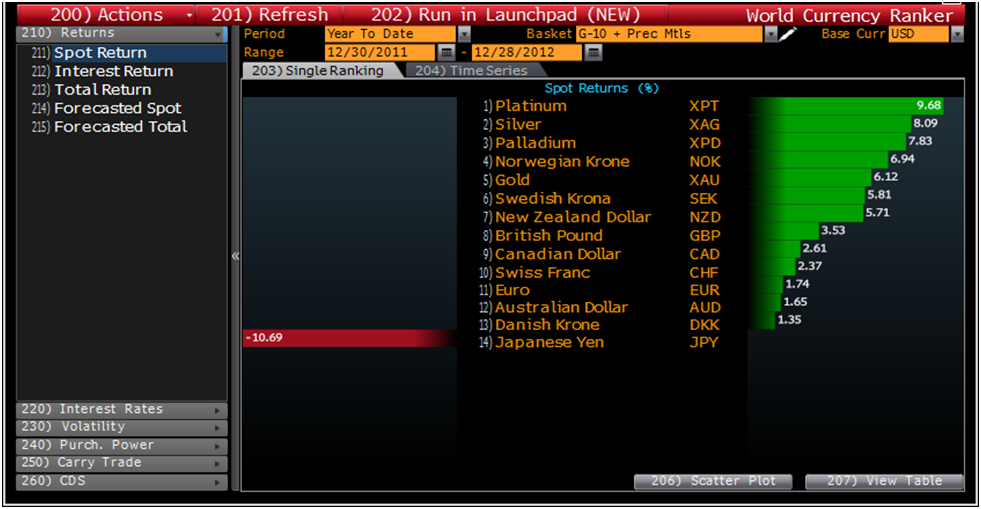
Currency Ranked Returns in US Dollars – (Bloomberg)
Gold pared back early gains and edged down on Friday and tick tock goes the US “fiscal cliff” clock as time is running out for the somewhat irrelevant New Year’s deadline.
Gold bullion prices are on target for their first weekly gain in a month after the sharp fall in December (-3%) led to bargain hunters buying the dip. Gold bottomed on December 29th last year prior to very strong gains in January 2012 and we believe a similar pattern may be seen again this year.
The yellow metal looks set to rack up its 12th straight year of gains on low to zero interest rates, concerns of the eurozone debt crisis and diversification into bullion by central banks.
2013 should see global gold demand grow on further strength from China and a recovery in India, helping the precious metal continue its bull run into its 13th year, according to the World Gold Council.
U.S. CFTC commitment of traders’ data is at 1930 GMT today.
President Obama meets congressional leaders from both parties regarding the fiscal cliff and if a deal isn’t struck it will likely fuel safe haven buying of gold.
Negotiations to avert the ‘fiscal cliff’ offer great political drama, but they won’t solve America’s looming budget and debt crisis and may cast the nation into another recession or worse.
A deal is likely to be done but any deal will be another cynical exercise of kicking the can down the road while failing again to address the root causes of the debt crisis which is too much debt at all levels of American society.

Gold Spot $/oz, 1 Year – (Bloomberg)
The political and media side show that is the so-called “fiscal cliff” will soon be overshadowed by the appalling and rapidly deteriorating situation regarding the U.S. national debt.
Treasury Secretary Timothy Geithner has alerted Congress that the nation will once again hit the debt ceiling on Monday, but that his department can take “extraordinary measures” to keep paying the bills for another few months.
Incredibly, the debt ceiling was raised from $14.294 trillion in August 2011, to its current level of $16.394 trillion. Thus in the span of only sixteen months, the Obama administration has added a whopping $2.1 trillion to the national debt.

Silver Spot $/oz, from Oct. 2011 – (Bloomberg)
The U.S. federal deficit is now exceeding $1 trillion dollars every year —up from $161 billion in 2007, the last year before the financial crisis. Spending is up some $1 trillion, as outlays for Social Security, Medicare, Medicaid and other entitlements have increased by an amount equal to the entire 2013 military budget – a budget which may again surpass the combined military expenditure of every other nation in the world.
U.S. unfunded liabilities are now estimated at between $50 trillion and $100 trillion and by the end of the decade (in less than just 7 years), runaway entitlement spending will require shutting down the military or crippling many other vital domestic spending programs to head off massive deficits that will likely lead to a dollar crisis and significant inflation.
No matter what deal is eventually agreed, whether before or after the new year, it will at best nibble at the edges of the trillion dollar annual deficits that are being piled up.
While all the focus has been on the so called U.S. ‘fiscal cliff’, amnesia has taken hold and many market participants have forgotten about the far from resolved Eurozone debt crisis – not to mention looming debt crisis in the UK and Japan.

Cross Currency Table – (Bloomberg)
In Japan, the national debt is seen topping ¥1 quadrillion by the end of March 2013. A policy of money printing pursued for a decade has failed abysmally and now politicians look set to pursue currency debasement in an even more aggressive manner – with attendant consequences.
The UK is one of the most indebted countries in the industrialised world - the national debt now stands at more than 1 trillion pounds ($1.6 trillion) and total debt to GDP in the UK remains over 500%.
Gold is traditionally sought out as a safe-haven and inflation hedge that investors diversify into in times of trouble. This is because throughout history, those who own physical gold have been protected from financial, economic and monetary crisis.
Also, much recent academic research has shown gold is a proven safe haven asset.
Gold has lately been behaving like any risk asset. However, buyers should continues to focus on the long term as gold ownership will protect people from the fiscal abyss facing major economies and currencies internationally in the coming years.
NEWSWIRE
(Bloomberg) -- Silver ETP Holdings Expand to Record 18,915.75 Metric Tons
Assets in exchange-traded products backed by silver rose to an all-time high of 18,915.75 metric tons yesterday, data tracked by Bloomberg showed.
(Bloomberg) -- Economist Dennis Gartman Says He’s Buying Gold Priced in Yen
Gartman says he bought bullion priced in euros yesterday.
(Bloomberg) -- Gartman Buying Gold Again in Euros and May Add to Purchases
Economist Dennis Gartman is buying one unit of gold in euros today.
A close above 1,265 euros this week “would force us to add to the position,” Gartman said in his daily report today.
(Bloomberg) -- Shanghai Gold Exchange to Raise Margin Requirements for Holidays
The Shanghai Gold Exchange will raise the margin requirement for gold contracts to 13% from 12% starting with the settlement on Dec. 28, according to a statement posted on the bourse’s website today.
The bourse will widen the trading bands for gold contracts to 10% from 9% from Dec. 31, the statement says.
Silver contract margin requirement will be unchanged and the trading bands will be increased to 13% from 12%, it says.
The exchange made the changes to prevent risks during market closure from Jan. 1 to Jan. 3, the statement says.
Zero Hedge

