Saturday, December 8, 2012


Friday, December 7, 2012
Japan issues order to shoot down N Korean rocket
The Japanese government on Friday issued an order to shoot down a North Korean rocket if it threatens the nation’s territory.
Tokyo has readied surface-to-air missiles in and around Tokyo, as well as in Okinawa, and is putting its armed forces on standby ahead of Pyongyang’s planned missile launch.
It is also deploying Aegis warships in neighboring waters.
Defense Minister Satoshi Morimoto has told forces to destroy the projectile or any parts that look set to fall on Japanese territory, Chief Cabinet Secretary Osamu Fujimura told reporters.
The communist North announced last week a Dec 10 to 22 window, its second long-range rocket launch this year after a much-hyped but botched attempt in April.
Pyongyang insists it is a peaceful satellite launch, but the international community sees it as a poorly disguised test of ballistic missile technology, which is banned under United Nations Security Council resolutions.
Washington and Seoul have urged Pyongyang to scrap the launch while Tokyo has postponed talks originally planned this week with North Korea.
Once Pyongyang launches the rocket, “the government will swiftly deliver information” to local authorities, as well as to broadcasters and directly through Twitter and other social media, Fujimura said.
“We would like people to carry on as normal because the missile won’t fall toward Japan if all goes as expected,” he added.
Fujimura said Japan was still hoping that North Korea would abandon its plan.
“North Korea’s rocket launch clearly violates U.N. Security Council resolutions, and also contradicts the UNSC presidential statement issued after the launch in April,” Fujimura said.
“If the launch is forced through, Japan will regard it as extremely deplorable.
“In close cooperation with the United States and South Korea as well as China and Russia, we are making efforts to call on North Korea to refrain from launching,” he said.
U.N. diplomats inside and outside the Security Council have started consultations behind the scenes on what action to take if Pyongyang goes ahead with the launch, Kyodo News reported.
Japan, the United States and South Korea have agreed to demand the UN Security Council boost sanctions on North Korea to levels that match those on Iran, the Asahi Shimbun daily said.
That would include increasing the list of financial institutions, entities and individuals that are subject to asset freezes, it said.
Japan Today
Israel warning to Iran: we’re ready for you


TEL AVIV — Israel is close to completing a missile defence shield that will destroy Iranian ballistic missiles in space or on their launch pads, a development that has sharply increased the odds of an attack on Iran’s nuclear sites.
Israel’s Iron Dome rocket defence system successfully knocked out 421 rockets — an 84-per-cent success rate — in a stunning demonstration of its capabilities during the conflict with Gaza last month.
It is one part of a multi-tiered missile shield being developed by Israeli scientists that will defend the Jewish state from a variety of threats, including the vast stockpile of rockets held by Hezbollah in southern Lebanon and Syria’s armoury of Scuds and SS-21 ballistic missiles.
A second defensive system, Magic Wand (known outside Israel as David’s Sling), was successfully tested in late November and will be fully operational next year. A third tier consists of Arrow-2 and the soon-to-be- introduced Arrow-3 interceptors, which are designed to destroy Iranian long-range ballistic missiles in space before they re-enter the atmosphere.
Israel has deployed three Arrow batteries with a total of 144 interceptors. In addition it has several batteries of American-made Patriot PAC-2 and PAC-3 surface-to-air guided missiles that were last used in 1991 against Saddam Hussein’s Scud missiles.
Iron Dome’s success is reported to have stimulated interest in the system from other countries that face rocket threats from their neighbours, such as South Korea, which has already bought the Arrow’s radar system.
Leaps in technology mean the new systems will be far more effective than those used against Saddam. According to Ben Goodlad, an analyst at IHS Jane’s, “What we’re seeing now is a far higher success rate of interception than in the first Gulf War; it’s a significant step forward.”
The Arrow batteries are capable of dealing with multiple-warhead missiles. Some defence experts believe the ability to protect its civilian population will give Israel a freer hand in dealing with the Iranian threat.
Shashank Joshi, a research fellow at the Royal United Services Institute, says Israel’s new systems represents a “renaissance” in missile defence. “It could give Israel a degree of isolation behind which it could conduct military operations,” he says.
Joshi warns, however, that “Arrow is a different technology from Iron Dome; the nature of what they are trying to intercept is different”.
The three new anti-missile systems nearly failed to get off the ground after Pentagon experts doubted they would work. But since 2010 President Barack Obama has spent $275 million of U.S. funds developing Iron Dome and millions more on Arrow.
Even in Israel there was widespread skepticism that they would prove workable until last month’s demonstration of their effectiveness.
Israel’s early warning system relies on the American X-band radar system deployed at the Nevatim airbase deep in the Negev desert, which can detect an Iranian missile on its launch pad 1,000 miles to the northeast. The X-band system gives Israelis up to 13 minutes’ warning.
“We’ll try to ‘kill’ them at the booster stage — the moment their engines are ignited,” says an Israeli military source.
To launch a pre-emptive attack on Iranian missiles, the Israelis would use giant Eitan drones, which have a wingspan almost as big as a Boeing 737 and can hover for more than 24 hours at a time. The drones are based in Azerbaijan, which has close defence ties with Israel. With a one-ton payload, they are armed with American Hellfire missiles that can hit the Iranian missiles as their engines are fired.
“If that happens, and it isn’t as easy as it sounds,” says a well-informed Israeli source, “then the remaining missiles will be finished off by our Air Defence Command.”
In the event of an Israeli attack, rockets would almost certainly be fired into Israel from Gaza and southern Lebanon.
“We are preparing for a simultaneous attack,” says Brigadier-General Doron Gavish, the former head of Israel’s Air Defence Command. “We’re prepared for attacks on both civil and military targets with enemy missiles.”
The success of the Iron Dome system has led to a new-found confidence among the Israeli public. Last month, Tel Aviv residents raced for the shelters after air raid sirens rang out for the first time in 20 years. Two Fajr-5 rockets were successfully intercepted.
By the time a third rocket was launched and shot down a day later, most people hardly bothered to move from their café tables on the affluent Rothschild Boulevard. Many then went to the anti-missile batteries to take food and drink to the young soldiers, many of them women, who operated the system in the southern outskirts of the city.
“This new-found sense of confidence in Tel Aviv is Bibi Netanyahu’s biggest achievement,” says an acquaintance of the prime minister, Benjamin Netanyahu. “He knows now that when the showdown with Iran comes along, most Israelis will feel a lot more confident.”
Fereydoon Abbasi, the head of Iran’s nuclear programme, announced in late November that Tehran will step up its uranium enrichment program by sharply increasing the number of centrifuges used to make nuclear fuel. Iran insists its programme is peaceful.
Western analysts and most Israelis are convinced that Iran is developing a nuclear weapon. According to one of the architects of the anti-missile shield, “Many commentators in the West say the Iranians are rational and will not launch an atomic bomb on Israel as they will also kill Muslims. But if our enemies are so rational, how come that two weeks ago they fired rockets at Jerusalem, a holy place for Muslims where thousands of their fellow Muslims live?”
Read more: http://www.ottawacitizen.com/news/Israel+iron+shield+warning+Iran+ready/7661100/story.html#ixzz2ENKOnOuD
U.S. commander: N Korean situation 'very dangerous'

The commander of American troops in Japan said Thursday that the situation ahead of North Korea’s planned launch of a long-range rocket this month is “very dangerous.”
Lt Gen Salvatore Angelella said U.S. troops in the country are closely monitoring activity in North Korea as it prepares for the launch. He said the United States sees the launch as a violation of U.N. restrictions in place to keep North Korea from developing its long-range missile capabilities.
“This is a very dangerous situation, and we do not support those actions by North Korea. ... We are monitoring the situation closely,” Angelella, who commands the roughly 50,000 U.S. troops in Japan, said at a news conference in Tokyo.
He said U.S. troops are working closely with the Japanese to protect the country’s citizens and territory. He declined to give details. Two U.S. officials said Wednesday that the Navy had begun moving several ships into the western Pacific.
North Korea has announced it will launch the rocket between Dec 10 and 22. It attempted a similar launch in April, but it failed shortly after liftoff.
Japan Today
Turkey has located 700 Syrian missiles
Turkish Foreign Minister Ahmet Davutoglu told the Turkish daily Sabah in a recent interview that his ministry has located some 700 missiles in Syria and knows who controls them.
The Syrian regime has 700 missiles and their location, storage method and who controls them are no secret to Ankara, Turkish Foreign Minister Ahmet Davutoglu said in a recent interview with the Turkish daily Sabah.
Davutoğlu added that Turkey’s request to NATO for a Patriot missile system on its border with Syria was made as a precaution against any threat that might arise from whatever factions might end up in control of the country.
Davutoğlu said that a psychological line had been crossed in the civil war now engulfing its southern neighbour. In the past, he said, observers were concerned about what Damascus might do to exact revenge on regional neighbours following the unrest.
"But now, everyone thinks of what to do next if the regime falls,” he says.
France 24
What Assets Could U.S. Military Use Against Syrian Chemical Sites?
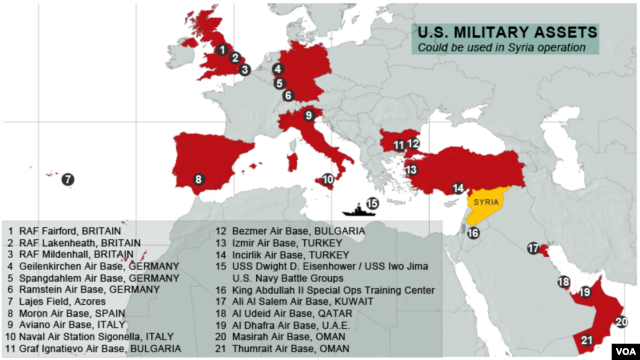
Western security experts say the U.S. military has three principal methods for carrying out a potential operation to secure or destroy Syria's suspected chemical weapons sites.
One option is to airlift U.S. ground forces into Syria with the goal of seizing and securing the sites, which are thought to be concentrated in the cities of Damascus, Hama, Homs and Latakia.
Parachuting troops
GlobalSecurity.org director John Pike said the U.S. 82nd Airborne Division could move a brigade into Syria within 12 hours of being given the task. The division is based in the East Coast state of North Carolina.
The U.S. military also has a small troop presence much closer to Syria.
U.S. media have reported that 150 military specialists were sent to Jordan earlier this year to train Jordanian forces in dealing with a possible Syrian chemical weapons crisis.
The U.S. specialists have been based at the King Abdullah II Special Operations Training Center northeast of Amman. Neither the United States nor Jordan has said whether those troops could be sent into Syria.
Navy strikes
A second option for the U.S. military is to destroy Syrian chemical stockpiles with cruise missiles fired from warships in the Mediterranean.
Two U.S. navy battle groups capable of firing those missiles are on duty in the region.
The USS Iwo Jima amphibious assault group is at sea as part of the U.S. 6th Fleet, whose area of responsibility includes the Mediterranean. Pike said that is where the group spends most of its time.
The USS Eisenhower aircraft carrier group is on duty specifically in the Mediterranean. Pike said the two battle groups likely have about 500 Tomahawk cruise missiles between them.
The USS Eisenhower also has the ability to launch warplanes into Syria. Additional U.S. warplanes could be sent into Syria from a variety of air bases that United States shares with allies in Europe and the Gulf.
Regional air bases
Two of the closest air bases to Syria are in Turkey, one of the strongest regional critics of Syrian President Bashar al-Assad. The Incirlik and Izmir bases would provide the shortest routes to the chemical weapons sites.
Pike said the U.S. Air Force also could fly some of its warplanes from bases in Western Europe to bases in Italy or Bulgaria, before dispatching them on a shorter journey to Syria.
Deploying U.S. fighter jets from air bases in Kuwait, Qatar, the United Arab Emirates and Oman could be trickier.
Gulf states including Saudi Arabia oppose Mr. Assad, but any warplanes heading from their territory toward Syria would need permission to fly over several other Arab nations.
Overflight issues
Pike said Iraq is unlikely to grant that approval because it has refused to take sides in the civil war plaguing its neighbor.
He also said Jordan may be reluctant to authorize overflights for fear of provoking Syrian retaliation with missiles that it cannot defend against.
That leaves Egypt, a major U.S. military aid recipient, as the only other route for U.S. warplanes from the Gulf.
Egyptian President Mohammed Morsi has expressed support for regime change in Syria. But he also has had a complex relationship with the United States.
Washington praised Mr. Morsi’s mediation of a truce between Israel and Hamas last month. It also has expressed concern about the Islamist leader’s handling of a political crisis with Egypt’s liberal opposition.
Would Mr. Morsi allow Washington to use Egyptian airspace for operations in Syria? “He probably would say, 'I’ll think about it,'” Pike said.
VOA
Subscribe to:
Posts (Atom)