
Business activity in the eurozone contracted at its fastest pace in almost three-and-a-half years in October, a survey suggests.
The Markit Flash Eurozone Purchasing Managers' (PMI) Composite Output Index fell to 45.8, from 46.1 in September. A figure below 50 indicates contraction.
The reading is consistent with a quarterly rate of economic contraction in the bloc of 0.5%, Markit said.
Firms also continued to cut employment, but at a slightly slower rate.
The figures represent an initial estimate based on 85% of the normal number of monthly responses, and so are likely to be revised slightly.
Earlier, PMI figures collected by HSBC bank showed that manufacturing activity in China in October slowed at a slower pace than in previous months. The country's PMI hit 49.1, up from 47.9 in September and the highest level in three months.
Separately, a survey by the UK's CBI business group found that manufacturing orders in the three months to October fell in the UK, while output from the sector was flat. The balance between those companies that saw output rise and those that saw it fall hit its lowest level in three years.
However, manufacturers said they expected a modest recovery in output in the next three months.'Clear deterioration'
The rate of decline in the services sector eased in the eurozone, to 46.2 from 46.1 in September, but in manufacturing the rate accelerated, to 45.3 from 46.1.
Despite the easing in services, optimism in the sector deteriorated, suggesting employment would be cut further, Markit said.
Europe's industrial powerhouse, Germany, saw output contract faster, with car exports particularly weak. France, the eurozone's second largest economy, saw a "steep contraction" in overall business activity.
"The eurozone has slid further into decline at the start of the fourth quarter," said Markit's chief economist Chris Williamson.
"Official data have showed surprising resilience over the summer compared to the survey data, but the underlying business climate has clearly deteriorated markedly in recent months.
"While GDP may decline only modestly in the third quarter, a steeper fall looks to be on the cards for the fourth quarter."'Unpleasant surprise'
The eurozone economy contracted by 0.2% between April and June, having recorded no growth in the first quarter.
Many economists expect official figures, released in the middle of November, to show a further contraction between July and September, pushing the bloc back into recession.
"October's decline in the eurozone composite PMI is an unpleasant surprise and reinforces concern that the economic downturn in the region may be deepening and widening," said Martin van Vliet at ING.
Eurozone economies are struggling as governments focus on reducing debt levels following the financial crisis by cutting spending and increasing taxes, measures that are undermining growth.
BBC
Egypt’s President Mohammed Morsi participated in prayers over the weekend in which the preacher urged Allah to “destroy the Jews and their supporters.”
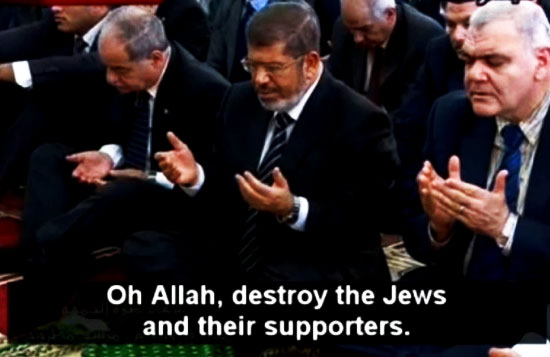
President Mohammed Morsi at prayer on October 19 at el-Taneim Mosque in Matrouh governorate (photo credit: MEMRI screenshot)
In footage of the service from Matrouh governorate’s el-Tenaim Mosque screened on Egyptian state television on Friday, Morsi was shown in fervent prayer as cleric Futouh Abd Al-Nabi Mansour, the local head of religious endowment, declared, “Oh Allah, absolve us of our sins, strengthen us, and grant us victory over the infidels. Oh Allah, destroy the Jews and their supporters. Oh Allah, disperse them, rend them asunder. Oh Allah, demonstrate Your might and greatness upon them. Show us Your omnipotence, oh Lord.”
According to the Anti-Defamation League (ADL), Morsi could be seen mouthing “amen” to these sentiments.
The service was also attended by the region’s governor and local officials. The footage was recorded and transcribed by MEMRI (the Middle East Media Research Institute). A similar translation was published by the ADL.
The ADL’s National Director Abraham Foxman complained Sunday that “The drumbeat of anti-Semitism in the ‘new’ Egypt is growing louder and reverberating further under President Morsiand we are increasingly concerned about the continuing expressions of hatred for Jews and Israel in Egyptian society and President Morsi’s silence in the face of most of these public expressions of hate.” Added Foxman, “The United States and other governments with influence on the Egyptian leadership should publicly urge President Morsi to speak out against this disturbing manifestation of hatred toward Jews.”
Earlier this week, the ADL wrote to Morsi urging him to reject statements made by the supreme authority of the Muslim Brotherhood, Mohammed Badie, who called for violence against Jews and Israel.
Morsi was making his first visit Friday to the coastal area in the country’s northwest since winning the presidency this summer. In a speech he delivered after the prayers, Morsi reportedly spoke of the need for Egyptian unity.
While Morsi was visiting Matrouh, demonstrators in Cairo’s Tahrir Square Friday held a peaceful protest demanding the president, a former leader of the Muslim Brotherhood, ensure the country’s constitution, currently being drafted, represent all factions of society.
Morsi has indicated he intends to maintain Egypt’s 1979 peace treaty with Israel, and his new ambassador to Israel presented his credentials to President Shimon Peres last week. The warm tone of the note Morsi sent to Peres in presenting his ambassador, though it accorded with normal diplomatic protocol, has caused a storm of controversy in Egypt.A Muslim Brotherhood leader initially claimed the letter was a “Zionist fabrication,” but Morsi’s office confirmed its authenticity. source – Times Of Israel
Now the end begins

The Russian Orthodox Church is worried about the persecution of Christians in Syria and other Arab countries where regimes changed rapidly, a top Church official said.
“We are deeply worried by what is going on in Syria, where radical forces are trying to come to power with the help of Western powers,” Metropolitan Hilarion of Volokolamsk, chairman of the Russian Church's Department of External Church Relations, told journalists.
“Where they come to power, Christian communities become the first victims,” he said.
Metropolitan Hilarion on Tuesday spoke at the UN General Assembly’s social and humanitarian affairs committee and met with UN chief Ban Ki-moon.
He also cited Iraq as an example, saying that 1.5 million Christians lived in the country 10 years ago, and adding that the number has significantly decreased since. Many have been killed or forced to escape to other countries, the metropolitan said.
The current number of Christians, a minority in mainly Muslim Iraq, does not exceed 350,000, and it was above 1 million before the Gulf War in 1991, according to human rights watchdog Open Doors USA.
Metropolitan Hilarion said the topic of the persecution of Christians is being hushed up by Western press and is not on the UN or other international organizations’ agenda.
“The talk is not about insufficient tolerance, but about a real full-scale persecution of Christians that embraces different countries and whose victims are tens and hundreds of thousands of Christians,” he said.
Russia, the Russian Church official said, is the key force trying to prevent Syria from the repetition of the Libyan or Iraqi scenarios.
“We should not just speak on the topic, but create a mechanism that would prevent further indulgence toward persecution of Christians,” he said.
The Syrian conflict has claimed tens of thousands of lives, according to various Syrian opposition groups. The UN puts the death toll at 20,000-30,000 people.
The West is pushing for Syrian President Bashar Assad’s ouster while Russia and China are trying to prevent outside interference in Syria, saying that the Assad regime and the opposition are both to blame for the bloodshed. Veto-wielding Moscow and Beijing have three times blocked sanctions resolutions on Syria.
Mainly Muslim Syria has seen violent attacks on Christians since the start of the conflict.
“As the Arab Spring continues to rage throughout Syria, thousands more people have lost their lives in a movement that seeks to strip President Bashar al-Assad’s regime of its power. And as Islamic protesters clash with government forces, Christians have become hopelessly tangled in the crossfire,” Christian Freedom International, a human rights organization, said on its website.
“Although the Syrian church has historically enjoyed peace and religious freedom under the Assad regime, the Arab Spring has destabilized that peace, as Christians are now typically perceived as supporters of the existing government,” it said.
RIA Novosti

At the beginning of the last decade the Europeans – headed by Germany Britain and France – initiated talks with Tehran in an effort to prevent the Ayatollah regime from moving forward with its nuclear program. It was a time when few people around the world knew who Mahmoud Ahmadinejad was and the regime in Tehran was in the hands of reformist mullahs.
The "great success" of this "critical dialogue" with Iran produced a sad joke: During the negotiations, the Europeans and Iranians would criticize the United States, together. The joke may be funny, but the result of this dialogue was not amusing at all.
Meanwhile, the reformist regime in Tehran was replaced by an extremist movement headed by Ahmadinejad, and in the US a Democratic president replaced the "belligerent" George W. Bush.
Under Obama, the US sent Tehran numerous signals indicating that it seeks reconciliation. An American representative even joined the talks between Europe and Iran. But this round of negotiations failed as well.
Everyone remembers Obama's famous "New beginning" speech in Cairo just after he took office. Now, as Obama's first term draws to a close, we are informed that Washington and Tehran may launch direct negotiations.
The American administration has turned itself into a joke. The US will give Iran the time it needs to complete the development of a nuclear bomb, after which it will be able to conduct negotiations from a position of power - and Israeli and American threats of an attack won’t help.
All of the Obama administration's overtures to the Arab and Muslim world have not yielded any results. The American president and his government do not understand the Middle East and are causing irreparable damage.
This failed policy is bolstering the extremists and reduces the chances of a peaceful resolution. We can only hope for a different American administration, one that will terminate this absurd plan before it becomes irreversible.
Ynet News

