Thursday, June 28, 2012


US tests of Interceptor missile off Hawaii coast
The mission off Hawaii late Tuesday was against a medium-range, separating ballistic missile, the Pentagon agency responsible for it said.
The mock warhead split from the target's booster section, presenting what is supposed to be a more realistic attack scenario.
The United States plans to deploy increasingly capable versions of Raytheon's Standard Missile-3 through 2020 to help counter missiles that might some day be capable of delivering chemical, biological or nuclear warheads from Iran or North Korea.
The new model is to be put on land-based launchers in Romania in 2015 as well as on ships. It is a key part of President Barack Obama's plan to guard Nato's European territory from Iran, which is at odds with the US over its nuclear programme.
The Telegraph
Cybercriminals Build Massive Banking Fraud System in the Cloud
Cybercriminals have built a cloud-based fraud system that targeted wealthy people and commercial accounts in bilking primarily European banks of possibly billions of dollars, security vendors say.
The international ring targeted accounts with an average of $300,000 to $600,000, and attempted to transfer as much as $130,000 to bogus business accounts, Intel-owned McAfee said Tuesday. While McAfee did not know how much money was actually stolen, the vendor estimates that it ranged from $75 million to $2.5 billion.
The ring targeted banks in Europe and then expanded to Latin America and more recently the United States, where it had just gotten started, Dave Marcus, director of advanced research and threat intelligence at McAfee Labs, said. McAfee, which investigated the ring's operation over the last six months with Guardian Analytics, is working with law enforcement agencies to shut down the fraudsters.
What is unique about the fraud was the amount of automation used, a feat made possible through the use of cloud computing, Marcus said. The combination of remote servers and an intimate knowledge of banking transaction systems made it possible to automate the theft, rather than simply stealing user names and passwords and having someone manually transfer money from a computer.
"The automated nature of these attacks really require that kind of server/cloud functionality," Marcus said. "It can't all take place on the host [computer]. All of the logic and all of the sophistication really does reside on that [cloud] server."
McAfee first discovered the fraudsters operating in Italy, and later followed them to Germany, the Netherlands and other countries in Europe. In March, the ring was found operating in Colombia and one server was later traced to the United States. "It looks like it [the ring] just started making the transition to the U.S.," Marcus said.
The fraud started with an email cleverly disguised to look like it came from the recipient's bank. Clicking on a link in the message downloaded the malware that would later use web-injects to steal the information needed to perform fund transfers. Web-injects are fake pages or form fields launched while a person is on an online banking site.Ã'Â
McAfee, which dubbed the investigation "Operation High Roller" because of the wealthy victims, found 60 servers processing thousands of attempted thefts. Most of the transfers were for less than $10,000, with the highest reaching $130,000.
The fraudsters used common Zeus and SpyEye malware platforms as the base of the malicious code, which was customized for each targeted bank. Once the malware stole the needed information, transfers were performed via the control servers, which were even able to obtain the information needed to bypass smartcard readers often used in Europe for two-factor authentication. "We have not seen this level of sophistication before," Marcus said.
Besides the use of the cloud, the fraudsters had an impressive knowledge of how banking transaction systems worked. McAfee wasn't able to determine how the criminals gained that level of understanding. "You can't make a fraudulent transaction look like a valid transaction, if you don't know what you're doing," Marcus said. "And these guys know what they're doing."
PCWorld
Russia May Deploy First S-500 Missiles in 2013

Russia's Armed Forces could receive the first of its next-generation S-500 air defense missile systems as early as in 2013, Air Force commander Maj.Gen. Viktor Bondarev said on Wednesday.
"I think that as soon as next year we will get the first of these (S-500) systems in service," Bondarev said at a RIA Novosti press conference dedicated to the 100th anniversary of the Russian Air Force.

S-400 Triumf air missile defense system
The commander stressed that Russia's air defenses are in very good shape with new regiments of a formidable S-400 Triumf air defense system entering service every year.
The crews of air defense systems regularly carry out training drills to improve their efficiency.
“We have improved the response time to airborne threats to 3-4 seconds compared to the previous 9-10 seconds.
Russia currently has four S-400 regiments - two in the Moscow region, one in the Baltic exclave of Kaliningrad, and one in the Eastern Military District.
By 2020, Russia is to have 28 S-400 regiments, each comprised of two battalions, mainly in maritime and border areas.
The S-400 Triumf long- to medium-range surface-to-air missile system can effectively engage any aerial target, including aircraft, unmanned aerial vehicles, and cruise and ballistic missiles at up to 400 kilometers and an altitude of up to 30 kilometers.
RIA Novosti
Why Is The Number Of Wildfires In The United States Increasing?

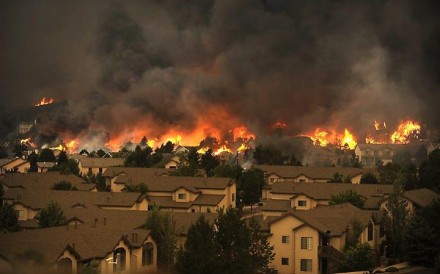
As America watches large sections of Colorado literally burn to the ground, many are wondering why all of this is happening. There have always been wildfires, but what we are experiencing now seems very unusual. So is the number of wildfires in the United States increasing? As you will see later in this article, the answer is yes. 2011 was a record setting year for wildfires and this wildfire season is off to a very frightening start. Right now the eyes of the nation are focused on the Waldo Canyon Fire in Colorado. It doubled in size overnight and it has consumed more than 300 homes so far. It is threatening the city of Colorado Springs, and at this point more than 35,000 people have been forced to evacuate - including the U.S. Air Force Academy. On Twitter and Facebook residents are describing what they are seeing as "the apocalypse" and as "the end of the world". But this is just the beginning of the wildfire season. We haven't even gotten to July and August yet.
The Waldo Canyon fire is rapidly becoming one of the most expensive and destructive wildfires in Colorado history. The historic Flying W Ranch has already been burned totally to the ground by this fire. Local authorities are struggling to find the words to describe how nightmarish this fire is. The following are a couple of quotes from a CNN article....
Richard Brown, the Colorado Springs fire chief, described it as a "firestorm of epic proportions."Gov. John Hickenlooper surveyed the Waldo Canyon Fire, telling reporters it was a difficult sight to see."There were people's homes burned to the ground. It was surreal," he said late Tuesday night. "There's no question, it's serious. It's as serious as it gets."
But this is not the only wildfire that is raging in Colorado. Right now there are 10 wildfires burning in the state. Overall, there are 33 large wildfires currently burning in twelve U.S. states.
If you will remember, New Mexico just experienced one of the worst wildfires that it has ever seen. Conditions throughout most of the western United States are ideal for wildfires right now. As USA Today reports, much of the western half of the country is under a "red flag warning" right now....
Throughout the interior West, firefighters have toiled for days in searing, record-setting heat against fires fueled by prolonged drought. Most, if not all, of Utah, Colorado, Wyoming and Montana were under red flag warnings, meaning extreme fire danger.
But wait, didn't this kind of thing happen last year too?
Yes it did.
In fact, 2011 was one of the worst years ever for wildfires in America. The following is a short excerpt from an EarthSky article....
Thousands of wildfires raged across the United States last year, 2011, burning a record amount of land, especially in the southern U.S. In fact, 2011 the third-most-active fire season since 1960 (when this record-keeping began) with respect to acres burned, according to preliminary data released from the National Interagency Fire Center (NIFC) in late December 2011. The NIFC will be releasing an official summary report detailing the 2011 wildfire season later in 2012, but for now you can read some of the details in the State of the Climate Wildfires 2011 report from NOAA.During 2011, a total of 73,484 wildfires burned an estimated 8,706,852 acres (35,235 square kilometers) of land across the United States. Wildfire activity during 2011 was exceptionally high and was only exceeded in the historical record by wildfire activity during the years 2006 and 2007.
We have seen highly unusual wildfire activity throughout America in recent years. In the article quoted above you can find a chart which shows that wildfire activity in the United States has been far above normal during the past decade.
Wildfire records have only been kept since 1960. The 6 worst years on record for wildfires in the U.S. have all happened since the year 2000. The following is from an Earth Island Journal article that I found....
In the United States, where some of the most accurate wildfire statistics are kept, the six worst fire seasons in the past 50 years have occurred since 2000. In Texas, nearly 4 million acres were burned in 2011, double the previous record. This included the Bastrop Fire last September that destroyed 1,600 homes and became the most destructive fire in Texas history. In Arizona more than one million acres were burned in 2011, a new record. The Wallow Fire, which destroyed nearly a half million acres, was the largest fire in Arizona history. The Pagami Creek Fire in northern Minnesota became the third largest fire in state history when it burned 100,000 acres in September 2011, most of this in an unprecedented 16-mile run on a single day.
So what does all of this mean?
It means that the number of wildfires in the United States is increasing and wildfires are becoming more powerful and doing more damage.
So what is causing all of this?
The truth is that this is happening because we are seeing exceptionally dry conditions throughout the western half of the United States. In fact, according to the U.S. National Academy of Sciences, the U.S. interior west is now the driest that it has been in 500 years.
The eastern half of the country also gets very hot during the summer, but they don't have as many wildfires because they get a lot more rain.
Many areas in the western half of the country have been experiencing drought conditions for quite a few years, and there seems to be no end in sight for the drought.
If you go check out the U.S. drought monitor, you will see that almost the entire southwest United States is experiencing some level of drought right now.
So what will July and August bring?
It is kind of frightening to think about that.
Earlier this year I wrote an article that postulated that we could actually see dust bowl conditions return to the middle of the United States. Many readers were skeptical of that article.
But as much of the western United States continues to experience bone dry conditions and continues to be ravaged by wildfires, perhaps more people will understand how bad things are really getting in the interior west.
Just because we have made great technological advances as a society does not mean that we know how to tame nature. We can attempt to contain the massive wildfires that are popping up all over the place and we can attempt to deal with the drought, but in the end we cannot stop what is happening.
So do you live in any of the areas that are being affected by these wildfires?
Do you have an opinion about why so much of America is on fire?
Please feel free to post a comment with your opinion below....
Economic Collapse
Nervous investors fill Swiss safes with cash, gold
By Catherine Bosley
ZURICH, June 25 (Reuters) - Investors trying to protect their wealth from global economic uncertainty have been stashing bank notes, gold bars and other valuables in Swiss banks, fuelling demand for safe deposit boxes.
The euro zone debt crisis and fear that loose policy by central banks will stoke inflation have sent investors in search of extra security. New deals to prevent secret bank accounts in Switzerland being used for evading taxes may also be contributing to the trend.
Some banks in Switzerland, known for its financial stability, say they have even run out of space.
"We are experiencing a rise in demand for safety deposit boxes. This rise can't really be quantified, however. In many branches the safe deposit boxes are fully rented," said Albert Steck, spokesman at Migros Bank, a cooperative bank which serves retail clients.
Zuercher Kantonalbank (ZKB) said requests for space in safes has climbed this year, as the euro zone debt crisis deepened and the outlook for the global economy worsened.
"Since the start of the year demand for safe deposit boxes has risen in the low single digits," said spokesman Igor Moser.
Baloise, an insurance company, said several bank clients had asked recently to raise the amount of coverage for the contents of safe deposit boxes.
"It's therefore likely that safes at some banks are somewhat fuller than they were a few years ago," said Baloise spokeswoman Jeanine Hoppe.
Another sign anxiety is rising, is that a phenomenon last seen when the financial crisis erupted in 2008 has reappeared: Appetite for Swiss franc bills has grown, according to Swiss National Bank data.
"This development was due largely to high demand for 1,000 franc notes, which points to the fact that the additional demand was primarily for storing money," an SNB spokesman said.
INFLATION HEDGE
With central banks around the world flooding markets with liquidity, some people fear spiraling inflation. The wealthy want assets that keep their value if prices rises.
"So much money has been pumped into the system that people are worried about inflation down the road," said Bruno S. Frey, professor of economics at the University of Zurich. "You counter that by buying real assets of material value."
Gold is one option. An Italian businessman was recently caught trying to smuggle gold bars into Switzerland under his car seat. In further evidence of rising interest in gold, ZKB has seen demand for its gold-backed exchange-traded fund rise over 20 percent since 2009.
Fine art and property are also considered sure bets in troubled times. The Swiss housing market is booming and the price of fine art has been on the up.
"Assets barely earn interest and blue-chip stocks move in one week what they used to move in one year," said Ulrich Koerner, chief operating officer of Swiss flagship bank UBS .
"Against that backdrop, some people say they would rather buy a nice painting instead of a mutual fund."
TAX HAVEN
The interest in real assets and in safe-deposit boxes may also be linked to offshore clients of Swiss banks, looking to find a way to circumvent pending deals with Germany, Austria and Britain that would tax their secret accounts.
Safe deposit boxes are not included in the tax deals, because their contents are not considered bankable assets.
Switzerland says safe deposit boxes cannot be used as a way for lots of people to get out of paying tax.
"It's not a way for people to escape the tax deal on a large scale," said Mario Tuor, spokesman for the Swiss federal office in charge of negotiating the agreements.
If account balances decline by more than 20 percent in the past two years, then the retroactive levy will be assessed based on the balance in late 2010, he said, precisely to prevent people from pulling money from their accounts.
But one private banker in Zurich told Reuters in May he was giving his "smaller" clients with less than $2 million in funds the following advice:
"If you have a small amount of undeclared money, the smartest thing you can do is withdraw it in cash and put it into a safe deposit box," the banker said.
The bilateral tax deals, which are scheduled to come into effect next year, preserve privacy by imposing a one-off levy on undeclared legacy capital, plus a tax on future earnings. Clients who refuse the tax face having their names revealed to foreign tax officials.
There is no official data on how much undeclared wealth is sitting in Switzerland, whose banks hold about $2 trillion in offshore assets. But according to some estimates Germans alone have 200 billion euros in untaxed funds in Switzerland.
Reuters
Subscribe to:
Posts (Atom)