We will have a mirror site at http://nunezreport.wordpress.com in case we are censored, Please save the link

Friday, March 23, 2012

You consent to a search if a camera sees you


When you go outside or go to other public places such as a bank or a mall, have you automatically given up your Fourth Amendment rights and consented to a search? When it comes to tracking you via facial recognition technology, what if the government or other law enforcement were to use that argument, that by simply being in a place where there are security cameras, you waived your Fourth Amendment rights and consented to a search?

The FBI and DOD sponsored a legal series about the U.S. government using facial recognition; the latest forum was titled "Striking the Balance - A Government Approach to Facial Recognition Privacy and Civil Liberties." Whenever the word 'balance' is used, privacy and civil liberties are usually about to be kicked in the name of 'security.' When it comes to surveillance via facial recognition technology, federal law enforcement, intelligence personnel and national security agencies are looking into the "gaps in legal/policy authority that may result in privacy and civil liberties vulnerabilities if left unaddressed."

The Future of Privacy Forum (FPF) Senior Fellow Peter Swire, also a law professor at Ohio State University, spoke about "Facial Recognition by the Government: Privacy and Civil Liberties Issues." Since using "one's facial image, with or without knowledge or consent," can identify and be used to track a person "an inherent tension exists between privacy and facial recognition." The forum was to "examine where the appropriate balance lies between crime and terrorism prevention using facial recognition and robust privacy safeguards." Swire started with two different perspectives about facial recognition


1) It has always been legal to observe people in public, and facial recognition technology is simply making this easier.

2) Facial recognition technology allows an unprecedented ability to surveil and track people, and this information could be stored indefinitely and correlated with other personal information.

Although "observing a person in public has traditionally not required a warrant," Professor Swire pointed out Fourth Amendment rights figure heavily into the constitutional issues impacting facial recognition tracking. Swire said the Supreme Court's GPS tracking decision "may dramatically impact privacy by requiring law enforcement agents to obtain a warrant to conduct surveillance on suspects in public, something law enforcement has never had to do. However, the fourth amendment contains a consent exception; if an individual consents to a search, a warrant is not required. Professor Swire pointed out that some might argue that individuals consent to going outside or to other public places (i.e. a bank or mall) where security cameras are present."

When the U.S. Supreme Court ruled on U.S. vs. Jones GPS tracking, Justice Sotomayor made a strong case for updating our Fourth Amendment laws to protect privacy in this digital age. Sotomayor, in discussing GPS tracking, wrote, "by making available at a relatively low cost such a substantial quantum of intimate information about any person whom the Government, in its unfettered discretion, chooses to track-may 'alter the relationship between citizen and government in a way that is inimical to democratic society'."

Professor Swire referenced Justice Sotomayor's worries "that constant surveillance by the government could chill free speech and free association." Constant biometric surveillance such as facial recognition technology may also "lead to discrimination." Just because something is legal doesnot mean it should be done, he advised the government. How should intelligence agencies "determine whether or not a surveillance program is a good idea?" Swire suggested using the New York Timestest: "if the program was detailed on the front page of the New York Times, would the public reaction be negative or positive?"

Other government agencies who spoke about facial recognition surveillance and privacy included the FBI, OMB, DoD, and DHS. "They are all in the same boat," one government official said. "A big facial recognition privacy mishap by one government agency would tarnish legitimate facial recognition programs in every other agency."

The idea that anyone who goes out in public has, by default, given up all Fourth Amendment privacy protection and "consented" to a search is as ludicrous as suggesting that everyone who has a cell phone has automatically consented to law enforcement accessing cell phone location data without a warrant. The EFF, ACLU, and CDT recently submitted court papers arguing that the government needs to prove probable cause and obtain a warrant before being granted cell site location information.

On a warrantless surveillance side note, the FBI claims the Supreme Court ruling has caused a hardship for the agency. The U.S. v. Jones decision "will inhibit our ability to use this in a number of surveillances where it has been tremendously beneficial," FBI Director Robert Mueller testified before the House Appropriations Committee. "We have a number of people in the United States whom we could not indict, there is not probable cause to indict them or to arrest them who present a threat of terrorism. ... [They] may be up on the Internet, may have purchased a gun, but have taken no particular steps to take a terrorist act."

When the government bemoans the need to heed constitutional rights, no matter the type of tracking, if there is no probable cause for a warrant then that's too boo hoo bad.

Network world

China 'warns' India with border drill


NEW DELHI\BEIJING: China is back to flexing its muscles close to the Indian border. ThePeople's Liberation Army has conducted a major "live fire" exercise, testing its multi-role J-10 fighters armed with laser-guided and other bombs, in the high-altitude Qinghai-Tibet Plateau.

Chinese official media on Thursday described the exercise as "the first operation of its kind" on the 3,500-metre high plateau, which saw the fighter jets being fuelled and loaded with bombs for ground attack missions during sub-zero temperatures.

The rare publicity given to the exercise comes at a time when China is getting ready for a change of guard, including the election of a new president and secretary general of the Communist Party.

It's also meant as a strong signal to India, which has belatedly taken to strategically counter China's massive build-up of military infrastructure all along the 4,057-km Line of Actual Control over the last two decades.

This is, of course, not the first time PLA has undertaken combat exercises in the Tibet Autonomous Region (TAR), having tested its Sukhoi-27UBK and Sukhoi-30MKK fighters as well as rapid reaction forces and airborne corps there over the last two-three years.

But China-watchers in the Indian defence establishment say the latest exercise, with fighters conducting both day and night sorties, seems to be "several rungs higher" than the ones conducted in the past. It comes barely five months after another major PLA exercise, involving air force, tanks and artillery, was held in the region.

"China usually deploys fighters in TAR only during summers from March onwards because of the thin air and tough operating conditions there. But last year for the first time, PLA kept the J-10 jets deployed at Gongar (Lhasa) throughout the winter," said a senior officer.

China, apart from nuclear missile bases in Qinghai province that unmistakably target India, has built five fully operational airbases at Gongar, Pangta, Linchi, Hoping and Gar Gunsa, an extensive rail network and over 58,000-km of roads in TAR.

This makes it possible for PLA to move around 30 divisions (each with over 15,000 soldiers) to the LAC within 30 days to outnumber Indian forces by at least three-is-to-one. The Chengdu military region and the PLA airbases in TAR are mainly tasked for an anti-India role, as earlier reported by TOI.

India, in turn, has based its most potent fighters Sukhoi-30MKIs, which can go deep into China, at Tezpur and Chabua in Assam, apart from planning to deploy six C-130J "Super Hercules" strategic airlift aircraft in the eastern sector.

"We have a slight advantage over China in the sense that its TAR airbases are located at an average height of 10,000 to 12,000-feet. This restricts the weapon loads their Sukhois and J-10s can carry. PLA Air Force, of course, is almost triple our size" said an IAF officer.

India is also now upgrading eastern sector ALGs (advanced landing grounds) like Pasighat, Mechuka, Walong, Tuting, Ziro and Vijaynagar as well as several helipads in Arunachal Pradesh. This comes after the reactivation of western sector ALGs like Daulat Beg Oldi, Fukche and Nyama in eastern Ladakh.

Moreover, Army is now planning a mountain strike corps (70,000 soldiers) after raising two new mountain infantry divisions, with 1,260 officers and 35,011 soldiers, in Assam and Nagaland. There are also plans to base Akash and BrahMos missile regiments in the North-East for conventional deterrence against China.


The Times of India

Ben Bernanke Tries To Convince America That The Federal Reserve Is Good And The Gold Standard Is Bad

Ben Bernanke has decided that he needs to teach all of us why the Federal Reserve is good for America and about why the gold standard is bad.  On Tuesday, Bernanke delivered the first of four planned lectures to a group of students at George Washington University.  But that lecture was not just for the benefit of those students.  Officials at the Fed have long planned for this lecture series to be an opportunity for Bernanke to "educate" the American people about the Federal Reserve.  The classroom was absolutely packed with reporters and just about every major news organization is running a story about this first lecture.  So the Federal Reserve is definitely getting the publicity that it was hoping for.  You can see the slides from the presentation that Bernanke gave to the students right here.  It is pretty obvious that one of the primary goals of this first lecture was to attack those that have been critical of the Fed over the past few years.  In doing so, Bernanke "stretched" the truth on more than one occasion.

The entire event was staged to make Bernanke and the Federal Reserve look as good as possible.  Prior to his arrival, the students gathered for the lecture were actually instructed to applaud Bernanke....
The 30 undergraduates at George Washington University sent up a round of applause. It was, they'd been told beforehand, "appropriate, even encouraged, to politely applaud" Tuesday's guest lecturer.
But as noted above, this lecture was not for the benefit of those students.  AUSA Today article even admitted that "addressing the public directly" was one of the real goals of this lecture....
For Bernanke, the GW lectures serve a dual function:
They give him a chance to reprise the role of professor he played for more than two decades, first at Stanford and then at Princeton, where he eventually chaired the economics department.
And they give him a way to expand his mission of demystifying the Fed. As part of that campaign, Bernanke became the first Fed chief to hold regular news conferences and conduct town-hall meetings.
In addressing the public directly, Bernanke has also sought to neutralize attacks on the Fed, some of them from Republican presidential candidates.
So what did Bernanke actually say during the lecture?
Well, you can read all of the slides right here, but the following are some of the highlights....
On page 6 of the presentation, Bernanke makes the following claim....
"A central bank is not an ordinary commercial bank, but a government agency."
Well, that is quite interesting considering the fact that the Federal Reserve hasargued in court that the Federal Reserve Bank of New York is not an agency of the federal government and that the various Federal Reserve banks around the country are private corporations with private funding.
So did the Federal Reserve lie to the court or is Ben Bernanke lying to us?
And what other "agency" of the federal government is owned by private banks?
It is even admitted that the individual member banks own shares of stock in the various Federal Reserve banks on the Federal Reserve website....
The twelve regional Federal Reserve Banks, which were established by Congress as the operating arms of the nation's central banking system, are organized much like private corporations--possibly leading to some confusion about "ownership." For example, the Reserve Banks issue shares of stock to member banks. However, owning Reserve Bank stock is quite different from owning stock in a private company. The Reserve Banks are not operated for profit, and ownership of a certain amount of stock is, by law, a condition of membership in the System. The stock may not be sold, traded, or pledged as security for a loan; dividends are, by law, 6 percent per year.
The Federal Reserve always talks about how it must be "independent" and "above politics", but when they start getting criticized they always want to seek shelter under the wing of the federal government.
It really is disgusting.
On page 7 of the presentation, the following statement is made....
"All central banks strive for low and stable inflation; most also try to promote stable growth in output and employment."
Well, on both counts the Federal Reserve has failed miserably.
Right now, if inflation was measured the same way that it was back in 1980, the annual rate of inflation would be more than 10 percent.
And when you take a longer view of things, the inflation that the Federal Reserve has manufactured has been absolutely horrific.
Even using the doctored inflation numbers that the Federal Reserve gives us, the U.S. dollar has still lost 83 percent of its value since 1970.
The truth is that inflation is a "hidden tax" that is constantly destroying the value of every single dollar that you and I hold.  Those that attempt to save money for the future or for retirement are deeply penalized under such a system.
As far as employment goes, the total number of workers that are "officially" unemployed in the United States is larger than the entire population of Portugal.
The average duration of unemployment is hovering near an all-time record high and almost every measure of government dependence is at an all-time record high.
So the Federal Reserve is failing at the exact things that Bernanke claims that it is supposed to be doing.
But instead of directly addressing many of the specific criticisms that have been leveled at the Fed, Bernanke instead chose to spend much of his lecture talking about the problems with adopting a gold standard.  The following are statements that were pulled directly off of the slides he used during his speech....
-"The gold standard sets the money supply and price level generally with limited central bank intervention."
-"The strength of a gold standard is its greatest weakness too: Because the money supply is determined by the supply of gold, it cannot be adjusted in response to changing economic conditions."
-"All countries on the gold standard are forced to maintain fixed exchange rates. As a result, the effects of bad policies in one country can be transmitted to other countries if both are on the gold standard."
-"If not perfectly credible, a gold standard is subject to speculative attack and ultimate collapse as people try to exchange paper money for gold."
-"The gold standard did not prevent frequent financial panics."
-"Although the gold standard promoted price stability over the very long run, over the medium run it sometimes caused periods of inflation and deflation."
-"In the second half of the 19th century, a global shortage of gold reduced the U.S. money supply and caused deflation (falling prices). Farmers were squeezed between declining prices for crops and the fixed dollar payments for their mortgages and other debts."
Bernanke spent more time on the gold standard during his speech than on anything else.  At one point during the lecture, Bernanke made the following statement....
"To have a gold standard, you have to go to South Africa or someplace and dig up tons of gold and move  it to New York and put it in the basement of the Federal Reserve Bank of New York and that's a lot of effort and work"
Bernanke even blamed the gold standard for the Great Depression.  On a slide entitled "Monetary Policy in the Great Depression", Bernanke made the following claims....
•The Fed’s tight monetary policy led to sharply falling prices and steep declines in output and employment.
•The effects of policy errors here and abroad were transmitted globally through the gold standard.
•The Fed kept money tight in part because it wanted to preserve the gold standard. When FDR abandoned the gold standard in 1933, monetary policy became less tight and deflation stopped.
Bernanke seems to want to frame the debate over monetary policy is such a way that the American people are given only two alternative systems to consider: the Federal Reserve and a gold standard.
But the truth is that there are a vast array of both "hard money" and "soft money" systems that would not include a central bank or a gold standard at all.
So the truth is that the American people would have many different systems to choose from if they wanted to shut down the Federal Reserve and set up something new.
In the past the U.S. government has issued debt-free money and it could certainly do so again.
But in his lecture, Bernanke did not even mention how the Federal Reserve creates money or how whenever new money is created more debt is created.
Under the Federal Reserve system, the money supply is designed to continually increase, and whenever more money is created more debt is also created.
In a previous article I discussed how more money is created on the federal level....
For example, whenever the U.S. government wants to spend more money than it takes in (which happens constantly), it has to go ask the Federal Reserve for it.  The federal government gives U.S. Treasury bonds to the Federal Reserve, and the Federal Reserve gives the U.S. government "Federal Reserve Notes" in return.  Usually this is just done electronically.
So where does the Federal Reserve get the Federal Reserve Notes?
It just creates them out of thin air.
Wouldn't you like to be able to create money out of thin air?
Instead of issuing money directly, the U.S. government lets the Federal Reserve create it out of thin air and then the U.S. government borrows it.
Talk about stupid.
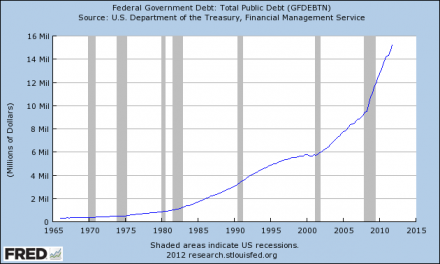
The designers of the Federal Reserve system intended to trap the U.S. government in a debt spiral that would expand perpetually.
So has their design worked?
Well, just look at the chart below....
Today, the U.S. national debt is more than 5000 times larger than it was when the Federal Reserve was first created.
So I guess you could say that the results have been spectacular.
The Federal Reserve system also greatly favors the big Wall Street banks that it is designed to serve.
When those big banks get into trouble, the Federal Reserve snaps into action.
According to a limited GAO audit of Fed transactions during the last financial crisis, $16.1 trillion in secret loans were made by the Federal Reserve to the big Wall Street banks between December 1, 2007 and July 21, 2010.
The following list is taken directly from page 131 of the GAO audit report and it shows which banks received money from the Fed....
Citigroup - $2.513 trillion
Morgan Stanley - $2.041 trillion
Merrill Lynch - $1.949 trillion
Bank of America - $1.344 trillion
Barclays PLC - $868 billion
Bear Sterns - $853 billion
Goldman Sachs - $814 billion
Royal Bank of Scotland - $541 billion
JP Morgan Chase - $391 billion
Deutsche Bank - $354 billion
UBS - $287 billion
Credit Suisse - $262 billion
Lehman Brothers - $183 billion
Bank of Scotland - $181 billion
BNP Paribas - $175 billion
Wells Fargo - $159 billion
Dexia - $159 billion
Wachovia - $142 billion
Dresdner Bank - $135 billion
Societe Generale - $124 billion
"All Other Borrowers" - $2.639 trillion
What about all the rest of us?
Did we get bailed out?
No, we were told that if Wall Street was rescued that the benefits would trickle down to the rest of us.
Unfortunately, that has not exactly worked out.  In article, after article, afterarticle I have detailed the horrible economic suffering that the American people are still going through.
But what Bernanke and the Fed have done is create inflation in commodities such as oil which is affecting the household finances of nearly everyone in America.
The average price of a gallon of gasoline in the United States is now up to $3.87.  That is an all-time record high for the month of March.
So far in 2012, the price of gasoline in the United States has risen by 17 percent.
Thanks Bernanke.
Over the past several decades, every time there has been a major spike in gasoline prices in the United States, a recession has always followed.  If you doubt this, just check out this amazing chart.
So will we soon see another recession?
If we are lucky.  Hopefully the next downturn will not be a full-blown depression.
The truth is that the Federal Reserve does not help us avoid booms and busts.  Rather, it creates them.  The Fed was at the heart of the housing bubble which helped bring on the last financial crisis when it crashed, and the current ultra-low interest rate policies of the Fed are creating more bubbles which will have devastating long-term consequences.
So Bernanke does not have anything to be proud of, and his track record has been absolutely nightmarish.
Hopefully the American people will not believe the propaganda and will take an honest look at the Federal Reserve.
When you take an honest look at the Federal Reserve, there is only one rational conclusion: Congress should shut it down, lock the doors and throw away the key.
Economic Collapse

3 Charts On Why Eurosis Never Really Went Away


Somehow the investing public managed to convince itself that a massive liquidity flood designed to 'help' banks (implicitly buy sovereign debt) with their government reacharounds actually 'fixed' the European economic imbalance problem because yields fell and reflexively this means all-is-well. Just ask Eastman Kodak shareholders how good it felt to rally over 100% the week before bankruptcy? Morgan Stanley has the mother-of-all-chartdecks on the European situation but 3 charts standout in our view by summarising the problems Europe faces.The last few days have seen Eurosis return - but away from the momentum and liquidity - did it ever really go away? This time is no different except LTRO 3 is becoming harder and harder as quality unencumbered collateralizable assets are few and far between - and with the recent weakness in Spain, how long before ECB margin calls start to ramp up?


European bank assets-to-GDP are out of this world!


If ever there were banks that were truly Too-Big-Too-Fail, Europe has them - is it any wonder the Greek Bailout was so focused on rescuing the bank balance sheets. Swiss banks dominate the worst end of the spectrum along with Dutch banks (huge covered bond markets) but the French, Spanish, and Belgian banks are all around two times their nations GDP! Of course this assumes the asset values are 'correctly priced' and not some non-MtM dream and while they are deleveraging (which itself causes aggregate credit supply issues for the real economy and overhangs for the financial economy), LTRO has done nothing but slow the efforts in a false-sense-of-security way. We could add a bonus chart here on European bank reliance of ECB funding - that shows Italy and Spain nearing Portugal's level of aggregate reliance - not exactly a resounding success.


Interest Payments as a % of GDP high and rising fast


Perhaps the cleanest measure of 'stress' or service-ability for the currency-using sovereigns shows that the amount European sovereigns pay in interest relative to their productive gains as an economy is rising rapidly and forecast to rise even faster. This will obviously get worse as the recession deepens from both rising costs (as post-LTRO rate normalize) and lower GDP (as austerity and balance sheet recession impacts come home to roost).


Gross Government Debt to Government Revenue is over 150% on average, rising fast, and at decade highs


The 'leverage' of the Euro-Area has never been higher.Across every nation, we are at over 20 year highs in terms of this measure of leverage. To impact this via the fiscal compact by raising taxes and deleveraging at the aggregate level can only exaggerate the recessionary pressure Europeans will feel.

While yields have indeed dropped, the reflexive response that ergo - Europe is fixed - is simply nonsense as nothing has changed and in fact the concentration and contagion stress is worse than it ever was. This time may be different as this time, the ECB is really in a box to fix the next risk flare without outright money-printing and Zee Germans vill not like sat!

Zero Hedge

For the elite of course...Mario Draghi says worst of euro crisis over

Ok everybody, you may go back to work.....Life is good now, right Mario?!!!!
Mr dragon you are the worst piece of crap I ever seen,  LIAR!!!!


Mario Draghi


European Central Bank President Mario Draghi has said the worst of the eurozone crisis is over.

In an interview with Germany's Bild newspaper, he said the situation in Europe was "stabilising".

Mr Draghi also said that some economic data, including inflation and budget deficits, showed that Europe was doing better than the United States.

But the latest surveys of purchasing managers, released on Thursday, suggest European economies could be flagging.

"The worst is over, but there are still risks. The situation is stabilising," the ECB chief said in his interview with Bild.

Mr Draghi is credited with having deflected a much more serious crisis by lending European banks large sums at very low interest rates.

It may be significant that he chose to speak to Bild, Germany's most popular newspaper. Mr Draghi, an Italian, has been portrayed in Germany as too loose with ECB money, in contrast to the more fiscally austere German way”

Over two rounds, one in December and one in February, the Long Term Refinancing Operation injected more than half a trillion euros of new funds into European banks, a measure Mr Draghi described as "powerful medicine".

"Last autumn, the situation was really critical. It could have come to a dangerous credit crunch for the banks.

"As a result, businesses could have gone bankrupt, because they would have been left high and dry. We had to prevent that."

But he cautioned that eurozone leaders still had work to do.

"Investor confidence is returning and the ECB hasn't had to buy government bonds as a support for weeks. The ball is in the governments' court. They must make the euro zone crisis-proof for the long-term."

BBC

Beijing coup rumors


U.S. intelligence agencies monitoring China’s Internet say that from March 14 to Wednesday bloggers circulated alarming reports of tanks entering Beijing and shots being fired in the city as part of what is said to have been a high-level political battle among party leaders - and even a possible military coup.

The Internet discussions included photos posted online of tanks and other military vehicles moving around Beijing.

The reports followed the ouster last week of senior Politburo member and Chongqing Party Secretary Bo Xilai, who was linked to corruption, but who is said to remain close to China’s increasingly nationalistic military.

Chinese microblogging sites Sina Weibo, QQ Weibo, and the bulletin board of the search engine Baidu all reported “abnormalities” in Beijing on the night of March 19.

The comments included rumors of the downfall of the Shanghai leadership faction and a possible “military coup,” along with reports of gunfire on Beijing’s Changan Street. The reports were quickly removed by Chinese censors shortly after postings and could no longer be accessed by Wednesday.

The unusual postings included reports that military vehicles were sent to control Changan Street, along with plainclothes police officers and metal barriers.

Another posting quoted internal sources as saying senior Communist Party leaders are divided over the ouster of Mr. Bo. The divide was said to pit Prime Minister Wen Jiabao and against party security forces and Minister of Public Security Zhou Yongkang.

Late Wednesday, another alarming indicator came when Beijing authorities ordered all levels of public-security and internal-security forces under Mr. Zhou to conduct nationwide study sessions, althoughMr. Zhou’s name was not on the order - a sign his future may be in doubt.

Additional references on Chinese social media included vague mention of high-level party political struggles and related police activity in Beijing.

One posting referred to a mysterious atmosphere in Beijing and a reported shooting Tuesday night. The posting was quickly censored by authorities.


Washington Times

A look at world's future battleground


Unmanned boats, cars and tanks and small remote-control operated aircraft are just some of the new developments presented at this week's AUVSI conference hosted by Israel's Defense Ministry in Tel Aviv.

They will also be able to take a look at two of the Air Force's star drones: the giant Eitan UAV, which foreign reports claim is able to reach Iran, and "Sky Rider" which recently supported intelligence efforts in the Gaza Strip in the latest round of violence with Hamas.

Foreign aircraft manufacturers from around the world will also be showcasing their developments.

Among the participants will be officials from NASA, General Motors and the US and British militaries. White House representatives will also be presenting the latest developments in robotics, aerospace and unmanned weapons and intelligence systems.

Ynet