
U.S. investors put $1.48 billion into stock mutual funds in the week ended Aug. 17, the first deposits in four months, according to theInvestment Company Institute.
Customers pulled $3.1 billion from U.S. mutual funds that buy bonds, the fourth straight week of withdrawals from fixed income, the Washington-based trade group said today in an e- mailed statement. U.S. stock funds collected $1.13 billion during the week ended Aug. 17.
The equity-fund deposits reversed a streak of withdrawals that accelerated to $30 billion during the previous week, the most since October 2008, ICI data show. Stocks fell in late July and the first three weeks of August amid concerns that the economic recovery is faltering and an unprecedented downgrade of U.S. credit by Standard & Poor’s.
The last previous equity deposits came in the week ended April 20, when $3.05 billion was invested, including $1.92 billion in domestic funds.
The S&P 500 Index, a benchmark for large-company stocks, has lost 14 percent since reaching this year’s high on April 29. The index has advanced 4.8 percent this week, trimming this year’s decline, as traders speculate that policy makers will take further steps to stimulate the economy.
Domestic equity funds experienced $9 billion in redemptions in the first six months of 2011 and may be headed for a record fifth straight year of withdrawals, ICI data show. All stock funds, including those that invest outside the U.S., gathered a net $13.7 billion in deposits in the first half.
Bloomberg
hostgator coupon 2011
 CHINA's military is increasingly focused on naval power and has invested in high-tech weaponry that will extend its reach in the Pacific and beyond, the Pentagon says.
China has ramped up efforts to produce anti-ship missiles that could knock out aircraft carriers, improved targeting radar, expanded its fleet of nuclear-powered submarines and warships and made advances in satellite technology and cyber warfare, the Pentagon wrote in an annual report to Congress.
The weapons buildup comes as the Asian economic giant places a growing priority on securing strategic shipping lanes and mineral-rich areas in the South China Sea.
"The evolution of China's economic and geostrategic interests has fundamentally altered Beijing's view of maritime power," the report said.
While Chinese leaders continue to prepare for a potential conflict with Taiwan, they now see a broader role for the People's Liberation Army, with the navy as a crucial element, it said.
"China's leaders have offered unambiguous guidance that the PLA Navy will play a growing role in protecting China's far-flung interests," the report said.
US commanders worry that China's advances could jeopardize America's longstanding military dominance in the Pacific while US officials have accused Beijing of aggressive tactics against neighboring countries over territorial disputes in the South China Sea.
An expanded Chinese naval presence in the region, including warships, submarines, missiles and possible aircraft carriers, would have "implications for regional rivalries and power dynamics," Michael Schiffer, deputy assistant secretary of secretary of defense, told reporters.
Chinese leaders have insisted its modernization program is aimed solely at "self-defense" and accused US officials of trying to portray the armed forces as a threat.
The report said China had sought to strengthen its nuclear forces by adding more "road-mobile" ballistic missiles and by stressing "camouflage" tactics to ensure the atomic arsenal could better survive a potential attack, the report said.
The Chinese buildup includes a new aircraft carrier that recently held its first sea trial. But the Pentagon played down the carrier's importance, saying the ship was a first step towards a future fleet of carriers expected to be built over 10 years.
The new carrier, a Ukrainian ship modified by the Chinese, "will serve initially as a training and evaluation platform, and eventually offer a limited operational capability," it said.
The aircraft carrier still has no warplanes on board and "it will take a number of additional years for an air group to achieve the sort of minimal level of combat capability," Schiffer said.
With an array of new weapons coming on line, China's military will face a challenge in the coming decade as it tries to train troops in new tactics and revise its approach to "adopt modern operational concepts," he said.
The report also noted an internal debate in China about the role of the military and whether the PLA "should develop to advance China's interests beyond traditional requirements."
The report renewed US warnings that China was extending its military edge over Taiwan, citing better artillery that could strike targets within or even across the Taiwan Strait.
China considers Taiwan, where the mainland's defeated nationalists fled in 1949, to be a province awaiting reunification, by force if necessary.
The dispute over Taiwan, including US arms sales to Taipei, has remained a stumbling block to Washington's attempts at promoting a security dialogue with the Chinese military.
Taiwan, and some US lawmakers, have called for the sale of F-16 fighter jets to help counter the Chinese threat.
The Pentagon report covered 2010 and was delayed for five months, following a high-profile visit to Beijing by the US military's top officer in July.
The document estimated China's overall military-related spending was more than $160 billion in 2010, and that its military budget grew at an average of 12.1 per cent over the past decade - outpacing the country's economic growth at 10.2 per cent over the same period.
Chinese military spending, however, is still far below the US defense budget, the world's largest, which was nearly $700 billion in 2010.
The Australian
hostgator coupon 2011

The bank he ran - Lehman Brothers - had collapsed with $639bn of assets two years earlier, triggering financial mayhem.
This week, hedge funds, investors and internet bloggers started to suspect that Brian Moynihan - Bank of America Merrill Lynch's benighted chief executive - was cut from the same cloth. Moynihan has presided over a near 50pc crash in Bank of America's share price since the start of the year that has wiped $70bn from the bank's value. On Tuesday, the cost to protect its debt from default touched new highs, with credit default swaps surging to 435 basis points (bps). That meant that it would cost $435,000 per year to insure $10m in bonds for five years.
In a month of crazy stock market jitters, investors worried about the size of the bank's mortgage-related liabilities and whether the flailing economy would mean the bank's capital adequacy would pass muster. Moynihan, traders claimed, could not be trusted.
The interest rate payable on the cash bonds that Bank of America issued shot up from 3.75pc to 5.5pc - making it 175bps more expensive for it to do business than its nearest rival Citigroup - putting huge pressure on its profit margins. Former analyst Henry Blodget said the bank risked a capital shortfall of between $100bn to $200bn. Investment bank Jefferies predicted a $50bn rights issue.
Specifically, analysts started to project bigger write-offs for the two mortgage issues. First, the so-called "mortgage put back liability" – claims by institutions like BlackRock about potential fraud in original mortgage agreements that were sold on by the banks. Bank of America put aside $8.5bn for this settlement hoping to draw a line under the exposure. But, with a judge not signing off on this until October, the market worried more might be needed.
hostgator coupon 2011
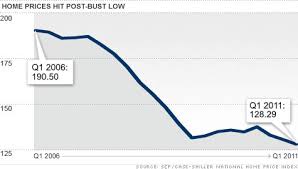
Home prices in the U.S. fell 5.9 percent in the second quarter from a year earlier, the biggest decline since 2009, as foreclosures added to the inventory of properties for sale.
Prices dropped 0.6 percent from the prior three months, the Federal Housing Finance Agency said today in a report from Washington. In June, prices retreated 4.3 percent from a year earlier, while increasing 0.9 percent from the previous month.
Foreclosures are boosting the supply of properties on the market and undercutting the confidence of homebuyers, sapping demand even as mortgage rates tumble to the lowest in more than half a century. The U.S. inventory of homes for sale averaged 3.7 million during the second quarter, the highest since the third quarter of 2010, data from the National Association of Realtors show. The mortgages on 6.5 million U.S. homes had late payments or were in foreclosure in June, according to Lender Processing Services Inc. in Jacksonville, Florida.
“Foreclosures water down home prices because banks want to get rid of properties as fast as they can,” said Patrick Newport, an economist at IHS Global Insight in Lexington, Massachusetts. “The key number driving foreclosures is the unemployment rate, and we saw that worsen in the second quarter.”
The unemployment rate in the three months ended June 30 rose to 9.1 percent from 8.9 percent, the first quarterly increase since 2009, according to the Labor Department.
California, Nevada
Home prices in June fell the most in the region that includes California, slumping 8 percent from a year earlier, the FHFA said. They decreased 7.9 percent in the area that includes Nevada and Arizona.
The month-over-month gain in prices exceeded analysts’ forecast of 0.2 percent, the median of 16 estimates compiled by Bloomberg. The region that includes Wisconsin, Illinois and Ohio had the biggest increase from May, with a 3.3 percent rise.
Mortgage rates for 30-year fixed loans fell to 4.15 percent last week, McLean, Virginia-based Freddie Mac said. The rate probably will average 4.6 percent this year, lower than 2010’s 4.7 percent, according to Fannie Mae in Washington.
Sales of U.S. previously owned homes dropped in July, reflecting an increase in contract cancellations due to strict lending rules and low appraisals, Lawrence Yun, chief economist of the National Association of Realtors, said Aug. 18. Purchases decreased 3.5 percent to a 4.67 million annual rate, the weakest since November.
Today’s FHFA report measures changes in real estate values using repeat data on individual properties with mortgages backed by Fannie Mae or Freddie Mac. It doesn’t include a dollar value for homes. The U.S. median home price was $171,900 in the second quarter, according to NAR.
Bloomberg
hostgator coupon 2011

In a cannon shot across Europe’s bows, he warned that Germany is reaching bailout exhaustion and cannot allow its own democracy to be undermined by EU mayhem.
“I regard the huge buy-up of bonds of individual states by the ECB as legally and politically questionable. Article 123 of the Treaty on the EU’s workings prohibits the ECB from directly purchasing debt instruments, in order to safeguard the central bank’s independence,” he said.
“This prohibition only makes sense if those responsible do not get around it by making substantial purchases on the secondary market,” he said, speaking at a forum of half the world’s Nobel economists on Lake Constance to review the errors of the profession over recent years.
Mr Wulff said the ECB had gone “way beyond the bounds of their mandate” by purchasing €110bn (£96.6bn) of bonds, echoing widespread concerns in Germany that ECB intervention in the Italian and Spanish bond markets this month mark a dangerous escalation.
He did not explain what else the ECB could have done once the bond spreads of these two big economies began to spiral out of control in early August, posing an imminent threat to monetary union and Europe’s financial system.
The blistering attack follows equally harsh words by the Bundesbank in its monthly report. The bank slammed the ECB’s bond purchases and also warned that the EU’s broader bail-out machinery violates EU treaties and lacks “democratic legitimacy”.
The combined attacks come just two weeks before the German constitutional court rules on the legality of the various bailout policies. The verdict is expected on September 7.
The tone of language from two of Germany’s most respected institutions suggests that both markets and Europe’s political establishment have been complacent in assuming that the court would rubberstamp the EU summit deals in Brussels.
Nobel laureate Joe Stiglitz told the forum that the euro is likely to fall apart unless Germany accepts some form of fiscal union. “More austerity for Greece and Spain is not the answer. Medieval blood-letting will kill the patient, and democracies won’t put up with this kind of medicine.”
Mr Stiglitz said Argentina’s 8pc annual growth rate after breaking its dollar peg in 2001 showed that “there is life after default, and life after breaking out of an exchange rate system”.
He warned that Germany is “going to lose a lot of money one way of another” since the exit of southern states will inflict large banking losses. The country might as well opt to shore up EMU and prevent its great dream of European unity “going down the drain”.
Chancellor Angela Merkel has struggled all this week to placate angry critics of her bailout policies within the Christian Democrat (CDU) party. Labour minister Ursula von der Leyen said countries that need rescues should be forced to put up their “gold reserves and industrial assets” as collateral, a sign that rising figures within the CDU are staking out eurosceptic positions as popular fury mounts.
Mrs Merkel insisted that this was “not the way to get things done” in the eurozone. She appears to have enough votes to back the EU summit deal in late July, which gives the bailout fund (EFSF) broader powers to shore up bond markets.
However, the simmering mutiny kills off any chance that Germany will agree to a major boost to the EFSF in coming months, let alone quadruple its firepower from €440bn to €2 trillion or more, the sort of figure deemed necessary by RBS, Citigroup and others to prevent the crisis engulfing Italy and Spain.
Marc Ostwald from Monument Securities said Germany is drifting towards a major constitutional crisis. “This has all the makings of the revolt that unseated Helmut Schmidt [in 1982], and indeed has political echoes of the inefficacy of the Weimar regime,” he said.
Mr Wulff said Germany’s public debt has reached 83pc of GDP and asked who will “rescue the rescuers?” as the dominoes keep falling. “We Germans mustn’t allow an inflated sense of the strength of the rescuers to take hold,” he said.
“Solidarity is the core of the European Idea, but it is a misunderstanding to measure solidarity in terms of willingness to act as guarantor or to incur shared debts. With whom would you be willing to take out a joint loan, or stand as guarantor? For your own children? Hopefully yes. For more distant relations it gets a bit more difficult,” he said.
The carefully-scripted comments are the clearest warning to date that Germany has reached the limits of self-sacrifice for Europe. The assumption that it will always - after much complaining - sign a cheque to keep the project of the road, no longer holds.
Fear that Germany’s torrid recovery from the Great Recession is already sputtering out is likely to harden feelings in Berlin.The IFO institute’s index of German business confidence saw the biggest one-month drop in August since the Lehman crisis in October 2008.
This follows a sharp fall in the ZEW financial index to -37.6, levels that have typically preceded recession in the past. German growth wilted to 0.1pc in the second quarter on falling export demand, though the figures may have been distorted by the stoppage of eight nuclear plants.
Mr Wulff rebuked Chancelor Merkel, saying political leaders should not break their holidays every time there is trouble in the markets. “They have to stop reacting frantically to every fall on the stock markets. They mustn’t allow themselves to be led around the nose by banks, rating agencies or the erratic media,” he said.
“This strikes at the very core of our democracies. Decisions have to be made in parliament in a liberal democracy. That is where legitimacy lies.”
hostgator coupon 2011

Video footage of Tatsuhiko Kodama's impassioned speech before a Diet committee in July went viral online recently, showing the medical expert's shocking revelation that the Fukushima No. 1 nuclear plant spewed some 30 times more radioactive materials than the fallout from the Hiroshima atomic bombing.
Kodama, a professor of systems biology and medicine at the University of Tokyo, used clear-cut terms to get his message across. His ruthless criticism of the government's slow response has been viewed at least 1 million times.
"It means a significantly large amount of radioactive material was released compared with the atomic bomb," he told the Diet committee.
"What has the Diet been doing as 70,000 people are forced to evacuate and wander outside of their homes?"
Despite a hard-nosed image, the expert on radiology and cancer briefly showed a softer side while speaking to The Japan Times about his two grandchildren and their summer in the Tokyo heat.
"A lot of people ask me this, but Tokyo is safe from radiation now," Kodama, who heads the university's Radioisotope Center and the Research Center for Advanced Science and Technology, said Aug. 12.
"My two grandchildren swim outside in the pool, and there is no concern with the safety of food at this point."
But his expression became grave when discussing the 20-km no-go zone in Fukushima, explaining that decontamination of such areas will take not years but decades.
There are places he wouldn't let his grandchildren spend time outdoors freely, even in areas outside of the restricted zone.
"Cesium has been detected from urine and breast milk from those residing in Fukushima Prefecture, and the cause for that is still not specified," he warned.
Kodama said he can't give an estimate of how many people will suffer from cancer symptoms due to exposure to radiation, or how long it will take for signs to surface.
There simply isn't enough epidemiological statistics to do that, he said.
But the government and scientists shouldn't be wasting time playing guessing games, he stressed.
"My theory is this — instead of trying to decide what is safe and what isn't at this point, we should focus on properly measuring the level of contamination in each area and on how to cleanse them."
According to Kodama, the Radioisotope Center estimates that radioactive materials released from Fukushima No. 1 amount to about 29.6 times of that released by the atomic bomb dropped on Hiroshima.
The group also found out that radiation from Fukushima will only decrease by one-tenth per year, which is about 100 times slower than radiation from the bomb.
The most difficult problem for the scientists trying to cope with the situation is that the Fukushima crisis is unprecedented.
"There are a lot of unknown (factors) regarding how this level of radiation will affect children and pregnant women," Kodama said, pointing out that the 1986 Chernobyl accident suggests the government should be on alert for any signs of bladder and thyroid cancer.
But apart from the aftermath of the Chernobyl incident, not many statistics are available to predict what may transpire, he said.
Still, that doesn't justify the government's slow response to Fukushima, he added.
For starters, the Diet has been extremely inept in updating laws on controlling radiation contamination.
While the Radiation Damage Prevention Law was created for handling small amounts of highly radioactive materials, specifically to handle accidents on site at nuclear plants, the Tohoku region is experiencing radioactive contamination in a radius beyond 200 km.
The situation calls for a completely different approach, yet the Diet has failed to update the prevention law.
That alone has been a major hindrance for scientists trying to diminish the damage in Fukushima, including Kodama, who pays visits to the prefecture every weekend to conduct decontamination efforts with his peers.
Another sign of a lax government can be seen in how local governments appear to be short of equipment to measure radiation contamination in food and other produce.
Considering that contamination will be a major problem for the next couple of decades, the central government shouldn't hesitate to invest in and develop, even mass-produce, equipment that can allow checks for radiation.
Some companies have told Kodama it would only take three months to develop a system for efficient radiation measurement.
Kodama advised the government to take two different approaches in decontaminating Fukushima.
The first step should focus on creating a rough map of the wider area and the level of contamination, possibly using remote-control helicopters and Japan's advanced GPS system.
For emergency decontamination procedures, each community should have a call-in center that conducts quick cleanups once a request is made from residents.
Kodama said the government has spent approximately ¥800 billion to decontaminate land after a mass cadmium poisoning broke out in Toyama Prefecture in 1912.
Contamination from radiation in the current crisis has spread to about 1,000 times that area, and the final cleanup cost is expected to be astronomical.
But both time and money should not be considered an issue, because it is the responsibility of this generation not to pass on the contaminated land to the next, Kodama said.
"I am aware that there are many opinions regarding nuclear power. However, I believe all of us can agree that Fukushima and the surrounding area needs to be decontaminated as soon as possible," he said.

Insurance on the debt of several major European banks has now hit historic levels, higher even than those recorded during financial crisis caused by the US financial group's implosion nearly three years ago.
Credit default swaps on the bonds of Royal Bank of Scotland, BNP Paribas, Deutsche Bank and Intesa Sanpaolo, among others, flashed warning signals on Wednesday. Credit default swaps (CDS) on RBS were trading at 343.54 basis points, meaning the annual cost to insure £10m of the state-backed lender's bonds against default is now £343,540.
The cost of insuring RBS bonds is now higher than before the taxpayer was forced to step in and rescue the bank in October 2008, and shows the recent dramatic downturn in sentiment among credit investors towards banks.
"The problem is a shortage of liquidity – that is what is causing the problems with the banks. It feels exactly as it felt in 2008," said one senior London-based bank executive.
"I think we are heading for a market shock in September or October that will match anything we have ever seen before," said a senior credit banker at a major European bank.
Despite this, bank shares rebounded on Wednesday, showing the growing disconnect between equity and credit investors. RBS closed up 9pc at 21.87p, while Barclays put on 3pc to 149.6p despite credit default swaps on the bank hitting a 12-month high. This mirrored the US trend, with Bank of America shares up 10pc in late Wall Street trade after a hitting a 12-month low on Tuesday over fears that it might have to raise as much as $200bn (£121bn). As with the European banks, the rebound in the share price was not reflected in the credit markets, where its CDS reached a 12-month high of 384.42 basis points.
European stock markets joined in the rally. The FTSE closed up 1.5pc at 5,206 on hopes the chance of a global recession had diminished. European shares hit a one-week high, with Germany's DAX closing up 2.7pc and France's CAC 1.8pc higher. The Dow Jones index edged higher on strong durable goods orders data as markets began to accept that the US Federal Reserve is unlikely to signal fresh stimulus at Jackson Hole this Friday.
Even Moody's decision to downgrade Japan's sovereign credit rating by one notch to Aa3 did little to damage global sentiment, although Tokyo's Nikkei closed down just over 1pc.
As stock market nerves settled, gold - which has recorded steady gains recently as investors seek a safe haven - fell 5.3pc to $1,777 in London.
The Telegraph

