We will have a mirror site at http://nunezreport.wordpress.com in case we are censored, Please save the link

Tuesday, April 5, 2011

Former SEIU Union Official Exposes Plot to Collapse U.S. Economy


A former top official with the SEIU was allegedly caught on tape during a March 19 forum describing a union-led plot to “destabilize” the country, bring down capitalism, crash the stock market and destroy the American economy for the purpose of redistributing wealth. Commentators are already referring to the alleged conspiracy as a plan for “economic terrorism” as the uproar continues to grow.

The speech detailing the supposed plot, presented at a leftist gathering at Pace University by former Service Employees International Union banking and finance boss Stephen Lerner, was first obtained by The Blaze news service. Since being posted online, the revelations have caused a firestorm that is spreading fast.

While the whole alleged conspiracy was not revealed because Lerner suspected there could be police present at the forum, the details he provided were enough to understand the basic ideas. Among other strategies, Lerner suggested mass strategic defaults on mortgage and student loans, civil disobedience, strikes, disruption of shareholder meetings and large-scale protests.

“There are actually extraordinary things we could do right now to start to destabilize the folks that are in power and start to rebuild a movement,” Lerner said. “There is going to be a ten state mobilization to try and shut down [the JP Morgan Chase shareholder] meeting and then looking at bank shareholder meetings around the country and try and create some moments like Madison [Wisconsin] except where we are on offense instead of defense.”

Claiming that organized labor and “community organizations” were in the process of dying, Lerner said a new strategy was needed. “We need to figure out in a much more — through direct action — more concrete way how we are really trying to disrupt and create uncertainty for capital, for how corporations operate,” he told the group.

And one of the primary targets — initially at least — would be JP Morgan Chase bank. “So a bunch of us around the country think: ‘who would be a really good company to hate?’” Lerner explained. “We decided that would be JP Morgan Chase, and so we are going to roll out over the next couple of months what would hopefully be an exciting campaign about JP Morgan Chase that is really about challenging the power of Wall Street.”

Another avenue for wealth redistribution Lerner described in his speech involves local and state governments blackmailing banks. Essentially, governments would threaten to refuse to do business with certain banks unless they were willing to renegotiate existing loans, reduce interest payments and rewrite mortgage contracts “for everybody in the communities.”

Students would also be encouraged not to pay back their estimated $1 trillion in student-loan debt. And government-employee union members should go on strike unless governments agree to coerce banks into accepting new terms. Finally, the recent “disruption” in Madison must spread to Wall Street and cities across America, Lerner suggested.

The “simple strategy” Lerner and his cohorts are pursuing would “bring down the stock market,” bring down bonuses and “interfere” with the ability to be rich, he said. “And that means we have to politically isolate [the people who allegedly control the country], economically isolate them and disrupt them.”

He said three main ideas needed to be emphasized. America is not broke and there is “plenty” of money, “they” have the money, and “they” are using people in government to try to “destroy us.” “And so we need to take on those folks at the same time.”

According to Lerner, “brave and heroic battles” will soon be challenging the power of giant corporations. “We hope to inspire a much bigger movement about redistributing wealth and power in the country and that labor can’t do itself, that community groups can’t do themselves, but maybe we can work something new and different that can be brave enough and daring and nimble enough to do that kind of thing.”


NEW AMERICAN
hostgator coupon 2011

Frightened residents flee as 7.1 quake hits Java


A magnitude 7.1 earthquake struck in the Indian Ocean south of the island of Java.
Indonesia has cancelled a tsunami warning after a powerful earthquake struck in the Indian Ocean south of the island of Java.
Coastal areas in parts of Indonesia had been on alert for a small tsunami after the quake struck at 3.06am local time (8.06am NZT) on Monday.
The quake prompted frightened residents to flee their homes and run onto the streets.
The quake was felt in the Indonesian capital of Jakarta, where buildings swayed for more than 30 seconds, as well as in Yogyakarta.
There were conflicting reports of the size and epicentre of the quake.
Indonesian authorities reported the quake as being a magnitude 7.1 and striking at a depth of 10km, with its epicentre 293km southwest of Cilacap in central Java.
However, the US Geological Survey said a magnitude-6.7 quake struck at a depth of 24km, 277 kilometres south of Tasikmalaya in West Java and 241km east-north-east of Christmas Island.


NZHERALD

hostgator coupon 2011

Royal Bank of Scotland's Irish loan losses double to £15bn after stress tests, says UB

Royal Bank of Scotland would need to more than double its provisions against potential losses on its Irish loan book if it faced the stress tests with the same criteria used by the Irish government earlier this week.

Royal Bank of Scotland would need to more than double its provisions against potential losses on its Irish loan book if it faced the stress tests with the same criteria used by the Irish government earlier this week.

The part-nationalised bank has so far put aside £6bn to cover the losses it expects to make on its Irish portfolio. However, UBS analysts estimate RBS would need to raise this to £15bn using the loss assumptions Blackrock applied to Irish banks.

In contrast, Lloyds Banking Group would need to increase its provisions by just £200m to £8bn, according to UBS.

On Thursday, Ireland's central bank revealed the country's four main banks will have to raise an additional €24bn (£21bn) in capital following stress tests designed to repair market confidence in the country's shattered financial system.

The tests uncovered the level of loan losses Allied Irish Bank, Bank of Ireland, Irish Life & Permanent and the EBS Building Society would face in a scenario where property prices continue to fall and economic growth remains weak.


The European Central Bank and International Monetary Fund, which last year provided Ireland with a €85bn bail-out, welcomed the announcements by the Irish government. The ECB said it would suspend the BBB– rating threshold for the eligibility of collateral for the Eurosystem credit operations for all debt instruments issued or guaranteed by the Irish government.

The Telegraph


hostgator coupon 2011

Monday, April 4, 2011

The year 2012 in bible codes Jewish view

hostgator coupon 2011

Nigel Farage: "they are waiting for an excuse"

hostgator coupon 2011

Wal-Mart Says “Serious” Inflation Is Coming


Thank you Ben Bernanke for all the money printing.  Thanks to a massive injection of cash into the financial system by the Federal Reserve and other central banks, the price of almost every major commodity has skyrocketed over the past six months.  Now those price increases are starting to filter down to the retail level.  During a recent meeting with USA TODAY's editorial board, Wal-Mart CEO Bill Simon said that rising inflation in the United States is "going to be serious" and that Wal-Mart is "seeing cost increases starting to come through at a pretty rapid rate."  For many years Wal-Mart has been famous for their "low prices", so for the head of Wal-Mart to publicly warn that much higher prices are coming is more than a little alarming.  There are millions of American families that are already drowning in debt, that can barely pay their mortgages and that are struggling to put food on the table for their families.  So what is going to happen to the U.S. economy when prices start rising substantially at places such as Wal-Mart?
But Wal-Mart is not the only major corporation that says that inflation is coming.  Hershey has just announced price increases of about 10 percenton their entire line of products.
So if you like chocolate you better start stocking up now.
Cocoa production is being seriously threatened by the political unrest in Africa right now.  The recent chaos in the Ivory Coast is certainly not good news for Hershey, but the truth is that all of the long-term trends indicate that prices for commodities such as cocoa, coffee and sugar are going to move up anyway.
In fact, Aaron Smith, the managing director of Superfund Financial, believes that coffee, sugar and cocoa will all be five to ten times more expensiveby 2014 than they are today.
So if you are addicted to coffee or to sugar you might want to start making your plans accordingly.
But the truth is that inflation is not limited to just a few commodities.  Virtually every major agricultural commodity has soared in price over the past 6 months to a year.
So what is causing all of this?
Well, there are several factors which are major contributors.
First of all, overall global demand continues to increase.  The population of the world continues to grow, and as the economies of nations such as China and India develop, millions more people want to enjoy luxury items such as chocolate and coffee just like Americans do.
Secondly, all over the world central banks have been recklessly printing money in an attempt to stimulate their economies, but this is also going to end up causing tremendous inflation.
So how does that work?
Well, it is actually very simple.
For example, in the United States when there are more dollars chasing the same number of goods and services, what is going to happen?
Prices are going to rise of course.
And we are seeing this happen all over the world right now.
Thirdly, as the price of oil continues to rise, it is going to increase the cost of everything else.  The era of massive amounts of cheap food being transported around the world using massive quantities of cheap oil is rapidly coming to an end.
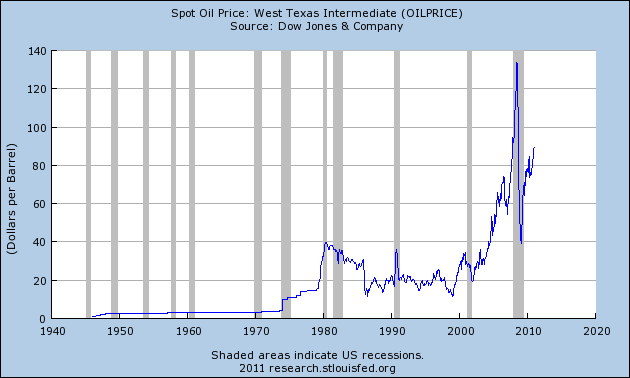
The following chart if from the Federal Reserve.  It shows that the price of oil is rapidly moving back to the level it was at prior to the financial crisis of 2008.  In fact, this chart is slightly out of date.  At last check, the price of oil was over $107 a barrel.  So what is it going to mean for our economy if we soon surpass the record that was set back in 2008?....
Fourthly, global instability is also going to cause prices to continue to rise.  Over the past year we have had really bizarre weather all over the globe, we have seen revolutions erupt all over Africa and the Middle East and the third largest economy in the world (Japan) just experienced the worst disaster that they have been through since World War 2 ended.
When things are unstable, economies don't work as efficiently.  That means that less goods and services are produced.
But when there are less goods and services being chased by an increasing amount of money that tends to push prices up.
The truth is that inflation is here, and if the CEO of Wal-Mart is right, it is not going to go away any time soon.
In fact, many believe that the world is on the verge of another major economic crisis.
If you stop and think about it, every major region of the world is dealing with very serious problems right now.
Right now, the European debt crisis is worse than it ever has been before.  Did you notice that Standard & Poor's just downgraded Portugal's debt for the second time in a week?  Now Portuguese debt is rated BBB-, which is only one level above junk status.
That is a very alarming sign.
Asia is dealing with the Japanese crisis, nearly all of the countries in the Middle East are dealing with protests or full-blown revolutions, Africa is dealing with the war in Libya and quite a few revolutions of their own, and the U.S. is still deeply struggling with a whole host of economic problems.
Most Americans don't realize just how precarious things are at the moment for the global economy.  The financial crash of 2008 did a lot of lasting damage, and the next wave of the financial crisis could potentially be even worse.  Unfortunately, the global financial system is more vulnerable than ever right now.
So what are the Federal Reserve and other central banks going to do the next time a major financial crisis happens?
They are going to print even larger quantities of money and they are going to give even larger bailouts to their friends of course.
The dollars that you have today are never going to be more valuable than they are right now.  Don't wait too long to use them.  If you have a huge pile of dollars sitting in the bank your wealth is slowly but surely rotting away.
Very hard economic times are coming.  The inflation that the CEO of Wal-Mart is warning about is only the beginning.  Eventually we are going to see inflation in this country that is going to be absolutely mind blowing.
But don't wait until the storm hits to start preparing.  We all have time now to prepare, so let us be wise and make the most of it.


hostgator coupon 2011

Cost of wars....


hostgator coupon 2011