A growing number of scientists are starting to worry that it is the magnetic pole shift that seems to be underway that is the real culprit behind climate change. Not man made air pollution, not the sun, not the underground volcanic activity heating up the oceans, but the slow beginning of a pole shift that has been thought to destroy entire civilizations in the past and be one major factor in mass extinctions. NASA recently discovered and released information about a major breach in the earth’s magnetic field.
This breach in the earth/s magnetic field alone, in that it is allowing solar winds to enter the earths atmosphere, is sufficient to really mess up the weather. Not only is this accelerating magnetic pole shift messing up the weather it is having major effects on geopolitics. These magnetic shifts are not only capable of causing massive global super storms, but can cause certain societies, cultures and whole countries to collapse, even go to war with one another.
All yet remains to be seen, but the magnetic reversal of the earth’s poles seems to be rapidly increasing and IS affecting world weather patterns. The real question is how bad will things get before it all settles backdown to a “new normal?” At one time in history it was thought the North Pole was in the area that is now known as Hudson Bay. If the Hudson Bay area was the last locatoin of the North Pole, where will it go next? And how bad will global super storms and climate change get before it is over?
The NOAA National Geophysical Data Center maintains a data set of annual magnetic north pole coordinates going back to the year 1590, derived from early measurements from ships logs to modern day techniques. Noting that there has been lots of reporting of pole shift lately, to the point where the phenomenon is actually causing real-world issues such as temporary airport closures, a deeper investigation was in order. After transferring 420 years of north pole position data from the NOAA Geo Data Center, configuring it to fit in an Excel spreadsheet, adding a complicated formula to determine exact distance between 2 sets of latitude-longitude coordinates, applying the formula to each data point in the series, and then finally plotting it all in a visual graph, it is alarming to discover the amount of pole shift just over the past 10 to 20 years. (GlobalRumbling)
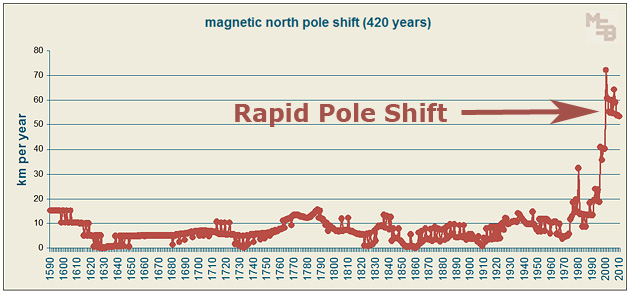
Graph of annual magnetic north pole shift during the past 420 years
Since 1860, the magnetic pole shift has more than doubled every 50 years. That is pretty significant. During the past 150 years, the pole shift has been in the same direction. During the past 10 years, the magnetic north pole has shifted nearly half of the total distance of the past 50 years! In other words, the pole shift has apparently sped up substantially. It is not known if the shift will speed up or slow down in the years ahead. Some say that a pole reversal is overdue, and this phenomenon may be indicators of the beginnings of that process.
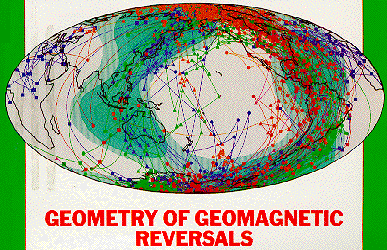
The Pole shift hypothesis is not to be confused with geomagnetic reversal, the periodic reversal of the Earth’s magnetic field (effectively switching the north and south magnetic poles). Geomagnetic reversal has more acceptance in the scientific community than pole shift hypotheses. The Pole shift hypothesis is almost always discussed in the context of Earth, but other bodies in the Solar System may have experienced axial reorientation during their existences. The theory says that the outer crust of the Earth has moved several times in the past and would move in the future.
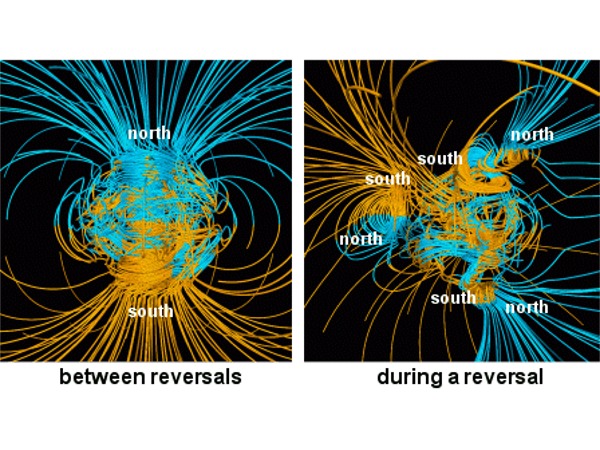
A geomagnetic reversal is a change in the orientation of Earth’s magnetic field such that the positions of magnetic north and magnetic south become interchanged. The Earth’s magnetic north pole is drifting from northern Canada towards Siberia with a presently accelerating rate. It is also unknown if this drift will continue to accelerate. Present society with its reliance of electricity and electromagnetic effects (e.g. radio, satellite communications) may be vulnerable to technological diruptions in the event of a full field reversal.
 The Earth’s geomagnetic field is currently undergoing a reversal. It is not known when it will be completed, but it is already well underway, will continue into 2012 and beyond. The field is weakening with consequences of irradiation from the sun and deep space. But the reversal also means deep seated changes inside the earth with consequences of earthquakes in places not familiar with them and new volcanoes. During the reversal, we can experience increased earthquake activity, even an earthquake storm. Three new volcanoes are being born in the various undersea locations of the Pacific Ocean at this time. The reversal is a product of the changes that go on inside the Earth. The core is spinning slightly faster than the crust that has been slowed by the effect of the moon by tidal dragging. The differential rotation is what generates the magnetic field. As the core rotates, the magnetic field lines behave like what happens on the surface of the sun as the sun has differential rotation from equator to pole. The differential rotation in both cases stretches the magnetic field lines so that they get wound round and round the sun or Earth. At a certain moment in each case, the magnetic field lines snap and the field reverses and rebuilds. The differential flow of the sun occurs much faster than in the earth, so the magnetic cycle occurs in the sun cycles around 22 years on average. The Earth takes longer and is aperiodic due to the slower winding and the interaction of the moon, sun and planets. Typical field reversals can take hundreds of thousands or millions of years.
The current state of the geomagnetosphere is very chaotic with no definitive north-south orientation of poles. Instead there is a patchwork of poles all over the place. It is analogous to the surface of the sun during a sunspot maximum period where there are many fields coupled by sunspot pairs. The remains of the main field still exist, but is weakening, with the south magnetic pole closer to the equator than the north magnetic pole. Satellite imaging shows that the overall field has broken into many local regions with plenty of neutral zones between them where solar and cosmic radiation can get to the earth’s surface unimpeded except by the atmosphere. As of March 2010, NASA space weather tells us two things. The first is that the Earth’s magnetic field is almost at zero strength overall, broken into hundreds of small coupled fields. The sun for the moment is relatively quiet according to what is observed by aural activity on earth. These magnetic zonesare shifting continually and presage change. It appears that the field will be globally neutral on or about 2012.
Right now, the earth is open to penetration by ionizing radiation from all sources, but the local solar weather and cosmos is relatively quiet. It will not remain so and it is hard to know in advance when a radiation event will come from the cosmos at large. With the sun, we may have a day or two concerning a proton event, but not for gamma rays as it will hit us the moment we see signs like a coronal mass ejection. Where the chaotic fields are at their weakest, is exactly where auras will show and warn us of oncoming radiation. Ionizing radiation means an increase in radiation driven evolutionary change and radiation related illness.
A sign of the times is increase in earthquake activity, including in regions that are considered geologically stableand not subject to earthquakes. (Newsolio)
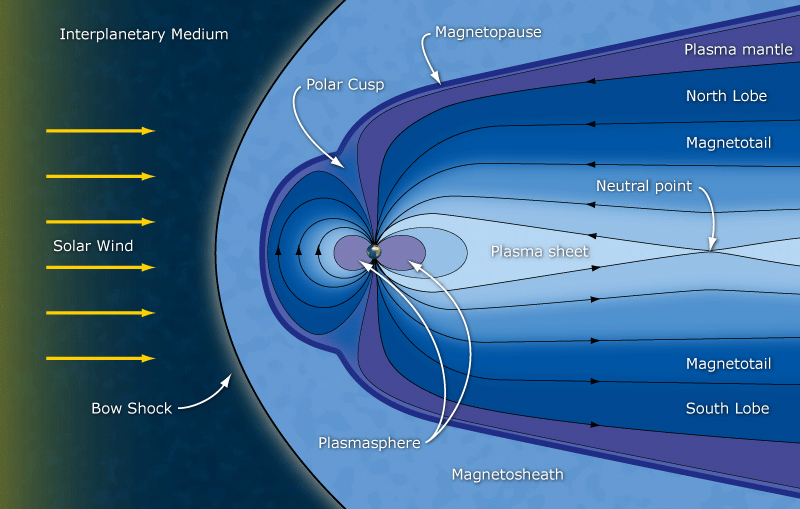
The Earth’s magnetosphere is what generates the Earth’s magnetic poles. It also protects us from harmful solar wind emanating from the Sun and radiation from outside our solar system. It sheathes the Earth and extends outside the atmosphere. This is why missions to the moon and other planets are plagued by radiation but orbiting missions less so.
Scientists know that reversals have occurred many times in the past. The direction of magnetic grains laid down successively in the Earth’s crust, particularly the sea floor are a primary piece of evidence. When the rock is new and molten the grains are free to align themselves with the prevailing magnetic field. As the rock cools, the grains are frozen in time. As the sea floor expands outward (in the Atlantic), it is regularly striped with rock oriented in different directions. This indicates that the magnetic poles have reversed many times throughout the Earth’s history.
The South Atlantic Anomaly (or SAA) is the region where Earth’s inner van Allen radiation belt makes its closest approach to the planet’s surface. Thus, for a given altitude, the radiation intensity is greater within this region than elsewhere. The van Allen radiation belts are symmetric with the Earth’s magnetic axis, which is tilted with respect to the Earth’s rotational axis by an angle of ~11 degrees. Additionally, the magnetic axis is offset from the rotational axis by ~450 kilometers (280 miles). Because of the tilt and offset, the inner van Allen belt is closest to the Earth’s surface over the south Atlantic ocean, and furthest from the Earth’s surface over the north Pacific ocean.
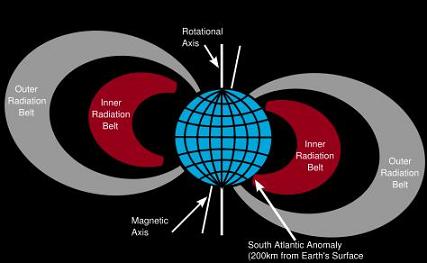 Some believe that the anomaly is a side effect of geomagnetic reversal. This may result from a misunderstanding of the extant literature, which mentions a slow weakening of the geomagnetic field as one of several causes for the changes in the borders of the SAA since its discovery. What is true is that as the geomagnetic field continues to weaken, the inner van Allen belt will get closer to the Earth, with a commensurate enlargement of the SAA at given altitudes. The highest intensity portion of the SAA drifts to the west at a speed of about 0.3 degrees per year, and is noticeable in the references listed below. The drift rate of the SAA is very close to the rotation differential between the Earth’s core and its surface, estimated to be between 0.3 and 0.5 degrees per year. (MaritimeConnector)
The South Atlantic Anomaly (SAA) is known to be growing in extent and spreading westwards from South Africa, as the Earth’s internal magnetic field rapidly weakens in this region. This may be early evidence of a forthcoming reversal in the direction of the Earth’s internal magnetic field. We do not know in detail precisely what occurs during such reversals, including the changes observed in the magnetic field and the time a reversal takes to complete. However these factors are important in knowing where the radiation risk may be increased and how the atmosphere might respond. Earth’s magnetic field has had many highs, lows and reversals in its past. The last reversal was around 800,000 years ago. So the Earth is known to be able to re-generate its field and has done so during human pre-history. Understanding the development of the SAA may therefore be significant in understanding the reversal process and its impact on life and the natural environment. (BrittishGeologicalSurvey)
Polar Shift and Earthquakes
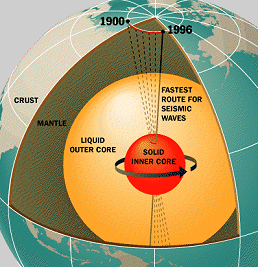 The increase in the number of strong earthquakes today may be related to the phenomenon of polar shift, and are both byproducts of Earth’s turbulent and boiling liquid Iron outer core, roiling around a solid Iron inner core as hot as the Sun and spinning faster than the rotation of the planet itself.
The Earth’s mantle and crust are floating on top of a stormy sea of electrically conducting molten Iron which produces the planet’s magnetic field by something called the Dynamo effect. The north magnetic pole was first located in 1831 and has been regularly tracked up until the most recent measurement taken some time ago in 2001. During that time the pole has moved an amazing 1,100 km. In fact, since 1970 the pole has been moving much faster, from 10 km to 40 km annually, an incredible four fold increase.
Polar shift is caused by substantial changes in movement of the molten Iron outer core.
Dr. Tony Phillips of Science News – NASA has stated the following details… About 400 polar shift reversals have occurred during the past 330 million years while the average interval between reversals during recent geological times has been about 200 thousand years. The Earth’s last field reversal occurred 780 thousand years ago and we are apparently way overdue. Most evidence gathered from analyzing certain types of rock indicates that a polar shift reversal process may take 1,000 or up to 8,000 years to complete. However there have also been reports of the process completing itself much, much faster than that, the most famous account being from measurements taken of lava rock at Steens Mountain, Oregon which indicate that the magnetic field had been shifting up to 6 degrees per day during one particular polar shift nearly 16 million years ago. Everything we are seeing here lately regarding magnetic polar shift and earthquakes today may all be related and may be reflections of changes that are occurring deep beneath our feet. (Modern Survivalist)

As massive earthquakes rip the earth’s crust, destroy cities and kill many thousands, scientists that have warned of the relationship between the ongoing magnetic polar shift, the planet’s molten cores and tectonic plates are scrambling to recheck their calculations.
Japan’s 9.1 superquake that destroyed much of northeastern land is a symptom of the growing devastation reverberating around the globe as the geomagnetic field continues to relentlessly warp, fluctuate and mutate. Both the superquake and super-tsunami were generated by a gigantic tear in the earth’s crust: the North American plate snapped upward. The mammoth fissure—150 miles long and 50 miles wide—gapes like a deadly wound in the seabed, plunging downwards into the depths of the crumbling, unstable mantle.
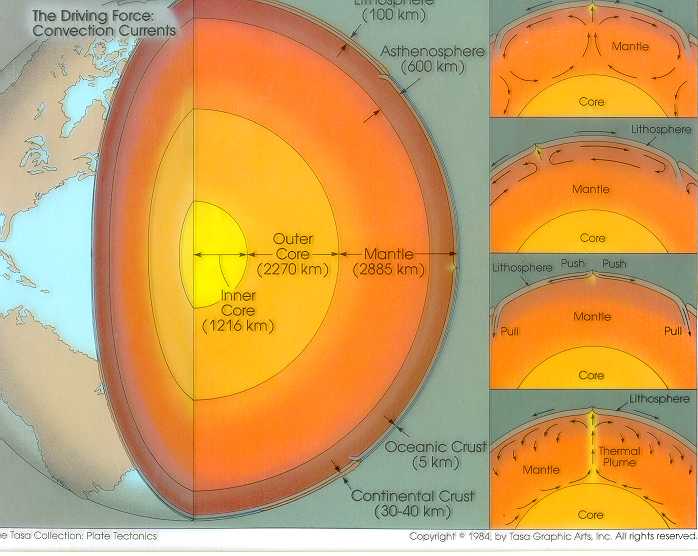
Most people are unaware that magnetic field fluctuations can precipitate earthquakes and initiate strange mass animal behavior—bizarre behavior like that reported since the final months of 2010. Yet it’s been demonstrated that changes in the geomagnetosphere affect the Earth’s plate tectonics. The reason why tectonics are affected has to do with how the Earth is built geologically. The planet’s primarily a core of superheated, dense viscous liquid with a relatively thin crust floating on the surface. That segmented crust—like a cracked pie crust—is what comprises the tectonic plates. They are in constant movement chiefly due to massive currents deep within the planet’s mantle and molten core.
The edges where two plates meet are called faults. Faults relieve the titanic internal pressure of the planet. The faults buckle and create mountains, rifts, and volcanic conduits. Some faults are structured different than others and exhibit different qualities.
The mighty currents of molten rock, under intense pressure, boil beneath the crust creating earthquakes, volcanoes and continental drift. It is also the geodynamo that creates the earth’s magnetic field and the interaction with the solar magnetosphere can initiate plate drift, tensions and the massive buckling and shearing between the plates called faults. The movement along the fault lines is called an earthquake.
Geomagnetic flux, often a precursor to mighty quakes, is sometimes accompanied by strange harmonics: people see colors dancing in the sky or hear what sounds like discordant music. The growing abberations of the magnetic field—and the increasing level activity of the sun—is symptomatic of the change in the earth’s core. A dangerous change. An uncontrollable change. A change that is leading to the possibility of greater and greater disasters. Volcanic activity will also increase. The evidence is there.
Japan’s superquake was followed by dozens of severe aftershocks and then an entirely new quake on a separate fault in central Japan measuring 6.6 magnitude. Hours later a volcano in Indonesia along the famous Pacific Rim ‘ring of fire” exploded into an intense eruption. The twisting field creates a perfect harmony of catastrophe, death and destruction.
As the flux in the Earth’s dynamic magnetic field becomes more erratic and the intensity of the field fluctuates to a greater degree, the formation of energetic torsion fields withing the electrical matrix can increase. A torsion field, as defined by A. Akimov, can manifest within an electrical field in a state of flux. They are distinct energy fields that can interact and affect both energy and matter. Some experimenters have found evidence that their emanations sometimes appear to exceed the speed of light. Torsion fields can change the light frequency of laser beams, affect electrical components, modify gravity waves, and impact biological processes.
Beyond that, torsion fields can go rogue, create escalating feedback by looping upon themselves and generate massive, uncontrollable forces upon the spinning molten core through permutations and episodes of erratic spin and pressure. It can be measured and deduced by the magnetic flux using supercomputers. But the data produced is always after the fact and is useless as a tool for prediction. It serves only as a means to determine exactly what it was that killed or displaced hundreds of thousands of people.
As the field effects intensify and the geomagnetic field becomes ever more erratic, more superstorms can erupt into global titans of fury; more superquakes can occur shifting coastlines, submerging islands, and destroying whole regions; and more volcanoes can reignite bringing superheated death and destruction to the surface from the very bowels of the earth. (Earth-Issues)
“What is so surprising is that rapid, almost sudden, changes take place in the Earth’s magnetic field. This suggests that similar sudden changes take place in the movement of the liquid metal deep inside the Earth which is the reason for the Earth’s magnetic field” said Nils Olsen, Senior Scientist with DTU Space.
The Earth’s core consists of an inner solid core which is surrounded by an outer liquid core approx. 3,000 km below our feet. Both the liquid core and the solid core consist primarily of iron and nickel, and it is the movements in the outer liquid part of the Earth’s core which create the Earth’s magnetic field. Changes in these movements are seen as changes in the magnetic field, and scientists can therefore use satellite measurements of the magnetic field to find out what is going on in the liquid core deep inside the Earth.
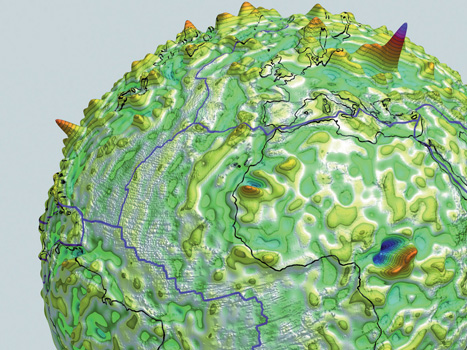
Crust field: magnetic minerals produce sharp fluctuations in the magnetic field, making iron deposits in Russia (top right) and diamond-bearing rocks in the west Sahara (middle) clearly visible
The magnetic field surrounds the planet in a cocoon of force that forms a barrier against the solar wind – the constant but fluctuating stream of charged particles emitted from the Sun. If the field weren’t there, the solar wind would strip away almost all of the atmosphere, the oceans would boil away into space and the planet would be left unable to support life. Mars, whose magnetic field faded away unknown aeons ago, suffered this fate. The magnetic fields of the core and the crust are fixed to the Earth, so they are in a rotating frame. The magnetic fields coming from the ionosphere are driven by the Sun, so they sit still with respect to the terrestrial fields.

The Earth's magnetic field is mainly produced by a self-sustaining dynamo in the fluid outer-core. Credits: GeoForschungsZentrum Potsdam (GFZ)
But the field is complex, and although we’ve known about it since 1600 -an English doctor, William Gilbert, was the first to describe it – we don’t understand how it works. The field is made up from several components. There’s the contribution of the molten core, but how the movement of the liquid iron generates the field is a complete mystery. Another contribution comes from naturally magnetic minerals in the Earth’s crust, such as ores of iron and nickel, and certain magnetic volcanic rocks. The ionosphere – the layer of ionised gases in the atmosphere from about 60km to 500km above the planet’s surface – also generates a magnetic field that contributes to the whole. Lastly, and rather surprisingly, the oceans, made from conductive salt water, generate a magnetic field as their currents move the water across the surface of the planet.
It’s becoming increasingly important that we understand more about the magnetic field; primarily, it’s responsible for our ongoing existence, but also because more and more of the technology we rely on depends upon it. The field protects communications, global positioning and Earth observation satellites from the solar wind. It may also be responsible for aspects of the climate.
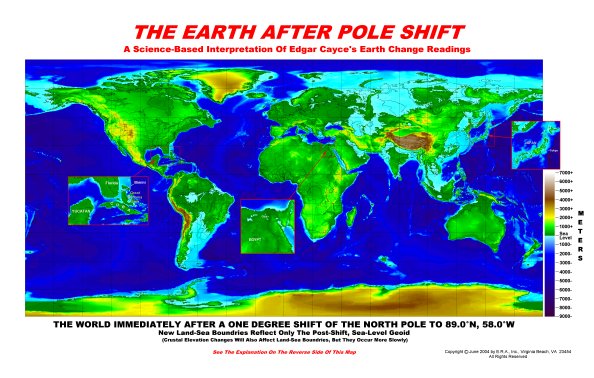
There’s evidence it happened in the past and this theory could explain a lot of things that remained mysterious. There’s a couple of theories about how it could happen next:
- Important mass building at the poles
- Continents drift
- An asteroid hitting Earth
- A large object/Planet not from the Solar system approaching Earth
- Something like a super sized volcano formed far from the equator
It’s a process that we can see happening. The only drastic way it could happen is with an asteroid striking Earth or a large object/planet getting near Earth. For the asteroid, NASA is monitoring near Earth objects and I’m sure they do a good job with that. For the planet approaching it’s clear people are making reference to Elenin/Planet X/Nibiru. There’s no clear link between 2012 and that physical pole shift. It’s most likely linked with Planet X approaching Earth and then causing a pole shift due to the change in gravity which holds our Solar system the way it is.
(DailyCommonSense)
(DailyCommonSense)
hostgator coupon 2011