We will have a mirror site at http://nunezreport.wordpress.com in case we are censored, Please save the link

Monday, February 28, 2011

Attack cripples Iraq's largest refinery, kills 1


FILE - In this April 18, 2005 file photo, Iraqi police officers, assigned to protecting oil production and distribution, watch from across the Tigris

BAGHDAD – Gunmen stormed Iraq's largest oil refinery and bombed the facility Saturday, forcing operations to shut down at a time when Iraqis are already suffering through electricity shortages and lines at the gas pump.
The attack north of Baghdad casts doubt on the Iraqi government's ability to protect its vital infrastructure and could shake already nervous international investors. If not fixed swiftly, the shutdown will likely further fuel anger over a lack of public services that led to violent nationwide protests last week.
"It probably couldn't have come at a worse time for (Prime Minister) al-Maliki and his government," said Raad Al-Kadiri, an energy analyst with the Washington-based PXE Energy.
The Beiji oil refinery accounts for a little more than a quarter of the country's entire refining capacity — all of which goes toward domestic consumption for things like gasoline, cooking oil and fuel for power stations.
One of the key demands during protests Friday in which at least 14 people were killed was that Prime Minister Nouri al-Maliki's government improve the country's electricity output — some Iraqis get only a few hours a day.
A lengthy outage would force Iraq, already grappling with a $13 billion budget deficit, to purchase more refined products on the open market. Analysts said storage facilities in Dora and Basra will be able to compensate for at least some of the immediate shortfall in production.
The sophisticated attack against the Beiji facility, located about 155 miles (250 kilometers) north of Baghdad in the heart of what used to be an al-Qaida infested area, was carried out in the dead of night.
Assailants carrying pistols fitted with silencers attacked the guards at about 3:30 a.m. and planted bombs near some benzene and kerosene production units, said the spokesman for Salahuddin province, Mohammed al-Asi.
One guard was shot dead and another wounded, al-Asi said. Smoke could be seen billowing from fields around the sprawling facility where fires raged for hours.
Dr. Abdul Jabbar al-Halfi, a professor at Basra University's oil engineering department and frequent visitor to the Beiji refinery, pointed out that visitors to Beiji need a special badge to even get within a mile (2 kilometers) of the facility and suggested it might have been an inside job.
There was no immediate claim of responsibility, although insurgents have targeted oil facilities in the past.
The attackers knocked out the installation's North Refinery, which handles about 150,000 barrels a day; the refinery's other section, called the Salahuddin Refinery, is under renovation and was not affected.
Iraqi Oil Ministry spokesman Assem Jihad said an investigation would be launched.
Technicians currently repairing the refinery estimated it would be back online later this week, the province spokesman Al-Asi said. Authorities dispatched about 45 soldiers to temporarily protect the facility.
But the complicated attack on one of the most vital installations in the country raises questions about thegovernment's ability to protect its own infrastructure.
At the height of the insurgency from 2004 to late 2007, the Beiji refinery was under the control of Sunni militants who used to siphon off crude and petroleum products to finance their operations.
Iraq has the world's third-largest known oil reserves with an estimated 115 billion barrels, but its production is far below its potential due to decades of war, U.N. sanctions, lack of foreign investment and insurgent attacks.
Al-Maliki's government has tried to drum up international investment through three energy auctions. While those have focused on developing oil fields as opposed to refineries, any uptick in violence against oil-related installations could rattle investors.
Most oil companies doing business in Iraq, even in the relatively stable southern region, spend huge sums of money on security, including armed guards, armored vehicles.
"The oil industry and investors, while they're there in great numbers, already have one eye toward security," al-Kadiri said.
Hours after the Beiji facility was attacked, a fire in a storage unit at the small refinery in Samawa, a city on the Euphrates River about 230 miles (370 kilometers) southeast of Baghdad, knocked the facility offline, according to a local official.
The official, who spoke on condition of anonymity because he was not authorized to release information, said the fire was caused by a technical failure, not sabotage. He wouldn't say when work would resume at the plant, which has a production capacity of 30,000 barrels per day.
Iraq's current nationwide refining capacity stands at just more than 500,000 barrels per day. The country's three main oil refineries — Dora, Shuaiba and Beiji — now process around 350,000 barrels per day, roughly half of their prewar capacity.
Last year, Baghdad invited investors to help build four oil refineries at an estimated cost of $23 billion that would more than double the country's current refining capacity.


hostgator coupon 2011

Marc Faber says Pakistan next....

hostgator coupon 2011

IMF says weaker dollar would help global growth


The International Monetary Fund called for a weaker dollar to help the United States reduce its deficits with the rest of the world and rebalance the global economy, in a report released Wednesday.
AFP - The International Monetary Fund called for a weaker dollar to help the United States reduce its deficits with the rest of the world and rebalance the global economy, in a report released Wednesday.

In the report prepared for a Group of 20 finance chiefs meeting last week, the IMF said that its calculations showed the dollar remains "on the strong side" of medium-term fundamentals, while the euro and the Japanese yen were "broadly in line" and several Asian currencies, including China, were undervalued.

To address global imbalances, the G20 should allow the dollar to fall, the Washington-based institution said.

"Some further real effective depreciation of the US dollar would help ensure a sustained decline of the US current account deficit towards a level more consistent with medium-term fundamentals, helping to support more balanced growth," the IMF said.

The widening US current account deficit -- a broad measure of trade in goods, services, income and payment -- rose a fifth straight quarter in the third quarter last year, to $127.2 billion, according to the latest US official data.

The issue of a weak dollar is particularly sensitive in Brazil, where the government has said an international "currency war" is under way with the United States pumping cheap dollars into its post-crisis economy, while China's yuan sinks in tandem.

The IMF report was provided to finance ministers and central bank governors of the G20 major developed and emerging economies for their meeting Friday and Saturday in Paris.

The G20 countries reached agreement on a series of economic indicators to measure imbalances within and between countries, with the goal of helping nations avoid a repeat of the problems at the heart of the 2008 financial crisis.

The IMF urged stepped-up G20 efforts to sustain the global economic recovery, citing elevated downside risks for advanced economies and "overheating" in some emerging economies.

Among the threats to global growth, the IMF highlighted "insufficient progress in developing medium-term fiscal consolidation plans, especially in the United States and Japan" and "sovereign and banking sector risks in the euro area periphery."

In emerging economies, the key policy challenge is to keep overheating pressures in check and respond appropriately to capital inflows, the IMF said.

"In key surplus economies, overheating pressures can be alleviated by permitting currency appreciation, facilitating a healthy rebalancing from external to internal demand."

The 187-nation institution also said it "appears highly unlikely" the United States would be able to meet its commitment to halve its budget deficit between 2010 and 2013, pledged at a G20 Toronto summit in June 2010.


hostgator coupon 2011

Researchers use virtual-reality avatars to create 'out-of-body' experience

Avatar


Volunteers experienced the virtual bodies as if they were their own, with possible applications in computer games or to transport people digitally to other locations


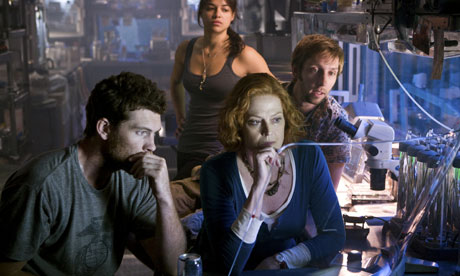
In the film Avatar, explorers on the planet Pandora transmit their minds into alternative bodies. Now scientists have come a step closer to recreating the experience in the lab.
They have successfully "projected" people into digital avatars that can move around a virtual environment. The participants experienced the digital body as if it were their own, even if the virtual humans were of the opposite sex.
The research is aimed at understanding how the brain integrates information coming from the senses in order to determine the position of the body in space. But the results could also be used in next generation computer games or for people who want to transport themselves, digitally, to other locations.
Olaf Blanke, a neurologist with the Brain Mind Institute at Ecole Polytechnique Fédérale de Lausanne in Switzerland, who led the work, used a virtual-reality (VR) setup with cameras linked to a head-mounted video display to achieve his results. He presented his work on Thursday at the annual meeting of the American Association for the Advancement of Science.
It is an extension of previous work by the same researchers that aims to recreate out-of-body experiences. These are defined as situations where a person who is awake sees their own body from somewhere outside themselves. This can occur when brain function has been damaged through a stroke, epilepsy or drug abuse. The most common cases happen in traumatic events such as car accidents or during operations.
In those experiments, carried out by Blanke and colleagues in 2007, volunteers wore goggles containing a video screen for each eye fed fed by a pair of cameras behind the participant. Because the two images were combined by the brain into a single image, they saw a 3D image of their own back.
Experimenters then moved a plastic rod towards a location just below the cameras, in their field of view, while the participant's real chest was simultaneously touched in the corresponding position. The participants reported feeling that they were located where the cameras had been placed, watching a body in front of them that belonged to someone else.
In his latest work, Blanke's volunteers used a similar VR set-up and then wandered through different digital 3D environments while researchers physically touched them either in sync or out of sync with the digital humans, to see where the volunteers thought their bodies were in the virtual space.
He also "projected" male volunteers into female avatars and placed volunteers directly into their avatars, so they were no longer watching from behind. Blanke reported that, even when moving in a virtual scene, volunteers felt as if whatever happened to the avatar happened to them.
"They start thinking that the avatar was their own body," said Blanke. "We created a partial out-of-body experience. We were able to disassociate touch and vision and make people think that their body was two metres in front of them."
THE GUARDIAN

MORE:


hostgator coupon 2011

Saturday, February 26, 2011

old price soars as unrest intensifies


The price of gold is back near record highs, as spreading turmoil in Libya and the Middle East sends investors looking for safe havens.
But fallout from political strife also poses a risk for gold companies: Surging oil prices are eating into the bottom line.
Gold has risen by almost 10 per cent since late January, when protests began to build in Egypt against former president Hosni Mubarak. Political unrest in northern Africa then moved to Libya, Africa’s third-largest oil producer.
The growing political unrest helped send the spot price of gold to around $1,418 (U.S.) an ounce on Thursday, not far from a record of around $1,430 an ounce reached in December. Rising inflation in emerging markets is also underpinning gold’s rise.
Buoyed by strong prices, gold companies are reporting a steady stream of record quarterly and annual financial results. But the corporations are warning of higher costs in the months ahead as a result of surging oil prices and other expenditures, and there’s growing concern that those pressures will erode future profits.
Gold producers are sensitive to higher oil prices, said Deutsche Bank Securities Inc. analyst Jorge Beristain.
“Their number one input cost is energy,” he said. “We are seeing shades of 2008, when the inflation drum was beating globally.”
Rising costs have put pressure on mining stocks despite near-record gold prices. For instance, Newmont Mining Corp. shares fell more than 7 per cent on the New York Stock Exchange Thursday while Yamana Gold Inc.’s stock was down 2.5 per cent in Toronto, despite the strong results. Barrick Gold Corp. shares fell 3 per cent, while Kinross Gold Corp. shed more than 2 per cent.

The Globe
MORE:


hostgator coupon 2011

Illusion 'cloak' makes you see what's not there


NOW you see it, now it looks like something else. Radar images might never be the same again, thanks to an illusion device that can change an object's appearance. The technology could ultimately be used to hide military aircraft.
The device is part of a growing family of metamaterials - structures designed to steer light along curved paths. They have already been used to makeobjects appear invisible and to disguise a gap between two objects.
Wei Xiang Jiang and Tie Jun Cui at Southeast University in Nanjing, China, have created a structure that changes the way radio waves interact with a copper cylinder so that it appears to be composed of another material altogether.
Copper conducts electricity well and reflects incoming radio waves, giving it a bright radar signature. To alter this behaviour, the team built a device made of 11 concentric rings of circuit boards etched with small metal-lined channels that prevent electromagnetic waves reflecting away. Instead, they guide the waves in a direction that the researchers choose specifically to make the hidden object appear to have different electrical properties.
Placed around a copper cylinder, the arrangement created the illusion that the cylinder was made of a dielectric, a class of materials including porcelain and glass that do not conduct electricity and are more transparent to radio waves.
The illusion only worked when the cylinder was viewed from the side; what's more, the imaginary object it generated was the same size as the original. Future designs would have to account for all three dimensions, and might produce an illusion quite different from the object they disguise.
"In principle, this technology could be used to make an illusion of an arbitrary shape and size," says Cui, whose team created an electromagnetic "black hole" for light in 2009. Similar illusion devices could eventually be used for stealth technology: for example, to "convert the radar image of an aircraft into a flying bird", Cui says.
The work, which is published in Physical Review E, is still at an early stage, however. At 45 millimetres, the team's illusion device is three times as wide as the cylinder it disguised. "Their device is still fairly bulky relative to the original object, so further work needs to be done before a real device can be deployed," says John Pendry of Imperial College London.
Although invisibility devices were invented first, the illusion technology might win the race to be put to practical use. "It is easier to falsify something than to hide it," Pendry says.
The team next plans to explore ways to design devices with more complex shapes.


hostgator coupon 2011