We will have a mirror site at http://nunezreport.wordpress.com in case we are censored, Please save the link

Thursday, June 6, 2013

Earth's magnetic field overdue a flip


The discovery by NASA rover Curiosity of evidence that water once flowed on Mars - the most Earth-like planet in the solar system - should intensify interest in what the future could hold for mankind.

The only thing stopping Earth having a lifeless environment like Mars is the magnetic field that shields us from deadly solar radiation and helps some animals migrate, and it may be a lot more fragile and febrile than one might think.

Scientists say earth's magnetic field is weakening and could all but disappear in as little as 500 years as a precursor to flipping upside down.

It has happened before - the geological record suggests the magnetic field has reversed every 250,000 years, meaning that, with the last event 800,000 years ago, another would seem to be overdue.

"Magnetic north has migrated more than 1,500 kilometres over the past century," said Conall Mac Niocaill, an earth scientist at Oxford University. "In the past 150 years, the strength of the magnetic field has lessened by 10 percent, which could indicate a reversal is on the cards."

While the effects are hard to predict, the consequences may be enormous. The loss of the magnetic field on Mars billions of years ago put paid to life on the planet if there ever was any, scientists say.

Mac Niocaill said Mars probably lost its magnetic field 3.5-4.0 billion years ago, based on observations that rocks in the planet's southern hemisphere have magnetisation.

The northern half of Mars looks younger because it has fewer impact craters, and has no magnetic structure to speak of, so the field must have shut down before the rocks there were formed, which would have been about 3.8 billion years ago.

"With the field dying away, the solar wind was then able to strip the atmosphere away, and you would also have an increase in the cosmic radiation making it to the surface," he said.

"Both of these things would be bad news for any life that might have formed on the surface - either wiping it out, or forcing it to migrate into the interior of the planet."

RIGHT HERE, RIGHT NOW
Earth's magnetic field has always restored itself but, as it continues to shift and weaken, it will present challenges - satellites could be more exposed to solar wind and the oil industry uses readings from the field to guide drills.

In nature, animals which use the field could be mightily confused - birds, bees, and some fish all use the field for navigation. So do sea turtles whose long lives, which can easily exceed a hundred years, means a single generation could feel the effects.

Birds may be able to cope because studies have shown they have back-up systems that rely on stars and landmarks, including roads and power lines, to find their way around.

The European Space Agency is taking the issue seriously. In November, it plans to launch three satellites to improve our fairly blurry understanding of the magnetosphere.

The project - Swarm - will send two satellites into a 450 kilometre high polar orbit to measure changes in the magnetic field, while a third satellite 530 kilometres high will look at the influence of the sun.

DESCENT INTO CHAOS
Scientists, who have known for some time the magnetic field has a tendency to flip, have made advances in recent years in understanding why and how it happens.

The field is generated by convection currents that churn in the molten iron of the planet's outer core. Other factors, such as ocean currents and magnetic rocks in the earth's crust also contribute.

The Swarm mission will pull all these elements together to improve computer models used to predict how the magnetic field will move and how fast it could weaken.

Ciaran Beggan, a geomagnetic specialist at the British Geological Survey in Edinburgh, said studies have also refined our understanding of how the field reverses.

They have focused on lava flows. When these cool and form crystals the atoms in iron-rich molten rock align under the influence of the magnetic field, providing a geological memory of the earth's field.

But that memory looks different in various locations around the world, suggesting the reversal could be a chaotic and fairly random process.

"Rather than having strong north and south poles, you get lots of poles around the planet. So, a compass would not do you much good," said Beggan.

While the whole process takes 3,000-5,000 years, latest research suggests the descent into a chaotic state could take as little as 500 years, although there are significant holes in scientific understanding.

"Although electricity grids and GPS systems would be more vulnerable, we are not really sure how all the complex things that are linked together would react," Beggan said.

Reuters

India Central Bank Prohibits Sales Of Gold Coins


Two weeks ago, with its current account getting crushed by relentless gold imports, India's finance minister Chidambaram literally begged the people to stop buying gold. Judging by the popular response, the ongoing physical shortage, and last night's increase in Indian gold import duties from 6% to 8%, appealing to people's feeling when it comes to the choice of fiat vs physical, has failed miserably. 

So the FinMin Chidambaram has decided to escalate. Per Reuters: "The Reserve Bank of India has advised banks against selling gold coins to retail customers, Finance Minister P. Chidambaram said on Thursday, a day after he raised gold import duty to try to ease pressure on India's bloated current account deficit." Well, if there ever was one sure way to send demand for any product through the roof (guns, ammo, etc), it is for the government to prohibit its outright sale. What follows next, almost without fail, is a panicked, chaotic buying scramble.

Gold imports by India, the world's biggest buyer of bullion, surged to
162 tonnes in May -- more than twice the monthly average in the record
year of 2011.


"I think the Reserve Bank has advised banks that they should not sell gold coins," said Chidambaram, while speaking at an event in Mumbai.

Chidambaram also urged banks to advise their customers not to invest in gold.

Why? If it is not clear by now, here is the explanation: there is simply not enough gold to satisfy demand at the current artificially downward-manipulated price, no matter what propaganda script is being spun on Verizon TV at any given moment. And with India's idiotic decree, even more gold will be purchased at these prices.

Dear India - here is a simple way to limit demand: price.

Petition the central banks to allow gold to price based on price discovery, or as it is also known supply and demand. Because if gold were to cost $2000,$5000, $10,000/oz then all problems resulting from excess demand would immediately disappear and India's current account would be back to normal.

Of course this will not happen, as the crumbling facade of the imploding fiath based regime would immediately peel away. So back to gold capital controls and other ad hoc made-up measures guaranteed to not only fail but push the price of physical gold much higher.

Good luck.

This is how the gov't is tracking YOU

Syria rebels, Assad troops battle for Golan crossing


Soldiers loyal to Syrian President Bashar Assad have recaptured the Quneitra border crossing on the Golan Heights just hours after reports Thursday morning indicated that rebels fighting the Damascus regime took over the symbolic terminus.

The Israel Defense Forces confirmed Thursday morning that the Quneitra border crossing on the Syrian-controlled side of the Golan Heights had been routed by rebels fighting forces loyal to the embattled Assad, Army Radio reported.

Hours later, however, Channel 10's web site quoted Arab news sources as reporting that the Syrian military had regained control over the crossing.

Israeli authorities have instructed their citizens to keep away from the border fence area, as heavy fighting continues between the warring parties.

The IDF filed a complaint to the UN over the Syrian army's presence in the ceasefire area, Israel Radio reported.

The head of the United Nations' peacekeeping operations confirmed there had been incidents on the Syrian-Israeli border.

"Yes there was shooting," Herve Ladsous told reporters during a visit to Paris, adding the UN would maintain its involvement in the nearby Golan Heights region.

"We are following events in the Golan Heights, which is a very sensitive region, with particularly close attention," he added, while not confirming that the crossing had been captured.

Ladsous said the 1,000-strong United Nations Disengagement Observer Force (UNDOF) had taken measures to ensure the safety of its personnel but stressed that its involvement was not called into doubt by the incidents.

"We are doing everything we can to reduce risks. We have closed posts that were too exposed, reinforced our equipment and vehicles, and our activities are more static," he said.

Quneitra is significant since control over the crossing point is considered one of the more symbolic demonstrations of power exercised by the Damascus government.

Israeli military sources told Army Radio in recent weeks that a takeover of the Quneitra crossing by rebels would constitute a major turning point in Jerusalem’s attitude toward the conflict ravaging its neighbor to the northeast.

Earlier on Thursday, a mortar shell landed at a United Nations base in Quneitra, just a few hundred meters from the border fence separating Israel and Syria, according to media reports Thursday.

Israel Radio reported that soldiers loyal to Assad were engaged in fierce gun battles with rebels near the border fence. The Israeli military has instructed agrarians on the Golan Heights to keep away from the border fence area near Quneitra.

In addition, authorities have banned civilians from entering Kibbutz Ein Zivan, a communal settlement that lies hundreds of meters away from the border fence, according to Israel Radio.


According to news reports, the military has also sealed off the section of Route 98 which extends from Aloni Habashan to Kibbutz Ein Zivan.

Alex Shalom, an Israeli farmer from the Golan Heights, said he saw heavy smoke rising from the crossing and Israeli military ambulances evacuating people from the site.

An Israeli military spokeswoman said the area leading to Quneitra had been closed off, but gave no other details on the fighting.

Officials from the United Nations Disengagement Observer Force (UNDOF), which operates the base, could not be reached for comment.

The Britain-based Syrian Observatory for Human Rights said it was the first time that rebels had seized a border crossing next to the Golan Heights, but it was unclear whether the anti-Assad fighters would be able to hold the site.

Israel is worried that the Golan, which it captured from Syria in 1967, will become a springboard for attacks on Israelis by jihadist fighters, who are taking part in the armed struggle against Assad.

"The rebels have seized the crossing near the old city of Quneitra in the occupied Golan Heights," said Rami Abdelrahman, head of the Observatory. "There are heavy explosions and fierce clashing ongoing in the area."


Jerusalem Post

I will fight this domination

Scientists create device that tears a hole in time

A 'time cloak' which bends light to tear holes in time itself has been created by scientists.

The device could have important implications for sending secret messages via fibre optic cables.

The device can hide a continuous stream of events at telecommunications data rates - much quicker than a similar invention unveiled last year.

Researchers used equipment known as modulators to make the holes by bending light, reports Nature.


A 'time cloak' which bends light to tear holes in time itself has been created by scientists. The device can hide a continuous stream of events at telecommunications data rates

Although a long way off the fictional 'invisibility cloaks' featured in Star Trek and the Harry Potter films the concept could have practical applications to conceal messages.

A time or 'temporal' cloak that made a single event undetectable by speeding up and slowing down different parts of a light beam was described 17 months ago.

But this technique only hid single brief events over periods of 0.00012 of a second - too slow for optical communications.

Andrew Weiner and colleagues have now demonstrated an alternative method based on a phenomenon known as the Talbot effect when light passing through a grating travels in different directions.

The computer engineers found this could hide optical data from a receiver at telecommunications data rates.

Professor Andrew Weiner, of Purdue University in Indiana, said: ‘Through advances in metamaterials - artificially engineered media with exotic properties - the once fanciful invisibility cloak has now assumed a prominent place in scientific research.

‘By extending these concepts investigators have recently described a cloak which hides events in time by creating a temporal gap in a probe beam that is subsequently closed up - any interaction which takes place during this hole in time is not detected.


‘However these results are limited to isolated events that fill a tiny portion of the temporal period giving a fractional cloaking window which is much too low for applications such as optical communications.


Time cloaking is a way of manipulating electromagnetic radiation in time and space so a collection of events or happenings are concealed from people who are observing from a distance

‘Here we demonstrate another technique for temporal cloaking which operates at telecommunication data rates and by exploiting temporal self-imaging through the Talbot effect hides optical data from a receiver.

‘We succeed in cloaking 46 per cent of the entire time axis and conceal pseudorandom digital data at a rate of 12.7 gigabits per second.

‘This potential to cloak real-world messages introduces temporal cloaking into the sphere of practical application with immediate ramifications in secure communications.’

Despite the breakthrough it will likely be far in the future when scientists will have the ability to cloak time for an entire second or longer.


The device could have important implications for sending secret messages via fibre optic cables

Time cloaking is a way of manipulating electromagnetic radiation in time and space so a collection of events or happenings are concealed from people who are observing from a distance.

In theory a thief could use time cloaking techniques to enter a building, steal cash or valuables and exit before their image was recorded on security cameras.

The concept employs the science of meta-materials in which light can be forced to behave in ways that it does not behave naturally.

Now research has proven it's possible, scientists are looking for ways to expand the amount of time that can be cloaked.

Time cloaking allows for data to be more secure because it separates optical signals - allowing them to travel at different speeds before being reassembled. This makes it more difficult for the data that is being transmitted to be intercepted.

A time lens may also allow information to be inserted into a continuous stream of data without disrupting the stream.

For example, a person who is streaming video on their iPad could potentially utilise time cloaking technology to create a gap that would allow them to download another file without interrupting their video.

But scientists estimate it would take a device about the size of our solar system for scientists to create a gap in time of eight minutes.

They are more concerned about terrorists using time cloaking technology to steal and record sensitive information without being detected.

Professor Weiner said: ‘Future cloaks based on our arrangement have the potential for significant improvements both in terms of operational bandwidth and the duration of the cloaked region.

‘Closely approaching the limit of 100 per cent would at present require too many modulators to be practical but it nonetheless remains a possibility for the future - nothing inherently prevents it.

‘From a more fundamental perspective our experiments highlight the efficacy of the Talbot effect for general cloaking.’


Mail Online

U.S. And Canadian Mint Sales: All Of Domestic Silver Supply Used Solely For Bullion


Analyzing the US Mint Sales Numbers
When analyzing sales numbers it is important that investors go past the headlines and dig deep into the true nature of the sales. For brevity we are only showing the last few years of sales, but for doing comparisons we have used data from the beginning of the current bull market in 2001. We also use the average monthly London price fix to calculate the dollar value of the month's bullion sales.

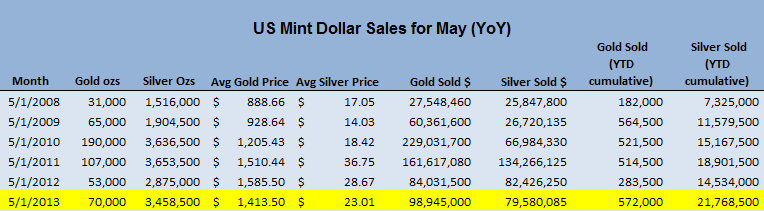
To start, let's take a look at the U.S. Mint sales numbers for silver and gold for May and compare them to the same month in previous years. We are doing a year-over-year comparison because coin sales are very seasonal in nature and to get a fair read we have to compare May to May.


(Click to enlarge)


We know that last month's April sales broke all sorts of sales records, so we were expecting a little bit of a slowdown in gold and silver sales. May sales came down from the previous month's totals, but still are at exceptionally high levels. Richard Peterson, the acting director of the U.S. Mint, commented that "Demand right now is unprecedented. We are buying all the coin (blanks) they can make," - that comment was made in June or two months AFTER the record-breaking April.

As investors can see from the table above, May sales continue to be exceptionally high for gold and silver. Silver once again surpassed 3 million ounces sold for the month and gold was fairly strong at 70,000 ounces sold. On a year-to-date basis, gold and silver sales are still breaking records and gold sales are 8,000 ounces higher than any other previous year, while silver sales are almost 2 million higher than the second highest silver sales year.

Canadian Mint Sales
Silver sales were also strong in Canada, as the Royal Canadian Mint (RCM) issued its first quarter report showing that it is also seeing record breaking sales. Unfortunately, the RCM does not issue monthly statistics, but on a quarterly basis (January through March of 2013) it has sold 269,000 gold ounces (96% higher than the 2012 first quarter) and 6.6 million silver ounces (65% higher than the 2012 first quarter). These sales numbers were before the major price drop in April, so we expect that second quarter sales numbers will be significantly higher than even this stellar first quarter.

US and Canadian Silver Mine Supply
Another interesting thing about these sales numbers is when investors compare them to the mining statistics from these two countries. According to the USGS in 2012, the U.S. mined around 34 million ounces of silver, while Canada mined around 17 million ounces of silver.

Let us now extrapolate U.S. and Canadian sales numbers to forecast how many ounces of silver will be sold by the end of the year. Since a linear calculation would be inaccurate (bullion sales are not linear in nature), we will simply compare our year-to-date sales totals with the next highest year and then forecast our number based on the comparison year's ending total.

Year-to-date U.S. sales are 21.7 million ounces of silver sold, which is around 15% higher than the second highest year-to-date sales for this period (in 2011). It would be fair to expect that if we run at the current pace we will end 15% higher than 2011 totals (39.8 million silver ounces sold in 2011) - which would put our 2013 forecast of silver sales at 46 million ounces.

For 2012, the Royal Canadian Mint sold 18.1 million silver maples and if we also extrapolate our first quarter numbers (65% higher than first quarter 2012) out for the rest of 2013 based on this total, they come out to a forecast of around 30 million ounces of silver. Again, this completely ignores the month of April - where we expect sales were record-breaking.

Based on year-to-date numbers, we forecast that the U.S. Mint will sell 46 million ounces of silver, while the RCM will sell 30 million ounces of silver - both significantly higher than their expected silver mine production amounts for 2013. In fact, if sales stay at these elevated levels, these two countries will be around 25 million ounces SHORT of silver - which means silver will have to be imported to satisfy mint demand.

Remember that we are exclusively talking about mint demand for silver to produce U.S. American Silver Eagles and Canadian Silver Maple coins - these demand totals assume absolutely no industrial or alternative investment (bars, rounds, etc) demand whatsoever. What happens if North American industry actually needs to use silver?

Finally, our mine production forecasts were based on 2012 USGS totals and as we know many primary silver miners are struggling to produce silver economically at current prices. In fact based on our exhaustive 2012 true all-in cost data, most silver miners are already below their all-in production costs for silver - which will lead to significant cost-cutting and cuts in exploration and silver supply. This probably will result in much lower silver production for 2013 as production is cut - so our 25 million ounce silver deficit for bullion production may be much higher if mines produce less silver than in 2012.

Conclusion
If investor physical demand stays at current levels, we think that the silver market can provide investors with a spectacular opportunity because the supply and demand picture is so bullish for silver. The fact that all U.S. and Canadian silver mine production will go to solely satisfy domestic demand for government issued coins (and supply will still be 25 million ounces short), should make investors turn their heads.

Industrial demand and alternative bullion suppliers will have no physical silver supply to use, and their silver needs will have to come from imports of silver. Additionally, low silver prices will cause many miners to cut production because their costs are above current silver spot prices, and so we also expect a drop in mine production. Finally, silver scrap supplies, which make up around 25% of silver supply, will definitely be impacted by low silver prices and we expect this source of supply to also drop. Throw in the exceptionally large short position that hedge funds and retail investors have taken in silver, and you have all the ingredients for an explosion in the silver price.

Investors should consider adding to positions in SLV, PSLV, SIVR, and CEF to get exposure to silver because we believe that the physical markets will be the source of a significant turnaround in the silver price. Also, investors should make sure they hedge their paper silver positions with physical silver bullion - this will not only hedge them from calamities in the financial markets, but it will also add to the physical pressure on the silver market and thus benefit their positions.

The supply and demand picture is about to get extremely tight in silver and we believe there will be a significant jump in the price as investors and shorts realize this - we think it is prudent to have an oversized position in both the silver ETFs and physical silver when the market realizes this.


Seeking Alpha