We will have a mirror site at http://nunezreport.wordpress.com in case we are censored, Please save the link

Thursday, November 16, 2017

Australians Vote to Approve Same-Sex ‘Marriage’


Image result for shame australia


LGBT activists in Australia were wildly celebrating Wednesday after the results of a vote-by-mail referendum over same-sex “marriage” showed they had achieved a landslide victory.

The final tallies, according to Australian Bureau of Statistics Chief Statistician David Kalisch, were:
Yes — 61.6 percent
No — 38.4 percent

Actual vote tallies were not provided via Australian media sources. The measure failed to pass in only three of the country’s electorates in the sparsely populated northern areas. “Turnout” for the mail-in vote was in excess of 80 percent of the country’s registered voters.

The binding plebiscite requires the government to enact new laws legalizing homosexual unions by Christmas. Prime Minister Malcom Turnbull, a staunch “marriage equality” supporter, considered the outcome a tremendous victory.

Shortly after the results were announced, he said:


"They voted “yes” for fairness, they voted “yes” for commitment, they voted “yes” for love. It is unequivocal; it is overwhelming. And now it is up to us, here in the Parliament of Australia, to get on with it—to get on with the job the Australian people have tasked us to do, and get this done this year, before Christmas. That must be our commitment."

Australia now becomes the 26th country to legalize homosexual “marriage.”

Credit to Trunews


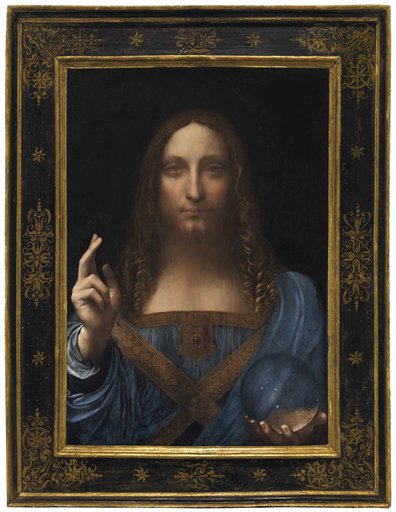
Leonardo Painting Sells For A Record $450 Million (Or 62,500 Bitcoin)

How do you know we are living through the biggest bubble in history? Simple: when a painting, doesn't matter who the artist is, doesn't matter who rare and prized, sells for half a billion dollars. 
A rediscovered painting by Leonardo da Vinci broke the record price for art at an auction on Wednesday night, selling for just over $450 million (or a bargain basement 62,500 bitcoin to the Chinese money launderer who bought it) at Christie’s in New York. The last da Vinci in private hands sold nearly 4 times above its estimated price after a fevered, 90-minute long round of bidding. It is widely believed to be the most expensive piece of art ever sold.

The 500-year-old “Christ as Salvator Mundi,” which was originally estimated at $100 million, was the star of Christie’s evening sale of postwar and contemporary art, what Bloomberg described an unconventional move by the auction house because of its vintage. The previous auction record for an Old Master painting was held by Peter Paul Rubens, whose “The Massacre of the Innocents” fetched $76.5 million in 2002.
“Salvator Mundi,” Latin for Saviour of the World, was one of only 15 surviving works by Leonardo da Vinci and depicts Jesus Christ in a flowing robe, holding a crystal orb and raising his right hand in benediction. 
The 67.5cm tall portrait, which once belonged to England’s King Charles I in the 17th century, disappeared around 1900. In 2005, it was bought at an estate sale and, after six years of research and restoration, attributed to da Vinci, the first such rediscovery in more than 100 years. Before the auction, Christie’s secured an irrevocable $100 million bid by an anonymous investor meaning it was sure to sell.
The painting, called "Salvator Mundi," Italian for "Savior of the World," is one of fewer than 20 paintings by Leonardo known to exist and the only one in private hands. It was being sold by Russian billionaire Dmitry Rybolovlev’s family trust. The fertilizer king purchased it for $127.5 million in 2013 and it’s been at the heart of an international legal battle. Rybolovlev assembled a $2 billion trove with the help of art entrepreneur Yves Bouvier, but in recent years has been selling off works from the collection, often at steep discounts. 
Well, even he will be happy with the 250% return in just 4 years. Also happy will be Christies: the $450 price also includes $50.3 million in premiums paid to Christie’s for its services by the buyer.
Jussi Pylkkanen, auctioneer for the evening, opened bidding on the piece at $70m and offers rapidly vaulted higher, according to the FT. Gasps broke out throughout the salesroom in Rockefeller Centre when an offer hit $200m. Bidders interested in the Da Vinci — lot 9 of the evening’s sale — were given special red paddles in the salesroom, a move the auction house attributed to the work’s high worth, although much of the action was fuelled by phone bidders.
Some more details on the painting's troubled recent history:
Following its rediscovery and sale in 2013, the painting was at the centre of a legal feud between current owner Dmitry Rybolovlev, the Russian billionaire and owner of AS Monaco football club, and Yves Bouvier, the owner of Natural Le Coultre, one of the largest fine art storage and shipping specialists. 

The protracted legal battle centred around claims that Mr Bouvier allegedly bought the painting for $80m and sold it to Mr Rybolovlev for $127.5m, a near $50m difference. A small group of critics have even questioned the painting’s authenticity. 
After its original disappearance, the painting was acquired in 2005, badly damaged and partly painted-over, by a consortium of art dealers who paid less than $10,000 (8,445 euros). The art dealers restored the painting and documented its authenticity as a work by Leonardo.
Christie's says most scholars agree that the painting is by Leonardo, though some critics have questioned the attribution and some say the extensive restoration muddies the work's authorship. Christie's capitalized on the public's interest in Leonardo, considered one of the greatest artists of all time, with a media campaign that labeled the painting "The Last Da Vinci." The work was exhibited in Hong Kong, San Francisco, London and New York before the sale.
Other paintings on offer on Wednesday evening included works by Mark Rothko, Jean-Michel Basquiat, Keith Haring, Cy Twombly, and Andy Warhol. Christie’s said it was in part the inclusion of the 32ft Warhol painting Sixty Last Suppers, which riffed on Da Vinci’s famed The Last Supper, that the house attempted to secure ‘Salvator Mundi’ for auction. ‘Sixty Last Suppers’ features a black-and-white silkscreen grid of 60 prints of ‘The Last Supper’ and was among the last works created by Mr Warhol before his death in 1987.
And just to confirm that everything around you is indeed one giant bubble, the exquisite piece of modernist "art" you see below, sold for more than $46 million.

Credit to ZeroHedge.com


Peter Schiff - Gold Will Explode & Dollar Wiped Out

The Truth About the Sex Abuse Scandal with Gavin McInnes & Paul Joseph Watson

‘Hundreds of youths’ clash with police in downtown Brussels

US Government Issues Warning Against North Korea's "Hidden Cobra"

Wednesday, November 15, 2017

Egyptologists Discover Pits Filled With Giant Severed Hands in “Joseph’s Palace”


“David gave orders to the young men, who killed them; they cut off their hands and feet and hung them up by the pool in Chevron. And they took the head of Ish-boshet and buried it in the grave of Avner at Chevron.” II Samuel 4:12 (The Israel Bible™)
A creepy find by egyptologists of a pit full of ancient severed hands confirms a theory about a disturbing ancient Egyptian practice. The find connects fleetingly with the Bible, appearing in what some believe to be the throne room of Biblical Joseph.
Egyptologists discovered 16 severed hands in the grounds surrounding buried in four pits in an ancient palace in Avaris, Egypt. The scientists estimated the hands had been separated from their rightful owners approximately 3,600 years ago. All were right hands and remarkably large.
The find was indeed gruesome but not entirely surprising for the egyptologists, as it confirmed their belief that soldiers would cut off the hands of defeated enemies and present them to noblemen in return for a gold bounty. Hieroglyphics have been discovered depicting this practice.
“You deprive him of his power eternally,” head archaeologist Austrian Manfred Bietak explained of the practice in an interview with Archaeology News Network . “Our evidence is the earliest evidence and the only physical evidence at all. Each pit represents a ceremony.” 
“Most of the hands are quite large and some of them are very large,” Bietak told LiveScience. 
Two of the pits, each containing one hand, are in what researchers believe is a throne room of a palace at Avaris. 
According to Bietak, the palace is believed to have belonged to King Khayan of the Hyksos, a foreign semitic-speaking nation that invaded Egypt in 1650 BCE and ruled for a short time. It is believed the Hyksos originated in Canaan or Syria.
There are other theories explaining the origin of the Hyksos and the palace discovered at Avaris. In his documentary Patterns of Evidence, Tim Mahoney suggested that the palace may have belonged to Biblical Joseph and that Avaris was the home of the Hebrews during their sojourn in Egypt.
Mahoney bases his claim on several factors, including the discovery on the grounds of the palace of 12 graves for distinguished personages, one marked by a large statue depicting a yellow-skinned royal leader. 
Though the discovery of the severed hands is disturbing, the practice is actually mentioned in the Bible.
David gave orders to the young men, who killed them; they cut off their hands and feet and hung them up by the pool in Chevron. And they took the head of Ish-boshet and buried it in the grave of Avner at Chevron. II Samuel 4:12
David Rohl, an egyptologist who worked with Mahoney on Patterns of Evidence, did not believe the pits containing the hands concerned his theory of the palace in Avaris belonging to Joseph.

“These were found in the level associated with the immediate post Hyksos expulsion, which would probably mean that these were the severed ands of either Hyksos soldiers or mercenaries in the Egyptian army who had perhaps revolted,” Rohl told Breaking Israel News, emphasizing that he did not have enough data to offer more than an educated guess. 
“If I were to bet on it, I would say that they are most probably part of the ‘hand count’ of Ahmose’s victory at Sharuhen to determine how many of the enemy were killed in the battle. So, having awarded Egyptian soldiers for the number of individual kills they had made, and paid for in gold, they would bury the hands in a mass grave.”
“This is too late to have anything to do with the Israelites in Egypt, in my opinion,” Rohl said.
Credit to breakingisraelnews.com
Read more at https://www.breakingisraelnews.com/97847/egyptologists-discover-pits-filled-giant-severed-hands-josephs-palace/#GUu4O3q0D57lyfTY.99