Saturday, June 11, 2016


The Pension Bubble: How The Defaults Will Occur
Experts worry about stock, bond and real estate market excesses. But a bubble is forming that dwarfs them all: in pension plans. Millions of Americans and Canadians who are counting on pension benefits to fund their retirements risk being severely disappointed.
The hard money community has, of course, been aware of this for some time. However in recent years, even the elites have been taking notice.
One such group, the International Forum of the Americas, will be holding its fourth annual pension conference in Montreal next Monday.
There politicians, financiers and monetary policy officials will discuss the declining rates of return in public and private sector pension plans.
The picture they will paint is increasingly grim.
Pension funds, which have been issuing over-optimistic revenue forecasts for years, aren’t going to earn nearly enough money to pay the benefits recipients expect.
Much of this relates to secular stagnation in the economy.
Bonds, which form a major part of most plans’ holdings, earn next to nothing in interest.
Stocks, which are trading at record levels, despite falling corporate earnings, look to have more downside risk than upside potential.
Worse, if bond returns average 2%, balanced portfolios projecting 7% to 8% annual returns have to earn 12% to 14% on equities investments to make up the difference. That’s unlikely to happen.
At least private sector plans have some money in them – public sector plans are in even in worse shape.
Governments have almost nothing put aside to fund future retirees – and they don’t even fully list their debts.
That process of “cooking the books” ramped up in a major way during Bill Clinton’s administration, whom Hillary Clinton, the current Democratic Presidential nominee, has promised to “put in charge of the economy.”
The upshot is that most Americans and Canadians have no clue how far in debt their countries are. Researchers such as Laurence Kotlikoff , a professor at Boston University and a write-in candidate for President in 2016, suggest that unfunded pension and other liabilities run into the tens of trillions of dollars in the United States. The Fraser Institute has shown that Canada isn’t much better.
Backing off commitments
Ironically, the biggest challenge facing government bureaucrats and private fund administrators has nothing to do with paying back pensioners. They have known for some time that would not be possible.
Their key challenge will be to ensure that shortfalls occur on someone else’s watch.
As such, these defaults will occur at a gradual pace. The first stages, already well under way, include steps such as raising eligibility requirements, increasing the tax burden on “wealthier” recipients and so on.
Congress, which teamed up to cut benefits during the Reagan administration, has been trying to find a way to do it a second time. Once the November elections are over, they will likely give it another shot.
A likely model will be Canada, where, in 2012, the late Jim Flaherty, a political master, camouflaged the Harper Government’s raising the eligibility requirements for Old Age Security from 65 to 67 by delaying implementation for ten years.
Flaherty further deflected media attention from the default by simultaneously banning the penny. Canadian journalists fell for the bait and spent the next week writing stories about the penny, never for a second realizing that Flaherty had slipped one by them.
House prices up 12%, food prices 3.7%. Pensions up 1.3%
Another tactic used by government officials and pension fund managers to avoid paying out pensioners is to inflate away the problem. As John Maynard Keynes, the great economist, noted: inflation is an excellent way to extract wealth, because not one man in a hundred will understand how it was done.
Here is how it works: governments promise pensioners that their benefits will be indexed to protect beneficiaries against rising prices. But they then use selected or massaged statistics to back out.
In Canada, federal (CPP) pension plan recipients will see their benefits rise by 1.3% during 2016. But food prices, according to Statistics Canada, rose by 3.7% last year. House prices rose by 12% up to December 2015 according to the Canadian Real Estate Association.
The controversial John Williams of Shadow Statistics provides credible research about how the data massaging works in the United States.
The effects of prices rising faster than benefits, over time, can be dramatic. If prices rise by 2% faster than pensions each year, then by the 20th year of retirement, beneficiaries will be losing 40% of their purchasing power (I am calculating using a straight line basis for simplicity).
In short, most pensioners won’t have a clue what hit them.
Outright defaults
Seniors vote – and there are a lot of them. So outright defaults on pension obligations will be a last resort of politicians and private sector plan managers.
However, it is starting to happen.
The ongoing saga of the US Central States Pension Fund, whose 400,000 beneficiaries were recently offered cuts of up to 60% in the amounts they receive, provides an excellent warning.
Amazingly the Central States Pension Fund, which manages funds for retirees from a number of companies in 37 states, actually has $18 billion in funds. Managers from those companies simply over-promised workers how much money they would get.
Pensioners in a variety of public plans including Detroit’s - which went bankrupt – and Illinois – which is insolvent - haven’t been much luckier. Many more will suffer the same fate.
Governments still have some time to manage the fallout. So do taxpayers who are counting on those plans to fund their retirements.
For them, the time to plan is now.
Credit to Zero Hedge
Russia: We will respond to entry of U.S. naval vessel into Black Sea

The Russian Foreign ministry said Moscow would respond to a U.S. naval ship's entry into the Black Sea with unspecified measures, saying it and other deployments were designed to ratchet up tensions ahead of a NATO summit, the RIA news agency reported.
Russian state media reported that the USS Porter, a U.S. naval destroyer, entered the Black Sea a few days ago on a routine deployment, a move it said raised hackles in Moscow because it had recently been fitted with a new missile system.
U.S. Navy officials told reporters on Wednesday the U.S. military would also have two aircraft carriers in the Mediterranean this month ahead of a July NATO summit in Warsaw as Washington sought to balance Russian military activities.
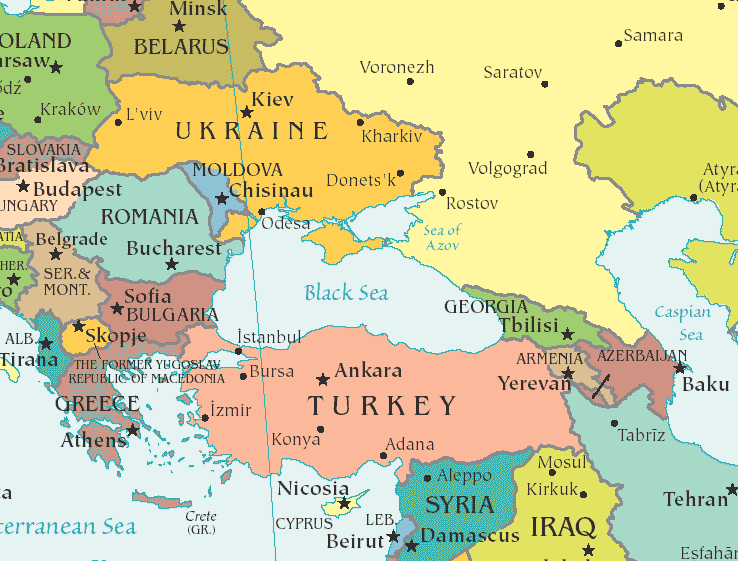
"Of course, this does not meet with our approval and will undoubtedly lead to response measures," RIA cited Andrei Kelin, a senior Foreign Ministry official, as saying about the USS Porter's movements.
He also said the deployment of U.S. aircraft carriers in the Mediterranean was a show of force which in his view deepened a chill in ties between Moscow and Washington caused by Russia's actions in Ukraine and Syria.
Credit to Reuters
Friday, June 10, 2016
George Soros Is Preparing For Economic Collapse – Does He Know Something That You Don’t?
 Why is George Soros selling stocks, buying gold and making “a series of big, bearish investments”? If things stay relatively stable like they are right now, these moves will likely cost George Soros a tremendous amount of money. But if a major financial crisis is imminent, he stands to make obscene returns. So does George Soros know something that the rest of us do not? Could it be possible that he has spent too much time reading websites such as The Economic Collapse Blog? What are we to make of all of this?
The recent trading moves that Soros has made are so big and so bearish that they have even gotten the attention of the Wall Street Journal…
Worried about the outlook for the global economy and concerned that large market shifts may be at hand, the billionaire hedge-fund founder and philanthropist recently directed a series of big, bearish investments, according to people close to the matter.Soros Fund Management LLC, which manages $30 billion for Mr. Soros and his family, sold stocks and bought gold and shares of gold miners, anticipating weakness in various markets. Investors often view gold as a haven during times of turmoil.
Hmmm – it sounds suspiciously like George Soros and Michael Snyder are on the exact same page as far as what is about to happen to the global economy.
You know that it is very late in the game when that starts happening…
One thing that George Soros is particularly concerned about that I haven’t been talking a lot about yet is the upcoming Brexit vote. If the United Kingdom leaves the EU (and hopefully they will), the short-term consequences for the European economy could potentially be absolutely catastrophic…
Mr. Soros also argues that there remains a good chance the European Union will collapse under the weight of the migration crisis, continuing challenges in Greece and a potential exit by the United Kingdom from the EU.“If Britain leaves, it could unleash a general exodus, and the disintegration of the European Union will become practically unavoidable,” he said.
The Brexit vote will be held two weeks from today on June 23rd, and we shall be watching to see what happens.
But Soros is not just concerned about a potential Brexit. The economic slowdown in China also has him very worried, and so he has directed his firm to make extremely bearish wagers.
According to the Wall Street Journal, the last time Soros made these kinds of bearish moves was back in 2007, and it resulted in more than a billion dollars of gains for his company.
Of course Soros is not alone in his bearish outlook. In fact, Goldman Sachs has just warned that “there may be significant risk to the downside for the market”…
Goldman Sachs is getting nervous about stocks.In a note to clients, equity strategist Christian Mueller-Glissmann outlined the firm’s fears that there may be significant risk to the downside for the market.
Ultimately, George Soros and Goldman Sachs are looking at the same economic data that I share with my readers on a daily basis.
As I have been documenting for months, almost every single economic indicator that you can possibly think of says that we are heading into a recession.
For instance, just today I was sent a piece by Mike Shedlock that showed that federal and state tax receipts are really slowing down just like they did just prior to the last two recessions…
US federal personal tax receipts receipts are falling fast. So is the Evercore ISI State Tax Survey.The last two times the survey plunged this much, the US was already in recession.Is it different this time?

And online job postings on LinkedIn have now been falling precipitously since February after 73 months in a row of growth…
After 73 consecutive months of year-over-year growth, online jobs postings have been in decline since February. May was by far the worst month since January 2009, down 285k from April and down 552k from a year ago.
Last week, the government issued the worst jobs report in nearly six years, and the energy industry continues to bleed good paying middle class jobs at a staggering rate. The following comes from oilprice.com…
That may seem counterintuitive in an industry that has been rapidly shedding workers, with more than 350,000 people laid off in the oil and gas industry worldwide.Texas is one place feeling the pain. Around 99,000 direct and indirect jobs in the Lone Star state have been eliminated since prices collapsed two years ago, or about one third of the entire industry. In April alone there were about 6,300 people in oil and gas and supporting services that were handed pink slips. Employment in Texas’ oil sector is close to levels not seen since the aftermath of the financial crisis in 2009. “We’re still losing big chunks of jobs with each passing month,” Karr Ingham, an Amarillo-based economist, told The Houston Chronicle.
At this point it is so obvious that we have entered a new economic downturn that I don’t know how anyone can possibly deny it any longer.
Unfortunately, the reality of what is happening has not sunk in with the general population yet.
Just like 2008, people are feverishly racking up huge credit card balances even though we stand on the precipice of a major financial crisis…
American taxpayers are quick to criticize the federal government for its ever-increasing national debt, but a new study released Wednesday found taxpayers are also saddled with debt, and are likely to end 2016 with a record high $1 trillion in outstanding balances.Wallethub, a site that recommends credit cards based on consumers’ needs, said that will be the highest amount of credit card debt on record, surpassing even the years during and before the Great Recession. The site said the record high was in 2008, when people owed $984.2 billion on their credit cards.
Will we ever learn?
This has got to be one of the worst possible times to be going into credit card debt.
Sadly, the “dumb money” will continue to act dumb and the “smart money” (such as George Soros) will continue to quietly position themselves to take advantage of the crisis that is already starting to unfold.
We can’t change what is happening to the economy, but we do have control over the choices that we make.
So I urge you to please make your choices wisely.
Credit to Economic Collapse
Subscribe to:
Posts (Atom)