We will have a mirror site at http://nunezreport.wordpress.com in case we are censored, Please save the link

Thursday, February 27, 2014

Russia Prepares for Naval Drills with China, India, ASEAN


VLADIVOSTOK, February 26 (RIA Novosti) – Russia’s Pacific Fleet in the next six months will take part in three large-scale international naval exercises, including joint drills with the navies of India, China and member states of the Association of Southeast Asian Nations, the fleet’s spokesman said Wednesday.

According to Capt. 1st Rank Roman Martov, Russia and India are holding talks on preparation for INDRA-2014 naval exercises scheduled to be held in the Sea of Japan in summer.

Martov said the drills will start with a visit of a group of Indian warships to Russia’s far-eastern port of Vladivostok in July.

Since 2003, India and Russia have conducted seven large exercises under the so-called INDRA series of joint ground and naval drills. The last such exercise was held between Russian and Indian army units in October at India’s Mahajan field firing range.

In 2011, Russia canceled joint naval drills with India in the Pacific Ocean, citing the tsunami and subsequent nuclear crisis in Japan.

Boosting its military ties with China, Russia is sending warships from the Pacific Fleet to hold Maritime Cooperation-2014 joint drills with the Chinese navy in the northern part of the East China Sea in May-June, Martov said.

The active phase of the exercise will involve several simulated missions and live-firing drills against sea and air targets, he said.

In addition, a Pacific Fleet task force led by Udaloy-class destroyer Marshal Shaposhnikov will join the 2014 KOMODO multilateral joint exercise in March to improve naval cooperation capabilities in disaster relief.

The exercise will be held off the coast of Indonesia and involve all 10 country members of ASEAN plus Australia, China, India, Japan, New Zealand, South Korea and the United States.

Credit to RIA Novosti

Russia and China walk out of UN Security Council meeting after US call for immediate action in Syria

Western countries may submit to the Security Council a draft resolution that will give the green light to an armed operation in Syria


Photo EPA/ITAR-TASS


UNITED NATIONS, August 28 (Itar-Tass) - The Russian and Chinese officials walked out of the U.N. Security Council meeting in New York on Wednesday, August 28, after U.S. Permanent Representative Samantha Power had called for an immediate action in Syria.

The permanent members of the U.N. Security Council - Russia, Britain, China, the U.S. and France - had been invited to the closed meeting. An hour later the Russian and Chinese diplomats left the meeting and headed to the Security Council’s main conference room where debates on Haiti was taking place.

Western countries may, until the end of the day, submit to the Security Council a draft resolution that will give the green light to an armed operation in Syria. Russia and China, which have the right of veto in the Security Council, have spoken up strongly against the use of force.

However Western countries have made it clear that they might take measures without waiting for the U.N. Security Council’s decision as they did in 1999 in Kosovo. Russian Deputy Foreign Minister Gennady Gatilov said this would be a gross violation of international law.

Meanwhile, Syria has asked the U.N. to investigate three chemical attacks carried out by rebels in the suburbs of Damascus on August 22, 23 and 24.

“Certain states are ready to use force even before U.N. experts make public the results of their investigation. Our country will be committed to international law,” he said. “Modern international law allows the use of force only in exceptional cases: for self-defence and if so authorised by the U.N. Security Council. Some states see priorities in a distorted way.”

Meanwhile, U.N. experts have arrived in Zamalka, an eastern suburb of the Syrian capital of Damascus, where chemical weapons were allegedly used, the Sky News television channel said.

It said the inspectors were planning to visit several settlements in the area.

In the morning, the experts left their hotel in Damascus, accompanied by six vehicles of the Syrian security forces, and headed to Al Maliha controlled by rebels.

Earlier in the day, the U.N. Secretary-General’s deputy spokesperson Farhan Haq said information about the U.N. inspectors’ route was kept secret for security reasons.

He said the U.N. Secretariat had received enough assurances from the warring sides for the experts to do their work in the area of an alleged chemical attack.

On the first day of their work on Monday, August 26, the U.N. inspectors took samples at the site of an alleged chemical attack and talked with survivor and witnesses.

“They visited two hospitals, they interviewed witnesses, survivors and doctors, they also collected some samples, Ban said.

On the way to the site of the alleged chemical attack in East Ghouta, a suburb of Damascus, a sniper opened fire at the first vehicle in the convoy, which had clearly distinctive U.N. markings. No one was injured but the experts had to return to Damascus to replace the damaged car.

The inspection team includes staff from the OPCW, which works in cooperation with the U.N., along with colleagues from the U.N. World Health Organisation (WHO).

U.N. Secretary-General Ban Ki-moon and the OPCW Head Ahmet Uzumcu called on all parties in Syria to extend their full cooperation to the team of United Nations inspectors probing the possible use of chemical weapons.

“The work of the UN investigation team represents an impartial and objective means to establish the facts on the allegations of use in Syria,” Ban and Uzumcu noted according to a U.N. spokesperson.

They urged that the inspectors’ work be treated as “inviolable and all cooperation must be extended to the Mission that includes avoidance of hostilities by all parties.”

The team, led by Swedish scientist Ake Sellstrom, is spending up to 14 days, with a possible extension, probing the alleged use of chemical weapons by the Government at Khan al-Asal, as well as other allegations reported by Member States.

Ban has said that any use of chemical weapons by anyone under any circumstances is a serious violation of inter

Credit to Itar-Tass

Google Glass for the Battlefield


Photo: BAE Systems

(Wired) Walking around Silicon Valley with an augmented reality display on your face makes you a glasshole. On the battlefield, though, similar technology will soon turn U.S. soldiers into a lethal cross between the Terminator and Iron Man.

Q-Warrior, the newest version of helmet-mounted display technology from BAE Systems’ Q-Sight line, is a full-color, 3D heads-up display designed to provide soldiers in the field with rapid, real-time “situational awareness.”

With a high-resolution transparent display, Q-Warrior overlays data and a video stream over the soldier’s view of the world. Q-Warrior also includes enhanced night vision, waypoints and routing information, and the ability to identify hostile and non-hostile forces, track personnel and assets, and coordinate small unit actions.

“Q-Warrior increases the user’s situational awareness by providing the potential to display ‘eyes-out’ information to the user, including textual information, warnings and threats,” Paul Wright, the soldier systems business development lead at BAE Systems’ Electronic Systems, said in a statement. “The biggest demand, in the short term at least, will be in roles where the early adoption of situational awareness technology offers a defined advantage.”

This technology is not the stretch you might think. Specialty work-related applications for everyone from cops to doctors are increasingly considered the future of wearable computing. BAE clearly wants to be the Google of the warzone.


Image: BAE Systems

The display would play well with the Army Tactical Assault Light Operator Suit (TALOS) currently under development. TALOS is a powered exoskeleton to haul heavier equipment with liquid armor capable of stopping bullets and the ability to apply wound-sealing foam.

“[The] requirement is a comprehensive family of systems in a combat armor suit where we bring together an exoskeleton with innovative armor, displays for power monitoring, health monitoring, and integrating a weapon into that — a whole bunch of stuff that RDECOM is playing heavily in,” said Lt. Col. Karl Borjes, a U.S. Army Research, Development and Engineering Command (RDECOM) science adviser, in a statement.

Q-Warrior is initially expected to be deployed with Special Forces and at the section commander level, but BAE says it expects the technology to eventually reach all soldiers.

“This is likely to be within non-traditional military units with reconnaissance roles, such as Forward Air Controllers/Joint Tactical Aircraft Controllers (JTACS) or with Special Forces during counter terrorist tasks,” said Wright. ”The next level of adoption could be light role troops such as airborne forces or marines, where technical systems and aggression help to overcome their lighter equipment.”

Credit to Breaking Deception

3 Missile Corvettes to Join Russian Navy by 2016


"Grad Sviyazhsk"© Photo courtesy of the Southern Military District press service
23:21 26/02/2014

MOSCOW, February 26 (RIA Novosti) – The Russian Navy will receive three new missile corvettes by the end of 2015, navy commander Adm. Viktor Chirkov said Wednesday.

“The navy is expecting the Veliky Ustyug corvette this year and two more warships of the same class in 2015,” Chirkov said.

The Defense Ministry has ordered a total of nine Project 21631 (Buyan-M) corvettes for the navy, with at least six vessels to be assigned to the Caspian Flotilla.

The first two Buyan-M corvettes, the Grad Sviyazhsk and the Uglich, entered service with the flotilla earlier this year, Chirkov said.

The Zelenodolsk shipyard, based in Russia’s Tatarstan Republic, began construction of the sixth corvette in the series, the Vyshny Volochek, in August last year.

A Buyan-M corvette has a displacement of 949 tons and a maximum speed of 25 knots. It is armed with Kalibr (SS-N-27) anti-ship missiles, 100-mm and 30-mm guns, as well as Igla-1M air defense missiles.

Credit to RIA Novosti

Wednesday, February 26, 2014

Visa is Exploring Biometric Payment Systems


Apple's iPhone 5S has a fingerprint scanner, and now Samsung's revealed a print-reading Galaxy S5. Each allows for payments to be verified using a swipe of your digits. Is this the possible future of all transactions? Perhaps, and Visa is now exploring the area too to ensure it will be ready for the possible sea-change.

"Smartphones equipped with fingerprint scanners are definitely useful. There are all kinds of technologies that we are seeing, and a lot of innovation in this space. We're working with these technologies, and they are all very interesting," said Jon White, Visa's Head of Marketing, Mobile Strategic Alliances.

For the time being at least, it seems any such system would still need to be linked to a mobile device, and Visa's current challenge is separating mobile device access authentication systems from the payment credentials -- were someone to infiltrate one system through biometric readings, Visa want to ensure your bank balance would not be compromised.

"It's a different consideration between drawing a squiggle to unlock a phone or putting in a four-digit password to access my mobile to what's required to access my bank account," continued White. "Secure management of payment credentials are the priority. I think there will be moves to form partnerships in this space though. That will continue, and we will pursue these technologies, but we need these multiple layers of encryption to preserve customer trust and integrity."

Consumer attitudes also need to be considered -- "Do users really want one password [in this respect an eye-scan or fingerprint - ed.] to access all of their services? One password for everything can sound quite romantic, but we all have our own eccentricities when it comes to authenticating passwords, and we need to recognise that," said White.

For now though, the focus at Visa remains on contactless, NFC payments. The company expects 50 per cent of the UK population to be using one of its contactless-enabled cards by the end of 2014, with more than 671,000 terminals now accepting the payment method.

Credit to Gizmodo UK

“Surrender Your Firearms,” Connecticut Tells Unregistered Gun Owners


The State of Connecticut is now demanding that gun owners across the state turn in all newly-banned, unregistered firearms and magazines or face felony arrest.
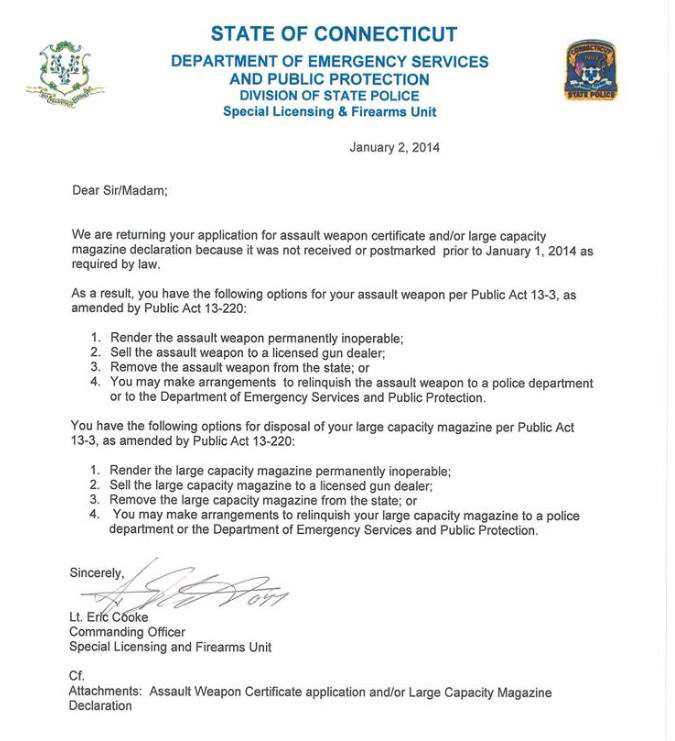
Connecticut is sending out this letter demanding that gun owners surrender their arms.  Click to enlarge.  Photo credit: capitalisminstitute.org
Connecticut is sending out this letter demanding that gun owners surrender their arms. Click to enlarge. Credit:capitalisminstitute.org
The State Police Special Licensing & Firearms Unit began mailing out notices to gun owners who attempted to register their firearms and accessories with the state but did not do so in time for the Jan. 1 deadline of Connecticut’s newly enacted gun control law.
The law bans the sale of magazines holding over 10 rounds and “assault rifles” manufactured after 1994 and requires that residents who possessed either before the ban to register them with the state.
“We are returning your application for [an] assault rifle certificate and/or [a] large capacity magazine declaration because it was not received or postmarked prior to January 1, 2014 as required by law,” the notice states.
The letter breaks down the gun owner’s “options,” including surrendering their firearms and magazines to the police, selling them to a gun dealer, removing them from the state or rendering them inoperable.
Because these owners attempted to register their guns and accessories, the state can now prosecute them at will because they know exactly who they are.
But when it comes to the vast majority of gun owners who did not register at all, Connecticut lacks clout.
Last month it was revealed that out of the over 2.4 million high-capacity magazines in Connecticut, only 38,000 have been registered.
“So, where did these millions of magazines go?” reporter Warner Todd Huston asked. “All that can be said is that it appears that gun owners in Connecticut are not quite the sheep that jackbooted government officials may have imagined they were.”
“After all, if there really were millions of high capacity magazines in the state – and it is very likely that there are – and they have now gone unregistered, that means that thousands of gun owners have refused to bow to this unconstitutional, anti-Second Amendment law.”
Likewise, only 50,000 semiautomatic rifles were also registered, further proof that Connecticut’s gun owners are revolting through civil disobedience.
These gun owners correctly realize that registration only leads to confiscation and that the overall agenda of gun control is to completely ban private gun ownership.
Last year, the New York Police Department began confiscating guns which were previously registered but are now banned under New York’s newest gun control law.
The NYPD knew exactly which gun owners to target by using the city’s centralized firearms registry which was already in place.
Connecticut’s anti-gun politicians want their own registry so they can eventually confiscate firearms in the exact same manner.
Credit to Infowars

The U.S. Stock Market: RIGHT NOW BE READY FOR ANYTHING!