Monday, April 8, 2013
s Archpriest Of St. Peter's Basilica Acknowledges Petrus Romanus Incarnate: Says Of Pope Francis That "The Life Of Peter" Has "Rose Out Of Centuries Past And Became Present And Living In The Current Successor"
Cardinal Angelo Comastri, Archpriest of St. Peter's Basilica since 2006, has discussed details of Pope Francis’s April 1 visit to St. Peter’s tomb, which is located in the necropolis under the basilica.
“His first stop was before the Egyptian Mausoleum (which dates back to the 2nd century),” Cardinal Comastri recounted. “In this mausoleum amid many pagan tombs there is also a Christian tomb. Christianity in fact, like yeast, was penetrating the pagan world. The Pope exclaimed in admiration: ‘It's like this today, too!’”
“We then made a second stop before the funerary stele of a man called Istatilio,” the cardinal continued. “He was certainly Christian: on his grave is the monogram [chi-rho]of Christ. On the stele is inscribed: ‘He was at peace with everyone and never caused strife.’ The Pope, after reading the phrase, looked at us and said, ‘That is a beautiful program of life.’”
Cardinal Comastri added:
Climbing back up the stairs and having reached the Clementine Chapel, Pope Francis became absorbed in prayer and repeated with a loud voice the three professions of Peter: “Lord, You are the Christ, Son of the Living God”; “Lord, to whom do we go? You have the words of eternal life”; “Lord, You know all things! You know that I love you!” At that moment, we had the distinct impression that the life of Peter rose out of centuries past and became present and living in the current Successor of the Apostle Peter.


Destruction of Cyprus is another step towards NWO

It would be naive to believe that the destruction of the Cyprus offshore zone was a "terrible mistake" of European politics made in a noble struggle with offshore companies in general or those where Russian oligarchs are laundering their money. The analysis shows that this is a part of the plan for building a new world order required for the forthcoming collapse of the U.S. debt pyramid. Is Russia involved in this process?
It is the U.S. economy that defines the state of the world economy, and given the financial and political influence of America, the prospect of its development. In the U.S., only 20 percent of GDP is created in the real sector, the remaining 80 is a financial speculation based on the current neoliberal model of development of nearly all countries on the planet. The U.S. debt for years has been growing at the rate of 10 percent a year, and GDP - 2 percent. Even all newly created assets in the world (4 percent of global GDP per year) will be unable to repay it. Raising the debt ceiling is becoming increasingly more difficult, and is a hopeless task. Those on Wall Street are well aware of it. Soon the debt pyramid will collapse, or rather will be collapsed. What should be done to provide the groundwork for the restoration of the financial power? Of course, for starters, all possible assets in the offshore must be collected.
Offshore is created precisely to lure capital with low or even zero tax on income from investments, and minimal oversight of monetary transactions in the market. Business is conducted in accordance with a simplified procedure, and clients and investors are protected by bank secrecy and other similar regulations. This system allows attracting capital ten times higher than the local production sector. In Cyprus, for example, it is seven times higher than the local GDP, or 126 billion euros, and this money will flow (according to experts) not to the European offshore - Gibraltar, Madeira, Ireland, Andorra, Luxembourg, Liechtenstein, but to the British or American ones - Delaware, Bermuda and the Cayman Islands, the Virgin Islands, and so on.
Now recall the statement of British Prime Minister David Cameron about a possible withdrawal from the EU, and the information about creating a free economic zone between the transatlantic U.S. and EU leaked to the press at the end of the year. It becomes clear that this has to do with a plan to change the world order with the old global players, but new alliances, with no room for weak links in the form of "peripheral", weak European economies.
Next task is to remove the European and other offshore companies from the playing field, tightening the entire system of capital accumulation, linking it to its territory. Part of it would be expropriated under the Cyprus scenario, and the rest will be used for the recovery. The U.S. and UK have found an ally in Europe - Germany. Obviously, the three main players are now actively negotiating the redistribution of financial flows. Germany, judging by the events in Cyprus, became actively involved in the process, and its position, albeit ambiguous, is more powerful, as the country has a strong real sector economy. Germans also have Finance Minister Wolfgang Schaeuble who is a gray cardinal and the engine behind the process.
He is the second most important person in the EU, and perhaps even the first, since he gives orders to the ECB President Mario Draghi to run the printing press. This is the only person who was elected by his party (CDU) in the Bundestag ten consecutive terms, that is, he has forty years of experience staying in power. His interview in November of 2011with The New York Times implies that the actions of Germany (and maybe even the U.S.) in Cyprus were not a tragic mistake, but a well-defined plan. In that interview Schaeuble spoke about the need to move towards a centralized Europe, as the euro zone was not enough. He spoke about the need to form a political union whose president would be elected directly by the people. He further said that at the time there was a limited transitional period and that nervousness in the market had to be controlled, but by the end of 2012 or mid-2013, everything needed to strengthen and deepen the political structures would be in place. The Minister concluded that a political union could only be achieved in times of a crisis.
The plan is simple: to achieve formation of a rigid centralized control and the use of force with the help of financial turmoil - the sentence of the "three" IMF, the ECB, and, frankly, Germany. Now the "three" will dictate how much money will be automatically deducted from the accounts to keep the system afloat. If there is opposition, Brussels will shut down services that the system created - online banking, ATMs and banks. Germany has nothing to fear as after the Cyprus events Europeans will start transferring the money to German banks.
In the near future Europe will either resolve to politically succumb to Germany or the EU will disintegrate and a new unit will be formed, represented by the donor countries, while other countries will be removed from the picture.
Russia can feel relatively unaffected by these perturbations as it is minimally involved in a virtual financial speculative market, and the real sector in the Russian Federation dominates over the speculative one. However, the Russians are not willing to give their money to save the Germans and Anglo-Saxons, and the Russian government may consider itself warned. If it does not take action to close the accounts of large Russian businesses (up to 80 percent) in foreign offshore, Russia will lose starting opportunities under the new world order. Due to the Cyprus precedent, Russia has a real chance to return the capital to the country. Russia would greatly benefit from a strategist similar to Schauble.
It appears that Russia must urgently create its own offshore, although the idea has been discredited by the liberal press bought by Golden Sachs and associates. Perhaps, Russia should impose a tax on withdrawal of capital, as did Rafael Correa in Ecuador, or even solve the problem through the prosecutor's office, but there is an urgent need to do something. Otherwise, in three to five years, the Americans will build a new world order with difficult for Russia conditions.
Lyuba Lulko
Pravda.Ru
Kissinger: ‘Illegal we do immediately; unconstitutional takes a little longer’

April 8, 2013
WikiLeaks has published the ‘Kissinger Cables’: its largest public release of documents in nearly a year, totaling some 1.7 million classified files, including information on the US’s secret diplomatic history.
Former US Secretary of State Henry Kissinger is quoted as saying, “Before the Freedom of Information Act, I used to say at meetings, ‘The illegal we do immediately; the unconstitutional takes a little longer’,”during a 1975 conversation which included a Turkish and Cypriot official.
Among the other information released is the revelation that that the Vatican may have collaborated with the US in supporting the Pinochet coup in Chile, which saw in a regime of bloodshed and disappearances.
In a cable dated 18 October 1973, it is stated that “Archbishop [Giovanni] Benelli, Vatican Deputy Secretary of State, expressed to illing [sic] his and Pope’s grave concern over successful international leftist campaign to misconstrue completely realities of Chilean situation.”
The events which preceded Pinochet’s 17-year dictatorship were dismissed as overblown.
“Bellini labeled exaggerated coverage of events as possibly greatest success of Communist propaganda, and highlighted fact that even moderate and conservative circles seem quite disposed to believe grossest lies about Chilean Junta’s excesses.”
Infowars
Soros: “I Don’t Expect Gold To Go Down”
Today’s AM fix was USD 1,577.25, EUR 1,212.80 and GBP 1,029.60 per ounce.
Friday’s AM fix was USD 1,552.75, EUR 1,207.42 and GBP 1,019.60 per ounce.
Gold climbed $25.90 or 1.67% to $1,579.10/oz and silver rose 42 cents or 1.6% to $27.29/oz on the COMEX on Friday. Gold and silver were down 1.07% and 3.77% for the week.

Cross Currencies Table – Bloomberg
Gold futures in Tokyo jumped almost 5% to near all time nominal highs, marking their sharpest daily rise since September 2011, after the yen dropped to near four-year lows on reports that the Bank of Japan would begin buying longer-dated bonds immediately and due to concerns about a currency crisis in Japan after George Soros warned of a potential “avalanche” of yen selling.
That “avalanche” would appear to have begun with the yen having fallen by 8% against gold in 3 trading days since last Thursday.
Overnight in Tokyo, gold futures surged to 5,025 yen ($51.71) per gram, near the record high of 5,081 yen per gramme touched in February. The BOJ is set to buy 1.2 trillion yen ($12.35 billion) of government bonds with a maturity of over five years this week. The measures reek of desperation and will lead to a further devaluation in the at risk yen.
Yuichi Ikemizu, branch manager for Standard Bank in Tokyo told Reuters that "if the yen goes up to 100 (USD) then we have quite a good chance to try higher prices for TOCOM gold."
Last week, the BOJ promised to inject about $1.4 trillion into the economy in less than two years, a gamble that saw the yen tumble 8% against gold from 0.144 million yen per ounce last Thursday to over 0.156 million yen per ounce this morning.

Gold in JPY (2 Months) – Bloomberg
Soros has made headlines again this morning after an interview done in the South China Morning Post.
Excerpt of Soros Interview with South China Morning Post:
What is your view on gold?
A: That’s a complicated question. It has disappointed the public, because it is meant to be the ultimate safe haven. But when the euro was close to collapsing in the last year, actually gold went down, because if people needed to sell something, they could sell gold. Therefore they sold gold. So gold went down together with everything else.
Gold was destroyed as a safe haven, proved to be unsafe. Because of the disappointment, most people are reducing their holdings of gold. But the central banks will continue to buy them, so I don’t expect gold to go down. If you have the prospect of a crisis, you will have occasional flurries or jumps. So gold is very volatile on a day-to-day basis, no trend on a longer-term basis.
In the interview, Soros makes some somewhat contradictory comments about gold. Soros said regarding gold that he did “not expect gold to go down” due to central bank adding to their gold reserves.
Soros notes that “the public” has been selling gold because they are “disappointed” because gold is “meant to be the ultimate safe haven” and yet is has not acted that way despite the “euro being close to collapsing last year”.
In the aftermath of the euro nearly collapsing, Soros says that gold was “destroyed as a safe haven” and “proved to be unsafe”.
Soros may be suggesting that the public’s perception in recent months that gold is no longer a safe haven has led to the less informed public selling gold, unlike more prudent central banks.
Soros can speak cryptically at the best of times and his choice of words are very important. Soros spoke in the past tense, using the words "was" and "proved" in relation to gold not being a safe haven during the euro crisis of 2012.
It is worth noting that the public perception is inaccurate as gold rose in all fiat currencies in 2011 and again 2012.

Gold in JPY (3 Years) – Bloomberg
As one of the most erudite investors in the world, Soros knows that long term gold remains a safe haven as shown in academic research and history including recent history since the financial crisis began.
Soros understands gold’s value as a diversification and as a store of wealth unlike some of the more sensationalist elements of the online financial media who reported Soros’ comments with a very anti gold bias.
People from all over the world who had euro deposits in banks in Cyprus have realised gold’s importance as a diversification and a hedge against counter party and systemic risk.
Japanese people who own gold today are realising gold’s importance as a diversification and a hedge against currency devaluation.
Global diversification remains fundamentally important for savers and investors internationally and will protect from inflation, currency devaluation and confiscation in the coming years.
Zero Hedge
Friday’s AM fix was USD 1,552.75, EUR 1,207.42 and GBP 1,019.60 per ounce.
Gold climbed $25.90 or 1.67% to $1,579.10/oz and silver rose 42 cents or 1.6% to $27.29/oz on the COMEX on Friday. Gold and silver were down 1.07% and 3.77% for the week.

Cross Currencies Table – Bloomberg
Gold futures in Tokyo jumped almost 5% to near all time nominal highs, marking their sharpest daily rise since September 2011, after the yen dropped to near four-year lows on reports that the Bank of Japan would begin buying longer-dated bonds immediately and due to concerns about a currency crisis in Japan after George Soros warned of a potential “avalanche” of yen selling.
That “avalanche” would appear to have begun with the yen having fallen by 8% against gold in 3 trading days since last Thursday.
Overnight in Tokyo, gold futures surged to 5,025 yen ($51.71) per gram, near the record high of 5,081 yen per gramme touched in February. The BOJ is set to buy 1.2 trillion yen ($12.35 billion) of government bonds with a maturity of over five years this week. The measures reek of desperation and will lead to a further devaluation in the at risk yen.
Yuichi Ikemizu, branch manager for Standard Bank in Tokyo told Reuters that "if the yen goes up to 100 (USD) then we have quite a good chance to try higher prices for TOCOM gold."
Last week, the BOJ promised to inject about $1.4 trillion into the economy in less than two years, a gamble that saw the yen tumble 8% against gold from 0.144 million yen per ounce last Thursday to over 0.156 million yen per ounce this morning.
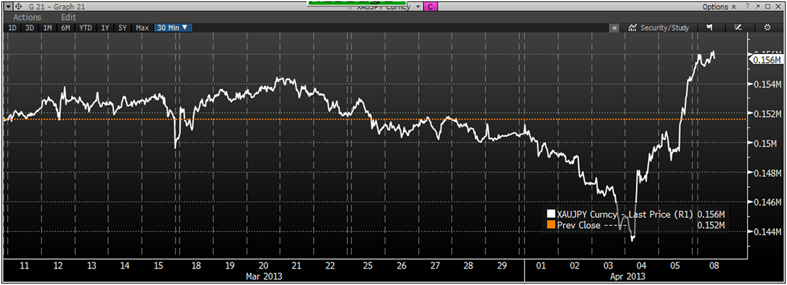
Gold in JPY (2 Months) – Bloomberg
Soros has made headlines again this morning after an interview done in the South China Morning Post.
Excerpt of Soros Interview with South China Morning Post:
What is your view on gold?
A: That’s a complicated question. It has disappointed the public, because it is meant to be the ultimate safe haven. But when the euro was close to collapsing in the last year, actually gold went down, because if people needed to sell something, they could sell gold. Therefore they sold gold. So gold went down together with everything else.
Gold was destroyed as a safe haven, proved to be unsafe. Because of the disappointment, most people are reducing their holdings of gold. But the central banks will continue to buy them, so I don’t expect gold to go down. If you have the prospect of a crisis, you will have occasional flurries or jumps. So gold is very volatile on a day-to-day basis, no trend on a longer-term basis.
In the interview, Soros makes some somewhat contradictory comments about gold. Soros said regarding gold that he did “not expect gold to go down” due to central bank adding to their gold reserves.
Soros notes that “the public” has been selling gold because they are “disappointed” because gold is “meant to be the ultimate safe haven” and yet is has not acted that way despite the “euro being close to collapsing last year”.
In the aftermath of the euro nearly collapsing, Soros says that gold was “destroyed as a safe haven” and “proved to be unsafe”.
Soros may be suggesting that the public’s perception in recent months that gold is no longer a safe haven has led to the less informed public selling gold, unlike more prudent central banks.
Soros can speak cryptically at the best of times and his choice of words are very important. Soros spoke in the past tense, using the words "was" and "proved" in relation to gold not being a safe haven during the euro crisis of 2012.
It is worth noting that the public perception is inaccurate as gold rose in all fiat currencies in 2011 and again 2012.

Gold in JPY (3 Years) – Bloomberg
As one of the most erudite investors in the world, Soros knows that long term gold remains a safe haven as shown in academic research and history including recent history since the financial crisis began.
Soros understands gold’s value as a diversification and as a store of wealth unlike some of the more sensationalist elements of the online financial media who reported Soros’ comments with a very anti gold bias.
People from all over the world who had euro deposits in banks in Cyprus have realised gold’s importance as a diversification and a hedge against counter party and systemic risk.
Japanese people who own gold today are realising gold’s importance as a diversification and a hedge against currency devaluation.
Global diversification remains fundamentally important for savers and investors internationally and will protect from inflation, currency devaluation and confiscation in the coming years.
Zero Hedge
North Korea recalling workers from joint factory complex

North Korea said Monday it will recall 51,000 North Korean workers and suspend operations at a factory complex it has jointly run with South Korea, moving closer to severing its last economic link with its rival as tensions escalate.
The statement from Kim Yang Gon, secretary of a key decision-making body, the Central Committee of the Workers' Party of Korea, did not say what would happen to the 475 South Korean managers still at the Kaesong industrial complex.
The statement comes amid weeks of North Korean war threats and other efforts to punish South Korea and the U.S. for ongoing joint military drills. North Korea is also angry over the U.S.-led push for U.N. sanctions over its Feb. 12 nuclear test.
The complex combines cheap North Korean labor and South Korean know-how and technology. It is the last remaining inter-Korean rapprochement project from previous eras of cooperation.
North Korea closed the border to northbound South Korean managers and cargo last week, though managers already there were allowed to stay. About a dozen of the more than 120 South Korean companies at Kaesong have already shut down because they can no longer get needed supplies.
"The zone is now in the grip of a serious crisis," Kim said, according to state media. He said it "has been reduced to a theater of confrontation with fellow countrymen and military provocation, quite contrary to its original nature and mission."
CBS
Sunday, April 7, 2013
US Secretly Deploys B-1 “Doomsday” Bombers Near North Korea

First the US fanfared the placement of two F-22 Raptors in the Osan airbase of South Korea. Then it demonstratively launched a B-2 stealth bomber on a training mission over a South Korean gunnery range.
Then it deployed an anti-ballistic missile defense system to Guam and positioned two guided-missile destroyers in the waters near Korea. And now, courtesy of the Aviationist, we learn that the Pentagon has escalated once more in an ongoing cat and mouse game with North Korea, of who blinks first, and dispatched several B-1 (“Bone”) Lancer strategic long-range bombers to Andersen Air Force Base in Guam.
What is different this time, however, is that unlike the previous very public and widely trumpeted reciprocal escalation steps, this particular deployment has been kept secret from the public (at least the broader public), “a fact that could be the sign that the U.S. is not only making symbolic moves (as the above mentioned ones), but it is preparing for the worst scenario: an attack on North Korea.”
Infowars
Subscribe to:
Posts (Atom)