We will have a mirror site at http://nunezreport.wordpress.com in case we are censored, Please save the link

Tuesday, November 22, 2011

UK's debts 'biggest in the world'


At the beginning of 2010, I highlighted a fascinating analysis by the consultants McKinsey called Debt and Deleveraging, which showed quite how indebted the economies of the developed west had become.

McKinsey said that the UK had by 2008 becomethe most indebted of all the big, rich economies, more indebted even than debt-engulfed Japan.

It has now become widely recognised that perhaps the greatest economic policy failure in the UK, US and eurozone during the 16 boom years before the crash of 2008 was the explosion of borrowing by banks, households, businesses and governments - or, to use the jargon, the unprecedented and massive leveraging up of entire economies.

These giant debts triggered the crash of 2008 because creditors refused to roll over short-term loans to banks, and caused the simultaneous recession because banks stopped lending, and have brought about our current economic malaise because our ability to spend and invest is hobbled by the imperative of repaying what we owe.

That is why getting the debt down to prudent levels is the most important economic challenge of our time.

As it happens, how we became so indebted and what to do about it, is what I am examining in a two-part documentary, called The Party's Over, that will be broadcast on BBC Two at 1900 on 4 and 11 December.

But how have we done since 2008? Are we getting the debt down?

Well, McKinsey is updating its 2010 report and has shared its interim findings with me (some of which I wrote about on Friday in my note on why investors are as wary of lending to Spain as to Italy).

These findings are not comforting.

According to the consulting firm, by the end of March this year, the aggregate indebtedness of the UK - that's the sum of household debts, company debts, government debts and bank debts - had risen to 492% of GDP, or almost five times the value of everything we produce in a single year.

That compares with 481% at the end of 2008.

So the UK's total indebtedness has increased, and is still the biggest relative to GDP of any of the big economies. That said, Japanese indebtedness is pretty much the same size - at the end of 2010, as opposed to the end of March 2011, Mckinsey says Japan's debts were also 492% of GDP.

US indebtedness is less, at 282% of GDP by the middle of this year, down from 296% in December 2008.

In the case of America, government debt is on a steeply rising trend, jumping from 61% of GDP to 80% over the past two and a half years.

But household debts have fallen from 98% of GDP to 87% of GDP, as homeowners have handed back the keys of their houses to lenders and reneged on the debts (which is possible in much of the US, but almost impossible in the UK).

So what's going on? Why are UK debts still going up?

Well partly it's to do with a phenomenon I've discussed here many times, that debt has been shuffled from the private sector to the public sector.

When banks stopped lending, and private-sector spending and investing collapsed, governments continued to spend, even though tax revenues were falling. So public-sector borrowing exploded.

To be clear, if governments had not continued to spend, our recession might well have become something much worse, a 1930s-style depression.

But it is fair to say that a consequence of banks, households and businesses trying to repay their debts has been a big increase in government borrowing.

Here are the numbers. From the end of 2008 to the spring of this year - so during the course of a bit more than two years - the debt of British companies fell from 122% of GDP to 109%, and the debt of households fell rather less, from 102% of GDP to 97% of GDP.

Most would say those are positive trends, although the pace of debt repayment by households is pretty sluggish and our personal debts (at close to 100% of GDP) remain substantial (and a worrying burden) by historical standards.

By contrast, government debt has risen from 52% of GDP, which at the time was pretty low by international standards, to 76% of GDP, which is more or less standard for the rich west.

But as you'll know, UK government debt remains on a fairly sharply rising path (the government's deficit is some distance from being closed).

One other slightly surprising and - perhaps - disturbing trend is that the debt of financial institutions has risen, from 205% of GDP to 210% of GDP.

In McKinsey's definition, this financial institution debt excludes bank lending to households and non-financial businesses, to avoid double counting. Its substantial size is a reflection of the size of the UK's financial services industry, the City of London.

McKinsey believes, however, that this increase in financial institutions' debt disguises a positive trend: much of the debt is now of a longer-term nature, so poses less of threat to the stability of the economy (it can't be called in at a moment's notice, to the potential ruin of the borrower).

The point is that if excessive debt is the disease, what we've had since the end of 2008 is analgesic and sticking plaster, rather than cure.

Record low interest rates and the creation of £275bn of new money through the quantitative easing programme have made it possible for us to live with our debts - cheap money has made the debts bearable.

But we haven't as yet found a way to get the debts down so that we can be confident that our economy's foundations are solid and sound again.

What it means is that we must brace ourselves for many years of relatively low growth, perhaps 1% versus the 3% of the 16 boom years before the crash, because we no longer have the fuel of borrowing more and more every year.

BBC

Wall Street Analysts Everywhere Are In Agreement: THE WORLD IS ENDING


EDITOR NOTE: We originally posted this on Friday after a lot of negative reports. Since then we've seen many more, so we're updating the timestamp on the post, and have added more at the bottom.

If you like your Wall Street analysis with a heavy dollop of rapture and Armageddon, today was the day for you.

Blame the weighty issues of the day (Europe, mostly), and yesterday's big selloff for the spasm of bearishness.

It started off with Nomura's Bob Janjuah. He said that any talk of the ECB saving Europe was a mere pipedream, and that if the ECB did go whole-hog buying up peripheral debt to suppress yields, then that would prompt a German departure from the the Eurozone.

Germany appears to be adamant that full political and fiscal integration over the next decade (nothing substantive will happen over the short term, in my view) is the only option, and ECB monetisation is no longer possible. I really think it is that clear and simple. And if I am wrong, and the ECB does a U-turn and agrees to unlimited monetisation, I will simply wait for the inevitable knee-jerk rally to fade before reloading my short risk positions. Even if Germany and the ECB somehow agree to unlimited monetisation I believe it will do nothing to fix the insolvency and lack of growth in the eurozone. It will just result in a major destruction of the ECB‟s balance sheet which will force an ECB recap. At that point, I think Germany and its northern partners would walk away. Markets always want short, sharp, simple solutions.

Okay, but that's Janjuah. He's always bearish so maybe that's not even news.

But then there was Deutsche Bank's Jim Reid, who is always sober, but not usually wildly negative. He offered up one of the most bearish lines in history in regards to German opposition to ECB debt monetization:

If you don't think Merkel's tone will change then our investment advice is to dig a hole in the ground and hide.

Oy.

But it got even wilder with the latest from SocGen's Dylan Grice. Again, he's always pretty negative, but he cranked it up a notch, comparing Germany's policy today against the policies that enabled the rise of Hitler. Specifically, he said that post-Weimar, Germany became too aggressive about fighting inflation, thus prompting deflation, thus prompting more unemployment, thus enabling the rise of the Nazis.

He included this chart:


Image: Societe Generale


And finally, in our inbox, we just received the latest note from Nomura rates guru George Goncalves, which is titled: US and Europe: At the Point of No Return?

He writes:

...we were wrong in assuming one could be optimistic around the EU policy process and have learned our lesson not to accept apathy as a sign that all is factored in as its clear downside risks remain. In fact, we could be approaching the point of no return for the fate of the euro, the European financial system and more broadly the concept of a singular economic zone for Europe; this obviously would change the path for the US and the global economy in a heartbeat too. We still believe there is time to prevent worst-case scenarios, but these sort of watershed moments reveal one thing, that market practitioners are ill-equipped to navigate the political process, especially one that is driven by 17 different governments.

Update: We originally posted this on Friday afternoon, but the hits keep on coming.

Since then we've seen:
Goldman says sovereign risk is spreading like "wildfire."
Credit Suisse says we're looking at the end of the euro as we know it.
Nomura has put out a big report on redenomination risk, and how the odds of a breakup are becoming very real.


Read more: http://www.businessinsider.com/apocalyptic-analyst-notes-2011-11#ixzz1eS189mBU

Investors pile into U.S. bond market, fuel rise in greenback


As the global financial system’s widening cloud of doubt spread to the United States on Monday, investors stepped up their rush to safety – and found it in a trusted shelter that now finds itself in the path of the storm.

Stocks, commodities and many currencies suffered another day of heavy selling, as the apparent failure of the U.S. Congressional “supercommittee” to agree on a government deficit-reduction plan rekindled fears that the United States could face its own debt crisis. That prospect, coupled with Europe’s relentless debt woes, triggered selling as investors sought to raise their cash cushion and find less risky homes for their money.


The safe harbour of choice was the U.S. bond market. Investors piled into U.S. government bonds, pushing the 10-year yield below 2 per cent for the third time this month and fuelling a rise in the U.S. dollar, which hit a six-week high against a basket of major global currencies. The U.S. bond and currency gains overwhelmed another traditional investor haven – gold – which slumped $42.30 (U.S.) to $1,682.80 an ounce in New York, its lowest level in almost a month.

The day’s trading highlighted a trend in recent weeks that, on the surface, defies logic. Investors are piling into U.S. bonds and the greenback even as the risks in the U.S. debt situation appear to be mounting, and are increasingly doing so at the expense of gold, which suddenly seems to be investors’ forgotten friend in the quest for safety.

The key to understanding this seemingly irrational pattern, market experts say, is the huge size of the U.S. bond market. U.S.-issued bonds account for roughly 40 per cent of the entire global bond market; the next-largest market, Japan, is about half as big. Europe's troubled bond market is not only exposed to risks from the debt troubles of Greece, Italy and others, but is fragmented into the many smaller markets of its issuer countries – giving investors far less ease of movement than the U.S. market in the event of a serious credit crunch.

That makes the U.S. bond market a de facto round-the-clock savings bank for nervous investors who want to know they can get to their money quickly in the event of a sudden financial crisis.

“In times of trouble, the one market that trades through hell and high water is the U.S. bond market and U.S. dollar,” said Stewart Hall, senior fixed income and currency strategist at RBC Dominion Securities. He said investors learned in the 2008 financial crisis that their only protection in times of panic is to be able to quickly liquidate their holdings and get access to cash – and that’s why they are turning to U.S. bonds as pressures mount again.

“It’s the last line of liquidity,” Mr. Hall said. “It’s the only market you can easily get in and out of, in size. These other markets just don’t have the depth.”

The much smaller gold market, on the other hand, has been the subject of selling precisely because nervous investors are seeking more liquid positions. Gold’s big gains this year make it a target for selling when fund managers want to scale back their holdings in less-liquid markets and keep more cash on hand for a rainy day.

“If a hedge fund faces redemptions, they’ve got to sell stuff,” said long-time gold expert Martin Murenbeeld, chief economist at DundeeWealth Inc. in Victoria.

But Mr. Murenbeeld said the bigger issue for gold investors has been the growing view that the European and U.S. debt problems will be a crippling weight on the global economy – one that triggers another recession, and perhaps even a “mini-depression” for Europe. That would be deflationary –which is distinctly bearish for gold, a traditional hedge against inflationary pressures.

“In times when people think the economy is headed toward recession, gold tends to go down,” Mr. Murenbeeld said.

Meanwhile, Mr. Hall said the failure of the U.S. supercommittee doesn’t seem to have the power to spook the bond market the way that uncertainty over U.S. debt did last summer, as investors are now more comfortable with impasses in Washington.

“The fact that [the Congressional panel] wasn’t able to come to terms was pretty much expected,” he said. “We already saw this in August. I don’t think it has the same impact any more.”

The Globe and Mail

Bilderberg Leader Mario Monti Takes Over Italy in “Coup”


Italy’s new Prime Minister Mario Monti (with wife at left), who rose to power in what critics called a “coup d’etat,” is a prominent member of the world elite in the truest sense of the term. In fact, he is a leader in at least two of the most influential cabals in existence today: the secretive Bilderberg Group and David Rockefeller’s Trilateral Commission.

Nicknamed “Super Mario,” Monti is also an “international advisor” to the infamous Goldman Sachs, one of the most powerful financial firms in the world. Critics refer to the giant bank as the “Vampire Squid” after a journalist famously used the term in a hit piece. But its tentacles truly do reach into the highest levels of governments worldwide.

Italy’s Political Crisis

Following the Italian government’s descent into the economic abyss that saw bond yields soar to record highs as the euro-zone began to come apart at the seams, ex-Prime Minister Silvio Berlusconi decided to step down. And late last week, President Giorgio Napolitano asked Monti to form a new government.

On November 16, the new Prime Minister — who will also serve as Italy’s “Economy Minister” — announced that he was appointing an array of bankers, technocrats, and lawyers to lead the emerging government. After unveiling proposed reforms later this week Monti and his unelected team will face Parliament in a confidence vote.

Some of the nation’s political parties have already said they support the new leadership. But others, including loyal members of Berlusconi’s party, complained of a “coup d’etat” engineered by bankers and the European Union.

“The truth is that there was a big operation, an ‘Italian Job,’ to get Berlusconi out of the way by forcing him to resign,” complained former Interior Minister Roberto Maroni, comparing Berlusconi’s ouster to themovie of that same name made in1969 and remade in 2003. While the ex-Prime Minister was not technically forced to resign, he said it was an act of “responsibility.”

Monti: Insider Extraordinaire

Listed as a member of the “steering committee” on the official Bilderberg website, critics say Monti has “establishment” written all over him. The shadowy group he helps lead includes a roster of the world’s real power brokers — media magnates, royalty, military leaders, big bankers, heads of state and government, key CEOs, and more.

The elite members gather once a year in total secrecy, sparking innumerable theories and widespread concern. In 2011 the group met in Switzerland and attracted more scrutiny than in the past.

But despite the attendance of influential reporters, editors, and media power houses, very little of substance was publicly revealed. It is known, however, that Bilderberg played a crucial role in erecting the increasingly powerful supranational regime in Brussels.

Monti is also the European Group chairman of the infamous Trilateral Commission, according to theorganization‘s website. The secretive group, which also lists among its members some of the most influential members of the world elite, was supposedly founded to bring about closer “cooperation” between North America, Europe, and Japan.

The Commission was founded in 1973 by the infamous banker and power-broker David Rockefeller. "Some even believe we are part of a secret cabal working against the best interests of the United States, characterizing my family and me as 'internationalists' and of conspiring with others around the world to build a more integrated global political and economic structure — one world, if you will,” Rockefeller wrote in his 2002 autobiography. “If that's the charge, I stand guilty, and I am proud of it.”

Monti is also a prominent leader of more than few smaller “think tanks” promoting more “integration,” big government, and globalism. He has been a long-time and consistent supporter of an “economic government” for the EU, as well as more Brussels meddling in social policies.

His career has included academia, politics, banking, and more. And he has held several prominent positions within the European Union apparatus including the job of European Commissioner for Internal Market, Financial Services, Financial Integration, and Taxation.

The Rescue Plan

"I would like to confirm my absolute serenity and conviction in the capacity of our country to overcome this difficult phase," Monti proclaimed recently. And he will have plenty of help.

The European Central Bank has started to do everything possible to rescue the profligate Italian government - albeit quietly. According to Bloomberg, the ECB began buying up huge quantities and sizesof the regime’s bonds this week.

“There are no real buyers,” European interest-rate strategy chief Mohit Kumar with Deutsche Bank told the news service. Analysts suspected that the ECB move was designed to bolster confidence in the new Italian government and its leader.

Monti’s first task will be to satisfy EU rulers by imposing massive new taxes on the Italian people. Tough “austerity” measures will follow soon after that. He said more growth — a tough task with new and higher taxes — will be his priority.

"I hope that, governing well, we can make a contribution to the calming and the cohesion of the political forces," Monti explained after meeting with union bosses.

The Italian government is currently drowning in trillions of euros worth of debt — well over 100 percent of GDP. And the market seems largely unwilling to loan it more money without EU prodding, guarantees, and huge yields.

EU and euro-zone advocates are doing everything possible to avoid a calamity that could bring down their precious supranational government and its regional currency. But Italy, as the third-largest euro-zone economy, is simply too big to bail out, according to experts — even with the emerging “dictatorship” mechanism designed to save bankrupt governments and banks using taxpayer money.

Monti could have until 2013 — the next scheduled election — to implement his “reforms,” assuming he gets his way. Critics, however, are calling for new elections to be held as soon as possible.

Critics, Greece & the Future

While Italy will now be governed by the very definition of an “insider,” Greece faces a similar situation. Its new Prime Minister, Lucas Papademos, was the vice president of the ECB and even worked for the Federal Reserve. He has also been a member of the Trilateral Commission for over a decade.

But critics are outraged. “The rise of bankers and unelected technocrats to power in Greece and Italy shows how the unfolding crisis of the euro-zone is undercutting democracy,” complained Costas Panayotakis, a professor of sociology at the New York City College of Technology at CUNY.

Italian activists had harsh words for Monti, too. “The proposed new coalition government headed by Mario Monti can be a fatal trap for Italy's future,” explained Campaign for World Bank Reform leader Antonio Tricarico. “If most of political forces from the right and the left would support it, the European Commission and the European Central Bank - whose agenda Monti represents - will rule Italy without any opposition for the years to come, beyond any minimum standard of democratic accountability.”

Analysts said installing pro-EU and single-currency rulers in Greece and Italy was aimed at quieting the growing calls for the euro-zone to be dismantled. But it remains unclear whether they will succeed as the economic crisis continues to spiral out of control across Europe.

New American

MF Global trustee doubles estimates of shortfall


(Reuters) - The shortfall of commodity customer funds at MF Global Holdings Ltd MFGLQ.PK may be around $1.2 billion (767 million pounds), about double initial estimates from regulators, the trustee liquidating the company said on Monday.

The news was a blow to customers still hoping to get more of their cash out of frozen broker accounts and raised new questions about why the authorities managed to locate only about 60 percent of the segregated customer funds three weeks after the parent firm's October 31 bankruptcy.

"I'm flabbergasted," said Tom Ward, a retired Chicago Board of Trade member whose two sons cleared their futures trades through MF Global and have been blocked from accessing their money. "The bottom line is, there's going to be a haircut involved. It's devastating, what this has done to the industry."

Monday's announcement was trustee James Giddens' first public statement on the size of the shortfall, which regulators initially said was about $600 million.

Regulators are investigating what happened to the money and whether MF Global may have improperly mixed customer money with its own -- a major violation of industry rules. No charges have been filed.

Hours after the statement, the bankrupt MF Global parent filed court papers along with JPMorgan Chase & Co (JPM.N), one of its key lenders, seeking the rare appointment of a separate trustee to take over the company's assets in bankruptcy.

Such appointments are reserved for cases in which a company's executives are accused of wrongdoing or when it may otherwise be in the estate's best interest. JPMorgan, which pledged $8 million of its collateral to keep MF Global afloat during bankruptcy, agreed to increase that pledge to $26 million if a trustee were appointed, according to the filing.

The request is on the agenda for a hearing tomorrow afternoon in U.S. Bankruptcy Court in Manhattan.

An MFGlobal spokeswomen declined to comment on the case.

QUESTIONS RAISED

In Monday's statement, Giddens said he currently controls about $1.6 billion of the brokerage's funds that he can use to pay back customers. His plans to pay back 60 percent of customer funds by early December would nearly exhaust that amount.

The sharply higher estimate of the shortfall raises questions about the investigation, said Tim Butler, an attorney for a group of customers demanding a fuller payback.

"What did the CFTC know three weeks ago and what do they know now?" Butler said. "If the amount has changed that much over three weeks, where did the money go? What were (regulators) looking at before?"

Leaders on Capitol Hill have entered the fray with calls for hearings and accountability.

Sen. Chuck Grassley, R-Iowa, said the CFTC should "do everything possible" to get more information to customers on the status of their funds. The call comes as angry farmers and ranchers across the country begin to reconsider a livelihood in the market and how they hedge future crops and livestocks.

"Unlike the big banks, the average farmer who lost money in this fiasco can't afford to hire an attorney and attend proceedings in a Manhattan courtroom," Grassley said in a statement.

MF Global was run by former Goldman Sachs & Co Inc (GS.N) chief and New Jersey governor Jon Corzine before its bankruptcy. The Chapter 11 filing came after the New York-based company revealed it made a $6.3 billion bet on European sovereign debt. Corzine resigned on November 4.

On Sunday, Reuters reported that, based on initial reports of what was supposed to be segregated for customers, the trustee appeared to be keeping about $3 billion on hand to cover the shortfall.

Customers had been clamouring for more specifics, saying that was too large of a cushion -- a notion Giddens rejected.

"Restoring 60 percent of what is in segregated customer accounts ... would require approximately $1.3 to $1.6 billion to implement," or nearly all the money at the trustee's disposal, he said.

Giddens previously transferred more than $2 billion to other brokers, giving most customers access to a portion of their funds.

Sen. Pat Roberts, R-Kan., said legislators should call on Corzine to testify about his former company's actions. Roberts said in a statement on Monday that the Senate Committee on Agriculture, Nutrition and Forestry should hold a special hearing on the matter.

If the trustee does exhaust the funds he now controls, his focus would shift to going after monies that may belong to the brokerage, but may be tied up in foreign depositories, or may be part of the shortfall, Giddens spokesman Kent Jarrell said.

"We can't distribute money we don't have, but we do have legal means for going after other assets," Jarrell said.

INVESTIGATION CONTINUES

The Commodity Futures Trading Commission and other regulators are investigating MF Global.

CFTC Commissioner Jill Sommers refused to speculate on how the $1.2 billion figure might compare with earlier estimates.

"From the very beginning we have tried as much as possible to never use a figure, out of fear that it's not right," said Sommers, who has been leading the agency's investigation into MF Global after Chairman Gary Gensler recused himself from the probe because of his ties to Corzine.

"Until the final reconciliation (of accounts) is done, you don't know what the shortfall is."

CME Group Inc (CME.O), operator of the clearinghouse for most of MF Global's customers, declined to comment.

Commodity customers say they have more questions than answers about MF Global's collapse and the safety of their money.

Sean McGillivray, vice president of Great Pacific Wealth Management, still has about $5 million tied up in MF Global for his customers. He was aware of the latest estimates of the shortfall, but wants exact figures.

"It would be in the best interest of all clients, brokers and anyone else caught in this mess to know just how much has been transferred ... and how much is supposed to be there," he said. "You could do this with an abacus and it would take less (time)."

A spokesman for the Commodity Customer Coalition in Chicago, which represents more than 7,000 former MF Global customers, said it was unclear how much of the trustee's estimate related to possible co-mingling of customer money.

Some of the missing money could be tied up overseas, said spokesman John L. Roe.

"We're hopeful given what was accounted for initially that more of the money will be found and that the trustee will work with us on an expedited claims process for customers," he said.

INVESTORS REACT

In a sign that even distressed investors are losing faith in a decent return, MF Global's bonds fell to an all-time low below 30 cents on the dollar, according to Tradeweb, down more than 5 cents on the day. The $325 million in 6.25 percent notes were issued at par in August.

Some investors have targeted other financial institutions. Two pension funds have sued seven banks, including Bank of America Corp (BAC.N), JPMorgan and Goldman Sachs, over prospectuses that allegedly concealed the problems that led to MF's collapse.

The trustee's case is In re MF Global Inc, U.S. Bankruptcy Court, Southern District of New York, No. 11-2790.

No deal for US 'super-committee'


A congressional committee tasked with reducing the deficit by $1.2tn (£762bn) has failed to come to an agreement.

The panel of six Republicans and six Democrats confirmed after the New York Stock Exchange closed that its work had ended without a deal.

The outcome means automatic cuts outlined in the bill that created the committee should take effect from 2013.

The US national debt has just risen above $15tn.

The panel was set up in August, the result of a last-minute deal between the two sides in Congress to raise the debt ceiling and avert a default on US debt payments.Blame game

"After months of hard work and intense deliberations, we have come to the conclusion today that it will not be possible to make any bipartisan agreement available to the public before the committee's deadline," Democratic Senator Patty Murray and Republican Representative Jeb Hensarling said in Monday's joint statement.

America is not about to default on its debts, but we've just seen default of a sort - by Congress, on its responsibilities. Americans are already aghast at their elected representatives' inability to agree on how to heal the nation's finances. The spectacle of the super-committee's failure will only cause them to slump deeper in their seats.

Now, supposedly, the so-called sequestration cuts kick in. They start in 2013, more than a trillion dollars worth, half of which will come from the military budget, the rest distributed across the federal government. These cuts are a sort of fiendish Plan B. They were designed to come into effect only if the super-committee failed. Nobody really wants them. Some in Congress are already muttering about undoing them. President Obama says he will force them through.

So look for fierce clashes over the future of those tax cuts enacted by President George W Bush. Look for ferocious lobbying by the defence industry. Look for howls of anger at cuts in federal education funding, and medical and welfare benefits for the elderly and poor. And much, much more. The deficit battle has been joined, and on this terrain will the presidential election be fought.

"We remain hopeful that Congress can build on this committee's work and can find a way to tackle this issue in a way that works for the American people and our economy," it added.

In a White House news conference later on Monday, President Barack Obama said it was Republicans' fault.

"There's still too many Republicans in Congress that have refused to listen to the voices of reason and compromise," he said.

President Obama said he would veto any attempt to reverse the automatic cuts to government spending.

They are to be applied over the next 10 years, split between defence and domestic budgets. A few programmes are to be protected, including Social Security and Medicaid.

Republicans said Democrats had never been serious about making cuts to entitlement programmes for the elderly and the poor.

Senator Pat Toomey said: "Unfortunately, our Democratic colleagues refused to agree to any meaningful deficit reduction without $1 trillion in job-crushing tax increases."

But Democrats said the Republicans were solely to blame for the failure - because they ruled out tax rises for the wealthiest Americans.

Senate Majority Leader Harry Reid said Republicans had "never found the courage to ignore the tea party extremists" and "never came close to meeting us half way".

The BBC's Steve Kingstone in Washington says the political finger-pointing is likely to continue through to next November's congressional and presidential elections.

Congressional approval ratings in recent polls have been at historic lows.

As the reductions triggered by Monday's announcement are not set to take effect until January 2013, lawmakers have the time to change or repeal the automatic cuts.

Republican senators John McCain of Arizona and Lindsey Graham of South Carolina are already working on legislation that would undo the automatic defence reduction, replacing it with cuts across the federal government.

The panel's work was contentious from the beginning, with Senator Murray's request that the negotiations should not be leaked to the press largely ignored.

Democrats initially proposed a $3tn package, including $1.3tn of new revenue and $400bn in Medicare savings.

Republicans rejected the plan's tax rises.

Senator Pat Toomey, one of the Republican members of the panel, proposed a $1.2tn deal, with about $300bn in new revenue through tax changes, including lowering the top tax rate from 35% to 28%. However, his own party officials did not endorse the plan publicly.

Democrats objected to the proposed permanent lowering of tax rates paid by the top bracket.

Last week, Republican House Speaker John Boehner, who was not a member of the committee, proposed a new plan of nearly $650bn in savings, well below the $1.2tn goal.

The package included $543bn in spending cuts, $3bn of new revenue generated by closing a tax loophole for businesses to buy private jets, and $98bn saved from lower interest payments.

Democrats rejected the offer, saying it focused too heavily on spending cuts.

BBC

On The Verge Of Huge Stock Market Crash


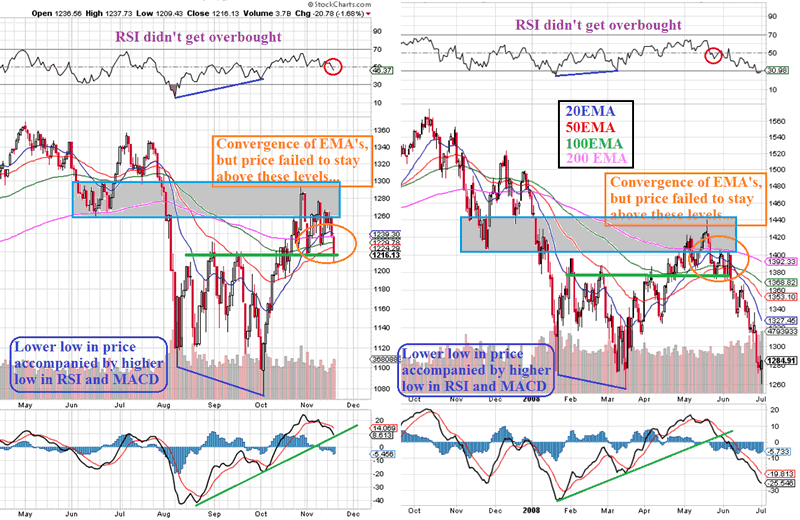
We might be on the verge of another huge market crash, one similar to 2008.
Check out the following chart below, and you will see why…
- The RSI hasn’t been overbought anymore in a long time, indicating weakness in stock markets… The same was true in 2008.
- The SP500 found heavy resistance in the 1260-1280 zone (just as we warned our subscribers), which was the low of June 2011. A similar thing happened back in May 2008, where price ran into resistance of the November 2007 low.
 
- Look at the exponential moving averages (20, 50, 100 and 200 EMA’s). They have now been converging as price rallied, but right now, price is falling below these EMA’s, just like in late May 2008.
- The MACD is now flirting to break the green support line, just like in May 2008, right before financial armageddon occured, and price is right at the green support line now, just like in 2008.
Chart courtesy stockcharts.com
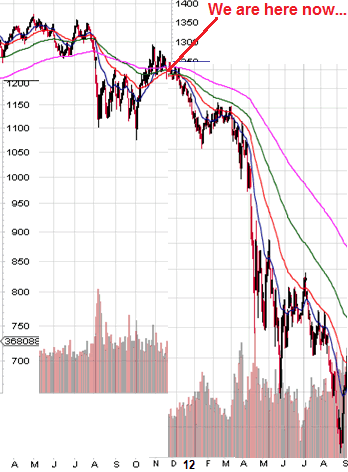
If we are about to see the exact move as in 2008, this is what it would look like…
However, Charles Schwab and Sentimentrader noted: “On Friday 11th of November, the market experienced the 17th time in the past three months that the S&P 500 SPY (exchange-traded fund trading the S&P 500) gapped by more than 1% at the open and then didn’t close that gap during the day. This means that the S&P didn’t reverse enough to “kiss” the previous day’s close. As you can see in the chart below, this level of “unclosed gap” behavior has been seen only four other times since the early-1990s. All occurred while the market was forming a major bottom.”